Life Activity
I often say that in a day, or throughout a lifetime, there are only three things to do: Play, Learn, and Create. I also say that Learning, Playing, and Creating are a trinity of life activities—they represent the past, the present, and the future of Life.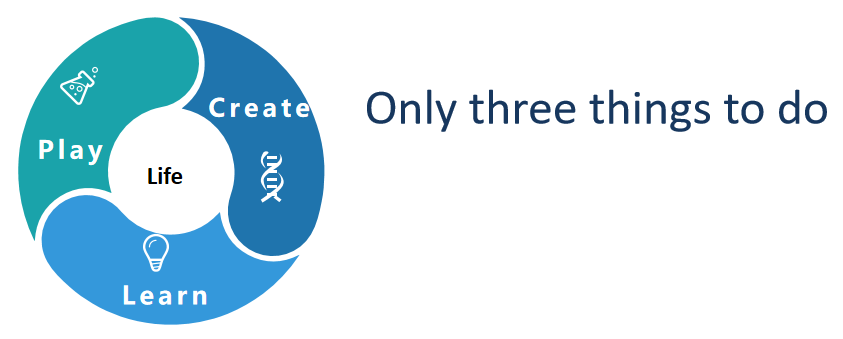
“education” and talk only about “learning.” Let us first clarify what learning actually is. To do that, we must return to our own learning—looking at everything we have acquired and examining how we actually learned it. The greatest problem with modern educators, including the “experts” in colleges of education, is that they themselves do not learn. They are profoundly lacking in the “Significant Experiences” of learning. The most vital learning experiences of my life came from playing with a large group of children when I was young. Often, all the children would be playing the same thing together. After a while, something new would emerge, and everyone would shift their focus to that new pursuit. Because every child was unique and came from a different background, our collective play was incredibly rich and diverse. In that environment, I could feel myself learning an immense amount. In contrast, from the very first day I started school in the first grade, I began to doubt whether this place called “school” was truly meant for learning. I could sense, even then, that I wasn’t actually learning much at all in school. It is precisely because I carry these fundamental, vital experiences of learning and growth that I felt an immediate, profound resonance with Sudbury Valley School. It felt instantly familiar—as if I had found a place that finally matched the truth of my own life. Therefore, a large group of people playing together is the ultimate form of learning. For adults, society itself is the greatest “PlayGround.” But for children, due to safety concerns, we cannot simply release them into society to learn. They need a safe environment where they can play freely. This is why Self-Directed Education communities like Sudbury are so essential. I use the term “PlayGround” to describe a field of freedom—a place for freely sensing, interacting, choosing, and exploring. This environment can be a physical site or a virtual digital space. The true responsibility of the educator is to architect these PlayGrounds, ensuring they support the trinity of life activities: playing, learning, and creating. Within a rich PlayGround, there are abundant life activities to engage in, thus completing the two tasks of education, one is life discovery as an input to education, and the other is life expression as an output of education. We recognize that life is diverse, and every individual begins at a unique starting point. Rather than forcing children into the narrow boxes of modern education—such as standardized extracurricular classes—we must flip the paradigm. The mentor’s role is to observe where a child’s natural interests lie, or better yet, to provide a rich PlayGround where children can discover those interests for themselves. In a truly rich PlayGround, every child will find something that resonates with their soul. The growth of life is interconnected; it does not exist in isolated categories like the subjects of modern education. When we realize that knowledge is built upon significant experiences, and we observe from that perspective, we see that every life activity encompasses a multitude of experiences. When different children play together, it is a process of these diverse experiences colliding and merging. A mentor, as an educator, should be able to see what is happening at the level of significant experiences, guiding the continuous growth of each child’s life accordingly. I have encountered many such cases in my practice with youth programming education. Children who love building and animation often discover the importance of programming through their play, gradually developing a genuine interest in the field. Conversely, children who enjoy programming can also discover that building and animation can cultivate programming thinking and are a part of programming skills. Given the length of this article, I will not recount those stories here, though I have shared them in my previous writings. An essential task of education is to facilitate this process of “Life Discovery,” which serves as the input of education. Another vital task is to help learners achieve “Life Expression.” This expression can take the form of a “Life Work” or other manifestations, including the act of teaching other learners; this constitutes the output of education. “Life Works” hold a critical position in education: it is through the exceptional Life Works of others that learners absorb the essential elements and nourishment for their own lives.
Life Conversation
Secondly, after gaining significant experiences from these life activities, there must be equal and diverse opportunities to exchange them—what I call “Life Conversation.” Mimsy, one of the founders of Sudbury Valley School, often spoke of the ubiquitous conversations that define the school. This conversation can happen between two learners, among a group (Sudbury even has dedicated discussion rooms), between learners and staff, or even as a dialogue with oneself—for at Sudbury, “being with oneself” or “staring into space” is also recognized as vital learning time. In other SDE communities, Life Conversation manifests as sharing one’s work or giving presentations. These conversations are always egalitarian. For instance, an interaction between two learners is like two gamers talking; even if one is a veteran and the other a novice, they interact as equals. The veteran simply points out where the fun is or demonstrates a few “pro tips,” rather than maintaining the power imbalance of a traditional teacher-student relationship. Conversation acts as a “developer.” Significant experiences are often vague and subjective at their onset. Through “Life Conversation”—whether by presenting one’s work, engaging in debate, or teaching others—learners are compelled to “verbalize” or “logically structure” these nebulous experiences. It is precisely within this process of conversation that experiences solidify, transforming into communicable and expandable knowledge. This is, in essence, a “P2P” (Peer-to-Peer) protocol. Traditional schools follow a “Client-Server” architecture; if the “Server” (the teacher) crashes or suffers from insufficient bandwidth, the entire system becomes paralyzed. In contrast, a Self-Directed Education community is a “P2P” architecture where every learner is a node. The more frequent the exchange, the higher the “knowledge bandwidth” of the entire network. This egalitarian and “decentralized”—or rather, “multi-centered,” where anyone can become a center—exchange protocol, together with the content that is exchanged (the significant experiences, the true raw material for constructing knowledge), is exactly why SDE communities can generate “true knowledge” more efficiently than traditional schools. In China’s Self-Directed Education (SDE) community, I have also noticed that writing and art have been used to help students dig deeper into their personal experiences and have rich conversations around those experiences. Overall, psychology is playing an increasingly important role among young people in China, especially among young educators. If we look at the methodology of psychology, its core is to use various methods to explore a person’s experiences. Therefore, the writing or art classes in Self-Directed Education communities may be influenced by psychology. The same approach is used in parenting in these communities. Parent education is an important part of these communities. I’ve noticed how these parents struggle to dig deeper into their own experiences with writing and how this profoundly changes their old thinking patterns and improves their understanding and communication with their children. I think it helps a lot in their professional work as well.Life Knowledge
The third element is the “Construction of Knowledge” built upon the previous two. Knowledge is alive. Our cognitive growth should be organic; we must construct our knowledge based on our “significant experiences,” allowing knowledge to form its own interconnections. Because this knowledge is grown from “significant experiences,” it is deeply rooted and far more resilient than the “stored information” found in traditional schooling. It becomes a part of the learner’s identity, not just something they “know,” but something they “are.” In many current Self-Directed Education (SDE) communities, there is a certain degree of neglect toward “knowledge.” On one hand, people strongly disagree with the categorized subject-based knowledge structures of the old educational paradigm. Since many are currently focused on “breaking the mold,” “knowledge” is often placed in an adversarial position by innovative educators. On the other hand, the diverse forms of knowledge found in the richness of life remain difficult for many to “grasp” or “handle.” After all, traditional paper-based formats—and even the digital documents that emerged after the rise of software and the internet, which remain limited by the concept of “paper”—struggle to represent knowledge that flows and connects everywhere. The Sudbury model is one that handles knowledge relatively well; almost every wall at Sudbury is a floor-to-ceiling bookshelf, filled with books. The lack of focus on “knowledge,” or the inability to effectively express it, is the most common criticism of Self-Directed Education from those within the old educational paradigm. It is also a major reason why many parents still find it difficult to “embrace” SDE. The old paradigm uses “standardized testing” as its yardstick. When Self-Directed Education (SDE) communities fail to provide these easily quantifiable “report cards,” the outside world assumes that no knowledge is being produced. As previously mentioned, if we lack new media to express “interconnected and flowing knowledge,” the learner’s growth effectively becomes a “black box.” This neglect of “knowledge construction” is not limited to Self-Directed Education; it exists across the broader landscape of innovative education, including popular approaches like “Project-Based Learning” (PBL). Why does PBL also fall into the trap of “neglecting knowledge”? The Trap of ” Doing for the Sake of Doing “: In many PBL cases, children may be busy with crafts, editing videos, or organizing events. While things look bustling and vibrant on the surface, the “knowledge architecture” supporting these actions remains thin. If a project is merely completed without the “developing process” of transforming “experience” into “knowledge” in the mind, the learning remains superficial. “Fragmentation”: PBL often revolves around a specific, narrow goal. If the element—”organic knowledge interconnections”—is missing, the knowledge points acquired are like scattered pearls without a string to hold them together. Once the project ends, this knowledge tends to dissipate over time. Lack of Conversion for “Significant Experiences”: As mentioned earlier, if PBL turns into a “prescribed task” assigned by a teacher, it loses the essence of “Life Discovery.” A project without internal drive is merely a complex, expensive “large assignment,” rather than a true “Life Work.” If we can recognize that knowledge is a “living entity” rooted in “significant experiences,” this understanding aligns perfectly with the practice of Self-Directed Education. Our life activities are dedicated to gaining a wealth of “significant experiences,” upon which we engage in “Life Conversation.” What we currently lack are effective “digital formats” to support these knowledge-based activities within SDE—tools that can construct “visualized knowledge” based on “significant experiences,” allowing it to be shared, discussed, and eventually transformed into traditional document formats. Beyond supporting offline “Life Activities” and “Life Conversations” within SDE, the digital expression of “Life Knowledge” allows Self-Directed Education to flourish online as well. In this way, outstanding professionals from across the country—and even the globe—who possess rich learning experiences can become mentors in their spare time. With the assistance of software, they can effectively teach or provide “Learning Guidance” based on SDE principles. Another benefit of the digital expression of “Life Knowledge” is that it solves the “exit problem” of Self-Directed Education. Because learning becomes visualized, stored online, dynamically constructed in real-time, and capable of being expressed, shared, and interacted with, it offers an “unparalleled advantage” over traditional test scores when employers are hiring. Students in the old educational paradigm simply cannot produce such a wealth of “significant experiences” and “abstract models.” In fact, teachers within the old paradigm often lack their own “significant experiences” and “abstract models” of learning themselves. Next, I will briefly explain what kind of “living entity” this “Life Knowledge” actually is. In today’s age of information explosion, there is a vast ocean of books to read. How do you absorb so much knowledge? Do you plan to read them one by one? You must have a way of exploration—a mechanism for filtering and absorption. To explore is to treat all knowledge as a “complex living system”; learning is “navigating” through it. You must rely heavily on your own sensing and courage to guide this navigation. Your filtering mechanism, to a large extent, depends on your “significant experiences.” Take study tours as an example: I often find that only after visiting a place and gaining “significant experiences” within that physical space do I suddenly find myself able to truly understand the books and films about it. Therefore, after traveling, I usually spend time exploring relevant high-quality books, movies, and even top-rated discussions on platforms like Quora. This is a method for the “rapid growth of knowledge.” The rapid growth of knowledge is actually an iterative process:- Cruising: Broadly perceiving and sensing the world.
- Anchoring: Generating “significant experiences.”
- Absorbing: Engaging in targeted reading, viewing, and interaction (such as exploring top-rated discussions on Quora) fueled by those experiences.
- Constructing: Forming your own “Life Knowledge.”
- From Passive to Active: In the traditional educational paradigm, information is “fed” or “poured” into the student. In this new paradigm, information is “drawn in” by the centripetal force generated by the “Life Center.”
- A Magnetic Field of Meaning: This centripetal force stems from the authentic needs of a life. Because you have had that “significant experience,” when you read a certain book or hear a particular sentence, you experience an instantaneous “resonance”—a feeling of: “This is exactly the answer I have been searching for.”
- a process of “Crystallization”: scattered information is like the solute in a supersaturated solution. Without a “Crystal Nucleus” (a “Life Center”), it remains nothing more than a cloudy liquid. However, once this “Core” exists, knowledge rapidly crystallizes and grows around it, forming a stable structure. This explains why some people read extensively but still lack original thought—they lack sufficient “Life Centers” to integrate those scattered points.
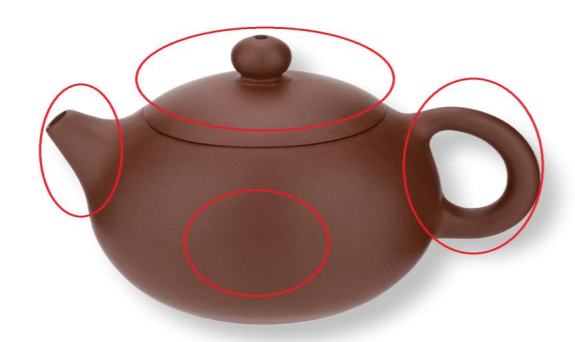

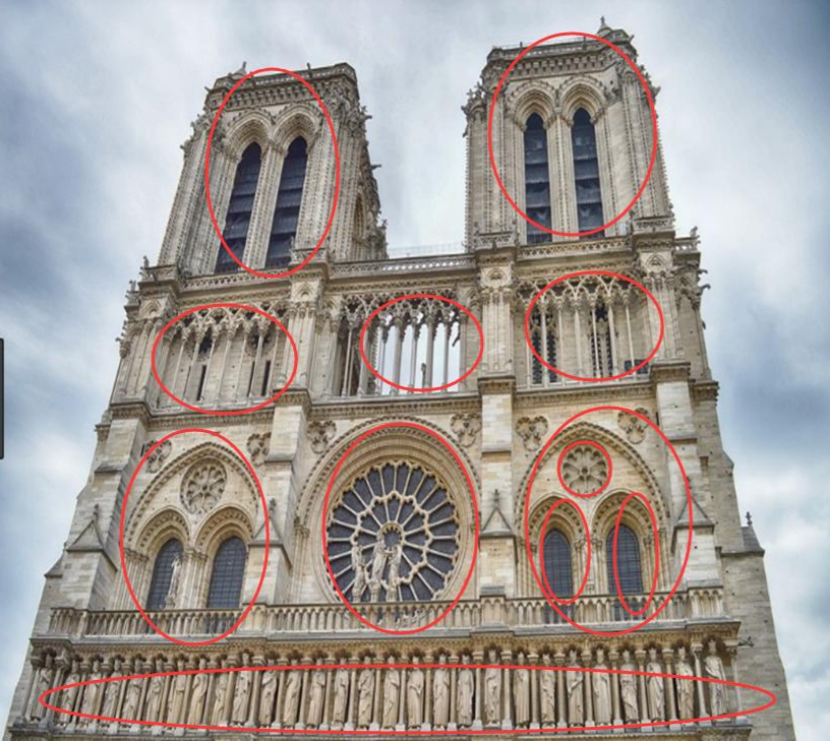

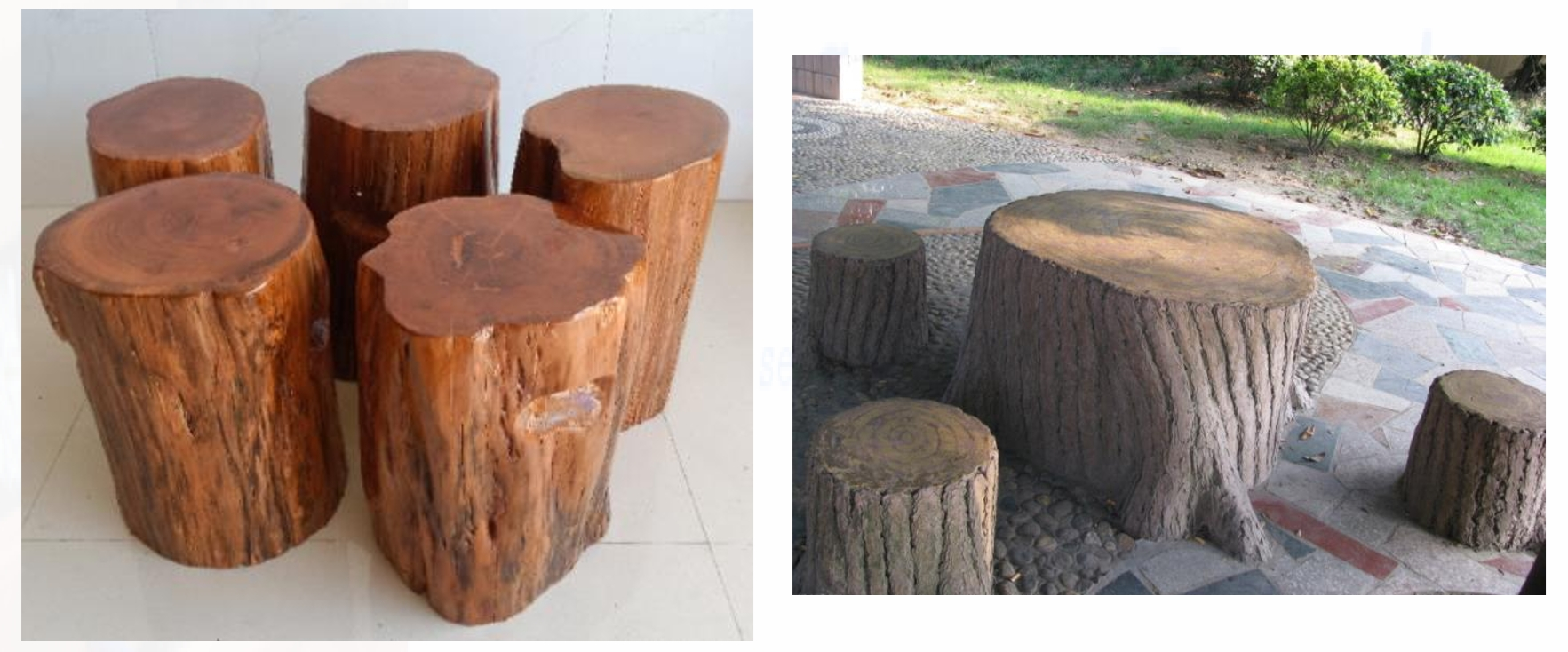
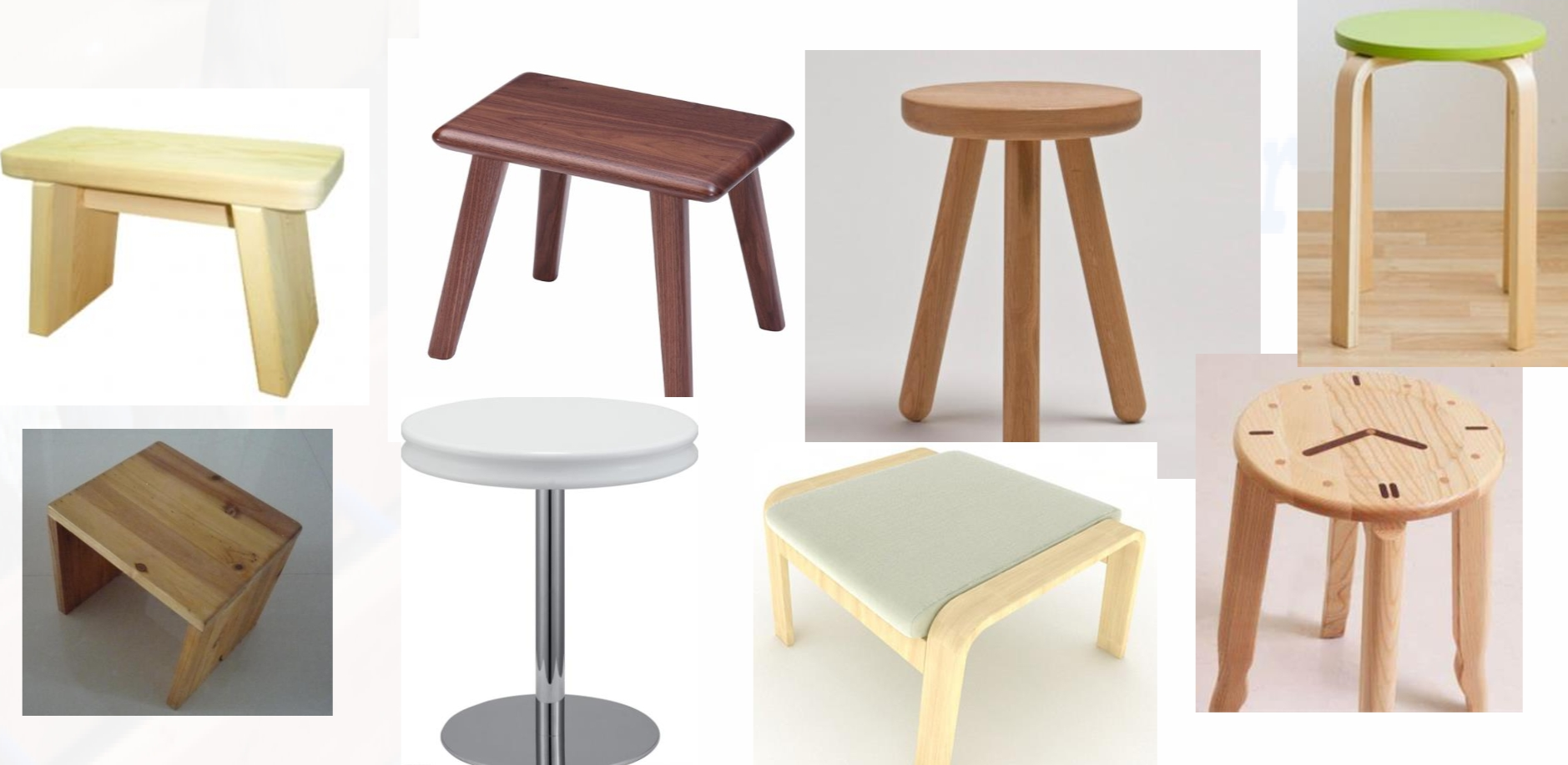

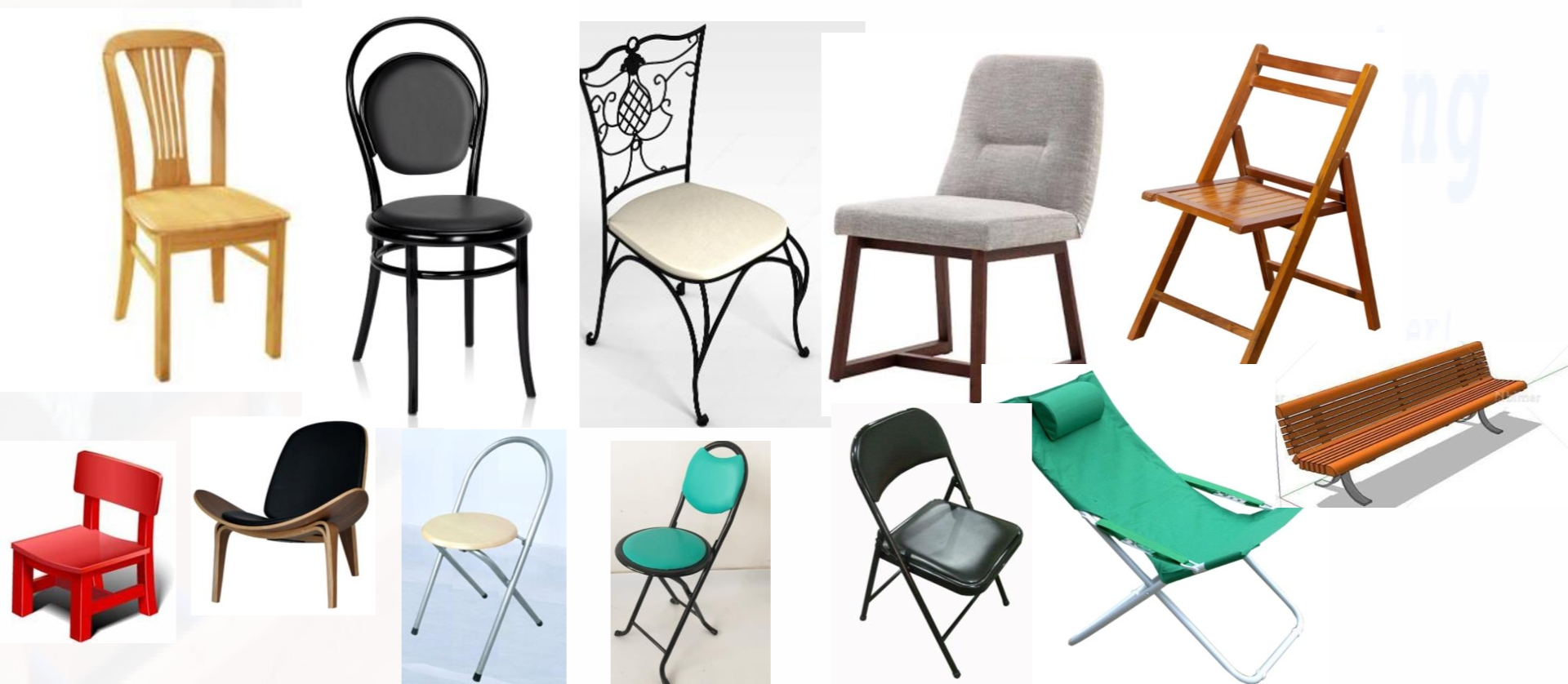

- Independent, bounded, fully functional, and possessing strong perceptibility;
- Self-explanatory, with a friendly interface that is easy to interact with or play with;
- Larger “Life Centers” are composed of several smaller “Life Centers”;
- Different layers remain relatively independent;
- “Life Centers” are equal, mutually supportive, and serve the whole;
- Repetitive or recursive structures within “Complex Living Systems” (where a “Complex Living System” can itself be treated as a single “Life Center”).
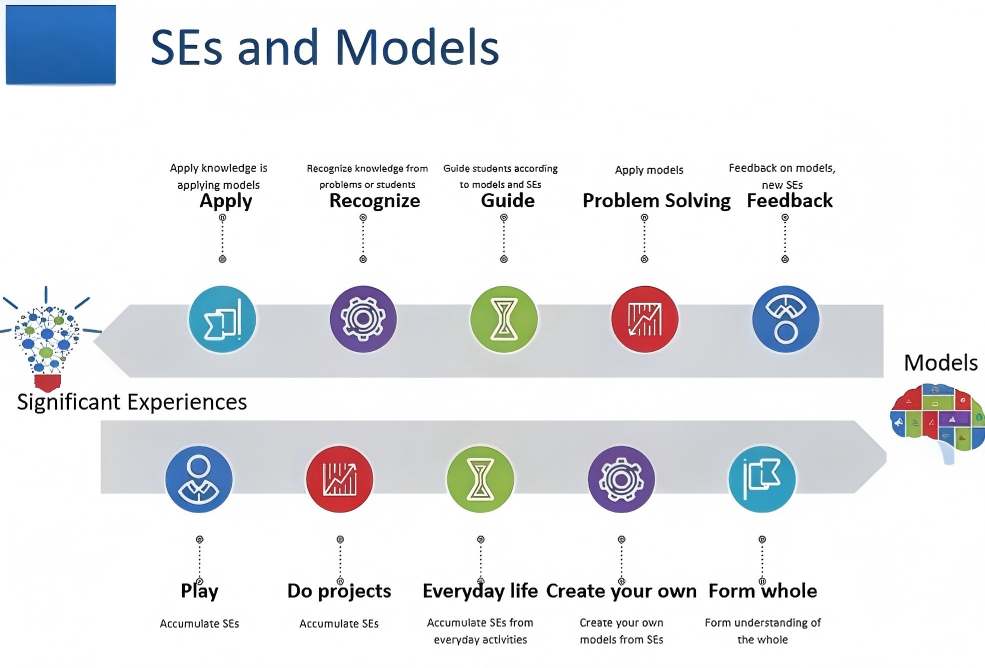
Applying “significant experiences” and “abstract models” to various cognitive skills