Open Party Speech: Real life learning and the design of Knowledge Engine

Here is the slides of my speech at open party.

Posted in selflearning, Speeches | Leave a comment

Screenshots of Knowledge Engine

中文版

Below are screenshot of the site. If you feel the pictures too small, you can click on each picture to see them in the original size.

The everyday entry page of the notebook. You can enter what you have learned here every day. What you have experienced significantly, or what import facts or infos you have collected. Cultivate the skills of self-reflection and self-feeling through daily recording and the teacher’s feedback. For the notes you have made, you can add two additional structural infos: one is tagging, the other is importance. You don’t have to add them. But if you add them, it will help you to better organize the notes in the future:

You can also start from writing Knowledge Frames. You can use Knowledge Frame to summarize knowledge according to your daily needs and share with others. Knowledge Frame is a faster and more convenient way of sharing knowledge than book publishing, blogs or wiki. It is also what we often use in our daily lives, for example, listing 1,2,3,4,5…key points:

A knowledge frame in details:

Member profile page:

A learning area. It has knowledge structure (knowledge frame), raw notes for students to dig into, collected learning materials(videos, magazines, books, blogs, examples, and so on) (these learning materials are collected automatically through some special system tags), as well as question set and project set. A learning area is a representation of a learner’s knowledge in a domain, it is also self-learning resources for the students. As long as you have rich learning material and are able to see the whole structure of knowledge, you can decide for yourself what is the fastest and best way to learn:

Another learning area:

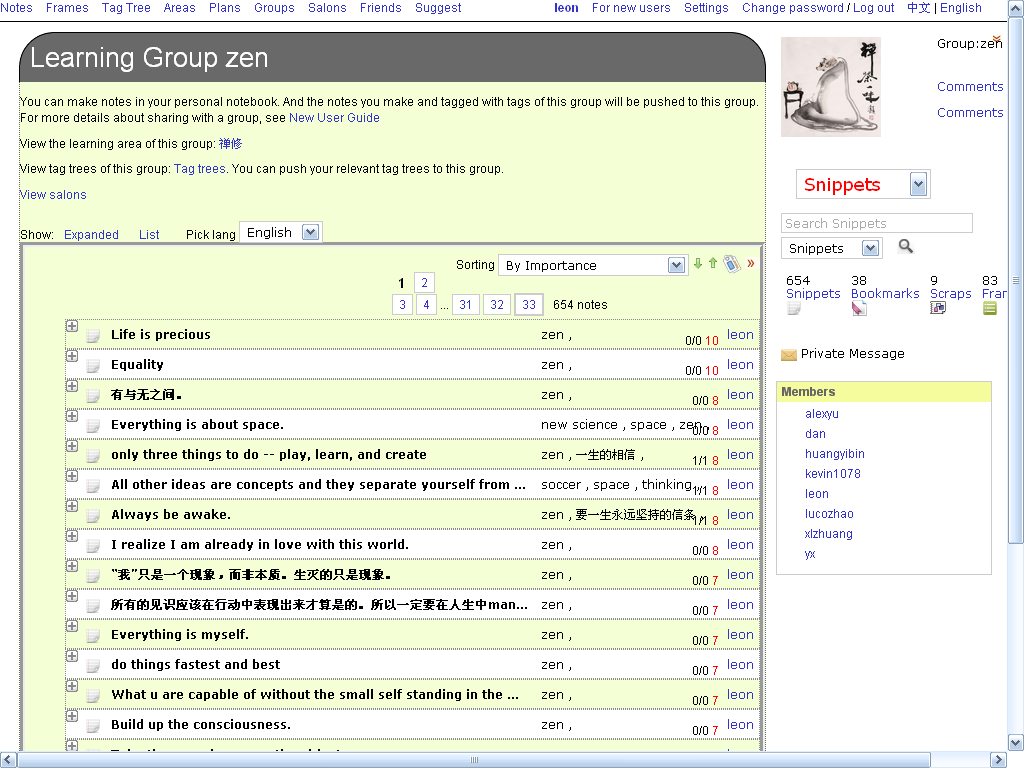
A learning group. A learning group will have a set of tags of the group. So after members join a learning group, the notes they made daily will be pushed to the learning group if they add the group tags to their notes. And there is email digest of each day’s new notes from a learner’s learning groups. (Email digest can be switched off in preference.) Other members of the learning group can give comments on the notes or vote on the usefulness of the notes. The teacher will also provide timely feedback this way. A learning group has its learning area and learning salons. Members learn mostly by themselves or through peer learning by using knowledge structure and learning materials provided by the teacher. Teachers provide guidance for the student learning mostly online and sometimes through face to face learning salons.Below is a learning group named Software Programming (named in Chinese currently):

Another learning group:

A tag tree. A tag tree is a representation of brain structure. It helps you view your notes:

Weekly learning plans (there are monthly learning plans as well). On Monday, the system will create for every member a weekly learning plan and a reminder email will sent to each member. The plan is an empty knowledge frame. The member only needs to fills in the frame. At the weekends, reminder emails will send to each member to remind them to review their learning plans of the week. Learning needs to form some good habits:

Posted in Usage Demo, User Manual | Leave a comment

New Feature: Learning Plans

New feature is implemented! Now there are weekly learning plans and monthly learning plans. They are automatically generated in the beginning of each week or each month, and you are reminded by email to fill them in or review them at the end of the week/month. With the learning plans, we hope to help individual learners form a good habit of self-reflection and planning. If you can choose to disable this feature in your setting. Several early learners have given very positive feedbacks on this feature.

Posted in New Features, selflearning | Leave a comment

New Feature: Learning Area

中文版

Now you can build a learning area based on your notes. What you need to do is to specify the root knowledge frame and root tag tree for this learning area. All related tags of this learning area can be extracted from the root tag tree, and based on these tags all notes that have these tags will be collected, as you can see in “View all notes in this learning area” section. These notes are further filtered by a standard set of tags to locate resources in them, such as references, videos, blogs, books, examples, questions, projects, people, and so on, as you can see in “View the learning resources in this area” section. So new learners or students can use these as their learning material. Other learners can even raise questions or submit projects to this learning area. Learning groups can be started based on this learning area, and the material in learning area can serve as the knowledge structure for these learning groups that they can continuously work on.

Posted in New Features, selflearning | Leave a comment

New Feature: for mobile devices

For mobile devices (pads or phones), if you visit the site from these devices, you will have an adapted site for you. Your home page will be a very simple note input box where you can make notes very quickly. We made special changes so that you can make notes quickly on the mobile device even without internet access. You can save this page as a shortcut on your desktop/main screen or you can set it as your home page to allow easy access.

Posted in New Features | Leave a comment

An education survey of schools

中文版

Note: Here is the knowledge frame for this essay (in Chinese only).

I had a chance to go to a local city in China to do a survey with public school (there are very few schools in China) teachers, instructional researchers (people who had been outstanding teachers and now more involved in providing teaching guidelines to other teachers), school principles, and some students. I think school problems are fundamentally the same everywhere around the world. I think what I found out in China should also applies to the states.

  • Everyone surveyed has a somewhat clear understanding of what school is. Especially the principles are very clear about it. Everyone knows test based teaching is the root of all evils. But only a few have the knowledge and courage to make some change. Here let me share with you what the school principles said of school. One school principle said to his teachers: “No one of you can survive if you get out of the school and get into society. None of you have the skills to survive.” He also said that school is a prison. Another school said that the wall of the school would be torn down in the future, and the that school would disappear too.
  • students had a big outcry over the testing. When asked what kind of online system they would like for education, one student answered that if the system has anything to do with testing it will have no future.
  • When visiting the classrooms, I learned that the coldness people have towards each other and towards public issues in society is developed when they are in school. Since they are forced to receive education passively and have no any means to change the way of education, they developed coldness and hypocrisy very early on.
  • The current system is a huge system that people play various roles. Everyone tries to fit into the roles. There are fixed routines to follow. People have a shared understanding of the system. There are various activities organized routinely to guide teaching. Within the existing framework, pretty what can be done have already been done.
  • Information technology has already had a big impact on schooling. Schools need the support of information technology. There are no arguments on this anymore. Teachers already had the habit of searching for course material online. Some schools are quite will equipped with technology, having IT covering various aspects of schooling.
  • Within the current education system, people have come up with various ways to improve teaching. They did a lot of work. But only a few teachers had the idea that students should learn more by themselves and that the teachers should teach less. Only a few teachers contemplated what the students should really learn.
  • With all the efforts put in, the current situation is still that the teachers are not happy, and that the students are not happy, according to a school principle. This is also shared by many others.
  • There are some right efforts within the system that I can recognize. For example, putting more emphasis on library, on reading, especially giving students more time to read during class time. Mentorship is implemented in some schools. There are also more emphasis on self-reflection. All these are good efforts. But it is far from enough.

It is interesting to see that even within the education system itself there is a widely shared view that standard testing is the root of all evils, and to see that right efforts are put more on ability instead of testing score, while in US so many people think standard testing is the way to save American education.

Posted in selflearning, Speeches | Leave a comment

New Feature:tag tree

So with note-making, it is more of a bottom-up approach. With frames, especially with frames that can have many child and grandchild frames inside, it get closer to a top-down approach so it is easy for you to locate what you need at the moment.

With tag tree, we added one more top-down approach for you. Take the root tag tree as something like your brain structure. Whatever you want to use your consciousness (for example, in learning something, or in time management), you can go from the root tag tree and find related notes or frames that you can use.

We added one extra sorting for notes corresponding a node in the tree: sorting by relevance. With the tag tree and the algorithm of relevance sorting, we hope to help you find your past notes quickly. For details of the algorithm of relevance sorting, we will have another article to describe it.

Posted in New Features | Leave a comment

The mobile version of notebook

中文版

This is about the mobile version of the online notebook.

No mobile app is developed currently. For mobile devices (pads or phones), if you visit the site from these devices, you will have an adapted site for you. Your home page will be a very simple note input box where you can make notes very quickly. You can make notes quickly on the mobile device even without internet access. (The notes you made is stored locally on your phone first and will get synced to the server once there is an internet connection.) You can save this page as a shortcut on your desktop/main screen or you can set it as your home page to allow easy access.

add_note_only_big

Posted in Documentation, User Manual | Leave a comment

Speech at guokr

to be translated from the Chinese version

Posted in selflearning, Speeches | Leave a comment

The invitation system in the notebook

To be translated from the Chinese version

Posted in Documentation, Experimentation | Leave a comment