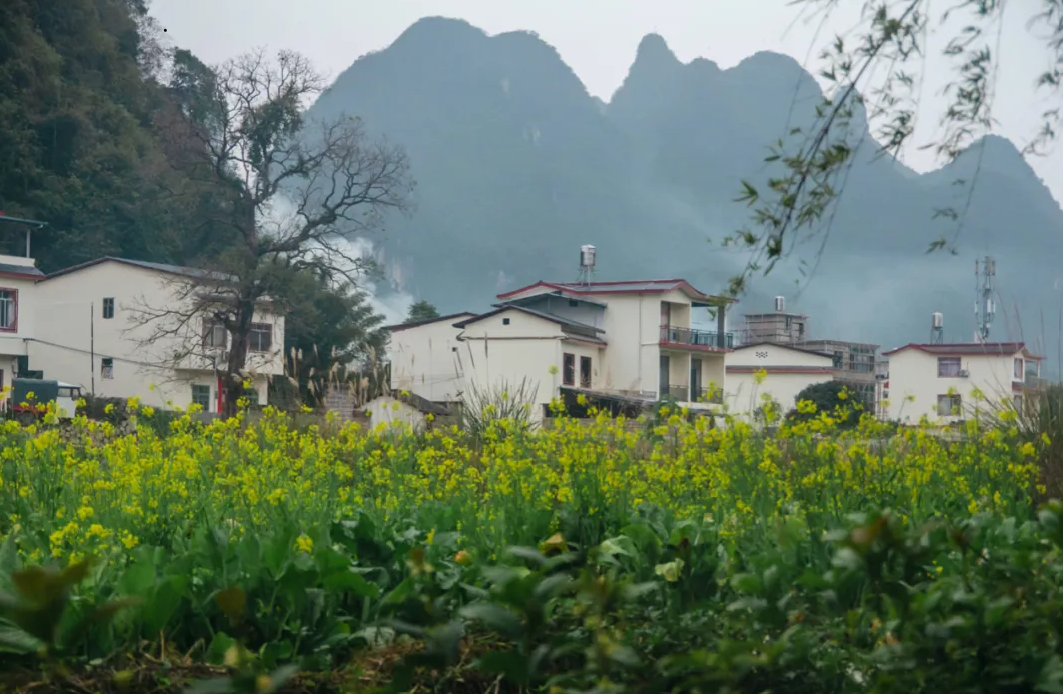
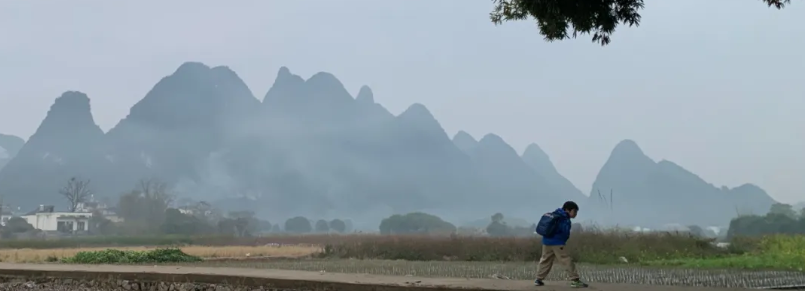
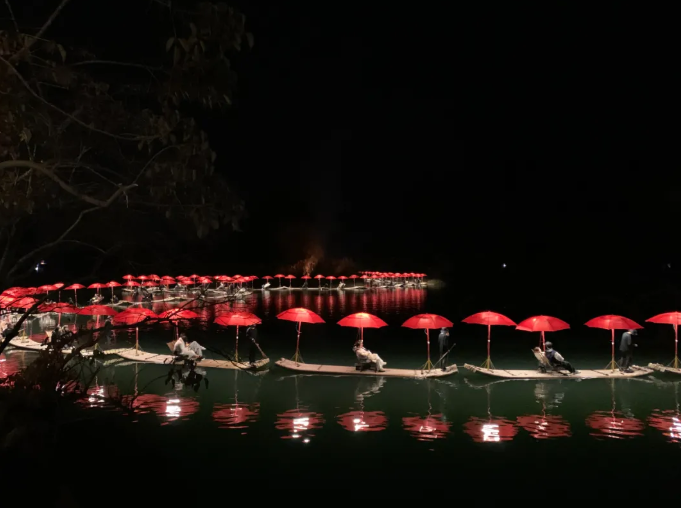
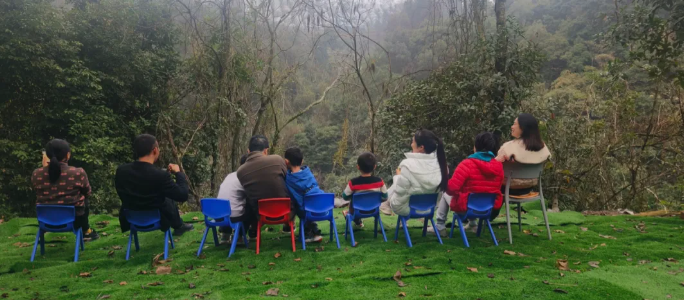
Original Chinese VersionEditor’s Note: The two-week Second Self-Directed
Education Experience Camp concluded successfully on January 21, 2024, at the
Yangshuo Tianfu Yuegu Learning Community. This article is an experience report
by resident advisor Leon, intended to help learners, parents, and educational
innovators better understand the essence of Self-Directed Education (SDE).
Summary: As self-directed educators, we believe that everyone—adults included—must continually pursue progress and growth. But how do we grow while sustaining a deep love for the world and a tight connection to its truths? Only through Self-Direction—and only through the Self-Directed Learning and Free Play built upon a richness of life experiences—can we achieve such vital growth.
Recently, many people have been asking about Progressive Education. I believe Peter Gray’s article, The Difference Between Self-Directed Education and Progressive Education, which I translated, has already clarified that topic. In this piece, I don’t intend to debate the merits of Progressive Education itself. Instead, I want to share my personal understanding of the word “progress” and explore the vital relationship between “progressing” and “being self-directed.”
01 / The Meaning of “Progress”
I have always believed that every individual should continually grow. To me, this is what distinguishes humans from plants and animals. Like them, we enjoy the sunshine, the rain, and all the splendor of nature; yet, as human beings, we possess the unique capacity to grow incessantly through the act of learning.
Why must we grow continuously? Perhaps I could say: it is to play better. Or, perhaps, it is to love more deeply. For those moments of sublime beauty we have touched, and for the moments that moved us to tears; for the love of this world and for those who stand beside us—it is for all of these that we must grow.
Unlike many parents who are prone to judging their children, I have always believed that all children share the same essence; they simply begin their journeys from different points. Life is incredibly diverse and multifaceted. A person might be naturally drawn to one specific facet of existence, and so their life begins by flourishing in that direction. There is nothing wrong with this—it is how we all begin. But true maturity, the act of transcending oneself, requires us to seek experiences and growth not just along that familiar path, but in the opposite direction as well.These experiences—of moving both forward and in the opposite direction—bring great self-identity and joy, but they also bring intense self-doubt and pain. These are the inevitable passages on the journey toward becoming a whole person; they are the essential lessons every human must complete in their own life’s growth.
These varied directions hold different levels of significance for a life. Among them, the largest is the understanding of the self, or the understanding of life itself. This is the largest life center. encompassing all other life centers within it (Regarding Life Center, please read this article . You can start by searching the term “life center”, and proceed from there). Much like the various life centers it contains, the understanding of self and life requires a richness of experience in both opposing directions. Only through this can we achieve the integration and fusion of these dualities, ultimately forming a complete life center.
This is a task that belongs to everyone. Each person has
their own unique problems to solve, but ultimately, all these paths lead back
to this largest task of all.
Everyone needs to continually “progress.” As we
understand the world and ourselves, we form many life centers; this is the very
process of life growing up. In this sense, I embrace the concept of
“progress.”
But if I were to say that everyone should take the task I
have defined above as their own goal for learning and growth, then I would
become a progressive educator.
Fortunately, I am not a progressive educator; I am a
self-directed educator. As a self-directed educator, I simply help each
individual life do what they truly want to do, without any trace of my own ego.
Of course, to be able to help every life develop and do what
it wishes to do, a self-directed educator must be sufficiently diverse and
possess multifaceted life experiences. Almost all problems in education stem
from an educator’s lack of understanding regarding the richness of life. An
educator must fully comprehend this richness while also striving to manifest
it. This is the true meaning of growth, or “progress,” for an
educator—and especially for a self-directed educator.
Even more importantly, you must transform yourself into the
“field”—the PlayGround—and manifest life in its truest form.
This includes manifesting the diversity of life and a state of open, lifelong
learning, where authority does not exist and every learner stands on equal
footing. When you manifest this, life will naturally sense it. As an educator,
when your own life is in full bloom, “authority” ceases to be a
concept that binds you. Whether you pick up or lay down the notion of authority
depends entirely on your own free playing, or your love for the world.
Life blossoms in stillness
The Zen masters of history might be the ultimate archetypes
of the self-directed educator. Even if they did not reach the level of the
“ideal teacher” described in Rousseau’s Émile, they are
certainly the closest humanity has ever come. Yet, these masters never employed
the methods of Rousseau’s ideal teacher. Most of the time, they simply
manifested—they manifested the true state of life. They maintained a constant
love for the lives around them, and at the right moment, with the right timing,
they would “cut through the flow” to aid someone. But such
“active” interventions were, in essence, no different from the
natural manifestation of life itself. These masters even claimed consistently
that they taught nothing—that the students learned everything themselves, that
everyone already possesses everything within them, and that every person is
inherently whole. This is what moved me so deeply when I read Cai Zhizhong’s
manga, The Platform Sutra and Zen Speaks, as a child.
In a self-directed education community, the presence of
adults with deep and multifaceted life experiences is essential. This adult
diversity acts as a vital nutrient for the growth of a living soul. To support
this, adults must strive to embody and share the full breadth of their
experiences, providing a rich landscape for learners to explore. Below, we
examine why this richness is of such profound significance for a child’s
development.
Just as individuals strive for progress, a team must do the
same. In the future, every organization will inevitably become a learning
organization. A team’s primary competitive advantage will stem from its
members’ ability to resolve their own “life tasks” within the context
of the organization’s mission and environment.
In the realm of self-directed education (SDE), learning and growth are never reserved solely for the students. A self-directed community is a living ecosystem where adults and minors grow alongside one another. It is a shared journey toward wholeness.
Growing together
02 / How to Progress?
Life as it first emerges
In a self-directed environment—defined by equality,
inclusion, and diversity—educators are privileged to witness the primordial
beauty of life in its original state, a state yet to be “polluted” by
fragmented knowledge.
We come to realize that children are already whole beings. Their capacity for sensing, and even their depth of thought, often far exceeds that of most adults. To witness their innate kindness, their profound empathy, and their unyielding courage in the face of life’s challenges—coupled with their boundless ability to explore and create—is to see the ultimate truth of the world.
This is precisely what was experienced during the 2nd
Self-Directed Education Experience Camp in Yangshuo. I believe that when an
educator says they truly “love children,” it is because they have
been moved by this magnificent state of being that children manifest so
naturally.
The second session of the camp lasted two weeks. During the
second week, a new group of children joined, including a boy named Xiao Song.
By then, the original group had already formed deep bonds. Xiao Song, feeling a
strong desire to belong, joined the community just as we were heading to Guilin
for a “City Exploration” adventure.
In an effort to integrate quickly, Xiao Song
“forced” his way into a conversation about anime—a topic the other
children were passionate about, but one he knew little about. His interjections
felt intrusive and disrespectful to the others’ shared interest. This tension
escalated from a verbal exchange into a minor physical confrontation.
Throughout the journey, the children were locked in a heated
debate over who was right and who was wrong. On the bus ride back to the
community, the two children who had been struck by Xiao Song sat together,
continuing to dissect and discuss every perceived wrong in his actions.
After a while, Liu Wei, a staff member, called me to the
back of the bus. She whispered that YY, who was sitting next to her, was
becoming emotionally unsettled by the children’s heated discussion. Everyone in
the community is aware of YY’s situation: in the presence of intense conflict,
YY easily becomes overwhelmed and agitated. My personal intuition was that this
was a manifestation of sensitivity and discomfort toward even the slightest
hint of violence or aggression.
So, I spoke softly to the children in front of me. Though
they were only nine or ten years old, they stopped their debating instantly.
They even leaned forward to tell the children ahead of them to be mindful of
YY, urging everyone to end the discussion.
When we returned to the community and stepped off the bus,
something remarkable happened. Xiao Song—who had been the target of the other
children’s intense criticism for the entire journey—initiated a gesture of
peace. He walked up to the two children he had struck and put his arms around
their shoulders, offering a wordless yet profound apology.
Reflecting on “The Incident”
The following morning, during the JC Meeting, the children
involved gathered to reconstruct and reflect upon the events. As I sat directly
across from them, I was overwhelmed by their profound capacity for sensing and
their incisive analytical skills. They didn’t just recount what happened; they
navigated the complex geography of intention, impact, and reconciliation with a
clarity that many adults struggle to achieve.
With tears welling in my eyes, I was struck by a singular,
humbling thought: In the world of self-directed education, the boundary between
the educator and the educated often dissolves entirely. We are not
“teaching” them to be human; they are reminding us of what being
human actually looks like. Looking at these young lives in their original,
unpolluted state, I had to ask myself: What right do we, as adults, have to
“educate” them?
After this incident, these few children have become
inseparable besties.
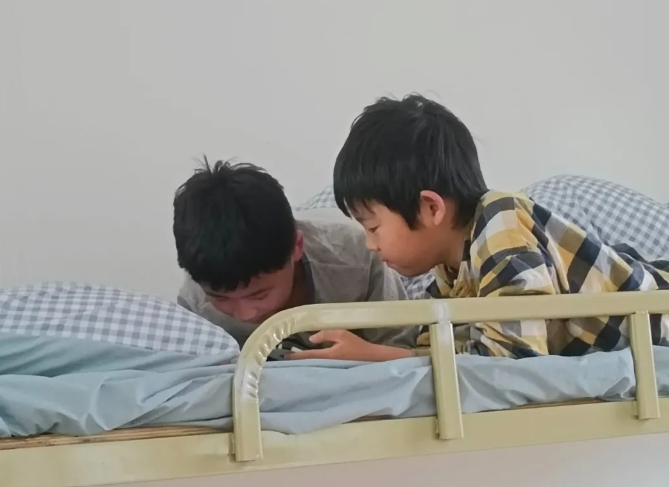
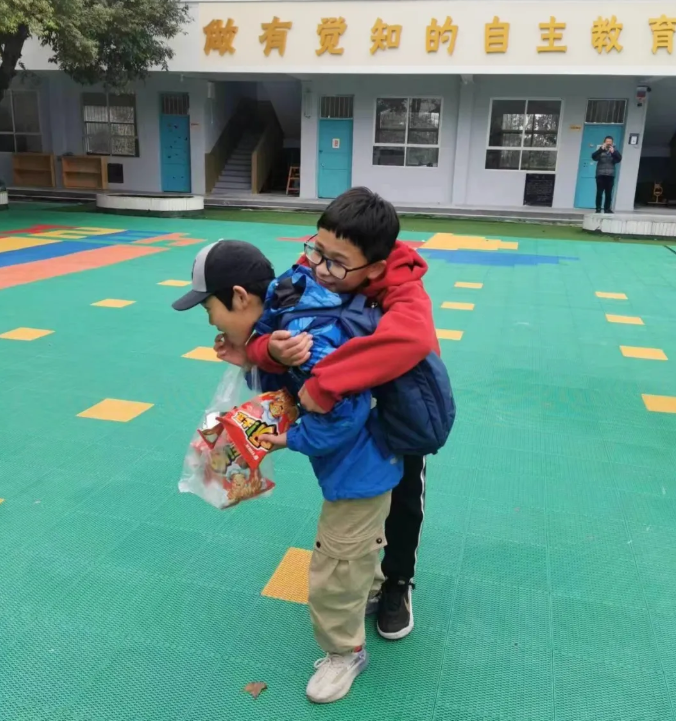
Xiao Song and DD are playing video games together on a dorm bed. Xiao Song and DD embracing on the playground at the moment of parting
There are a few more details to share about YY. At fifteen,
she was the oldest student in the Experience Camp. She has a deep passion for
creating her own RPG games, but her parents, troubled by what they perceive as
“dark” narratives in her scripts, have frequently pressured her to
give up her creative work. When she first arrived at the camp, she carried a
detached, icy demeanor—so much so that some community members were initially
intimidated by her cold gaze.
On the day of our Guilin field trip, during the lunch hour
dedicated to exploring local delicacies, four of the younger children insisted
on skipping the traditional Guilin rice noodles to go to McDonald’s instead. YY
didn’t actually want McDonald’s, but seeing that I might struggle to supervise
four energetic children alone in a crowded city, she stepped forward. She
voluntarily chose to join the McDonald’s group, sacrificing her own preference
to ensure the safety and balance of our small team.
At the Zhengyang Pedestrian Street, the moment the younger
children spotted the McDonald’s golden arches in the distance, they began to
dash forward, quickly widening the gap between us. YY asked me, “Should
they be allowed to go that far?” Before I could even respond, she took
off.
I was stunned to see her sprint. Given her build, I had
assumed she wasn’t much for physical activity—as is common with many children
today. But there she was, sprinting at full speed to catch up with them, a
sudden burst of energy fueled by pure concern for their safety.
For readers who are not part of our community and have never
met these children, it is difficult to fully capture the raw, emotional impact
of these moments through words alone. Yet, to protect the children’s privacy, I
must refrain from providing more specific details.
On another occasion, seven-year-old Little Apple was
practicing calligraphy when nine-year-old TZ tried to take a photo of him.
Little Apple, unhappy about being photographed, resisted, and a heated argument
broke out, even escalating into a physical scuffle—one of the more intense ones
we’ve seen.
However, shortly after TZ left, Little Apple turned to me
and asked if TZ was coming back. I asked him, “Why do you want TZ to come
back?”
“I want to play with TZ,” he replied simply.
Later, Little Apple kept reminding the staff to make sure the two boxes of milk
that was borrowed from TZ while making milk tea were returned to him.
During the Experience Camp, there were so many moments like
these—moments that moved us to tears—that I simply cannot recount them all.
During this JC Meeting, our staff member, Li Ming, said with deep emotion: “We
chose to pursue self-directed education, and now I see that we truly made the
right choice!”
He spoke for all of us. After completing the first session
and reaching the halfway point of the second, every staff member has begun to
truly enjoy this work—cherishing the beautiful time spent with the children.
Our bodies and minds have started to relax. I believe that in those moments,
each of us felt as though we were finally seeing the true nature of the
world.
This “truth” is the inherent goodness within every
heart—the compassion and empathy for others, the profound capacity to sense
life, the courage to explore its depths, and the innate creative power we all
possess. This truth manifests in both the adults and the children within our
community; it is a mutual resonance of life.
In a free and inclusive environment of self-directed
education, a child’s life can truly blossom, revealing its most beautiful and
original state. In turn, adults are touched and inspired, reawakening the very
source of their own existence.
Moments like these remind me of the most exquisite times in
my life—those instances that left me moved to tears. In those fleeting seconds,
we glimpse the truth of the world and feel, with every fiber of our being, how
much we love this world. We have all experienced such moments. What, then, is
it that distances us from this truth, pulling us away from our love for the
world? Life is finite; how can we preserve and practice this love in the time
we are given?
Seeing these children striving so hard to grow, loving this world with such immense courage and pursuing the beauty of life—despite every setback and the “violence” imposed upon them by the adult world—it fills my heart with a boundless mix of sorrow and joy. Our education has failed these children so deeply! We were once just like them; what, in the end, has turned us into what we are today?
Educators, how do you answer these questions?
How Do Children Make Progress?
In Western culture, the phrase “loss of innocence”
is often used to describe how people lose their childhood wonder and purity
through the acquisition of knowledge. This “innocence” can be
specifically understood as the qualities mentioned above: “inherent
goodness, compassion and empathy for others, the capacity to sense life, the
courage to explore, and the ability to continuously create.” The
Catcher in the Rye is the most classic novel expressing this “loss of
innocence.” The protagonist, Holden, strives to protect his own innocence
while also wishing to shield children playing freely from losing theirs as they
grow up.
As we grow, we must acquire knowledge. But what kind of knowledge should we seek?
Proponents of self-directed education believe that every individual is the creator of their own knowledge. Only by building knowledge based on our own life experiences—maintaining a tight connection with our inner sensing and staying aligned with the truth of the world—can we hope to preserve our innocence and remain whole human beings.
In this process of creating knowledge, one must not only build understanding upon positive experiences but also confront their “reverse side.” By establishing a complete cognition or a “life center” based on the totality of both positive and negative experiences, the self remains integrated with the world rather than alienated from it. Maintaining this tight, unyielding connection with the full spectrum of life’s experiences is the core mission of self-directed education.
Life is diverse, and it is only through free play that our
multifaceted experiences—the meeting of the positive and the negative—can truly
occur. Think of those adolescents confined to age-segregated classrooms,
trapped in a relentless cycle of lessons, homework, and exam preparation. How
much of life’s true diversity are they actually allowed to experience?
Self-directed education is inherently characterized by
age-mixing, which in itself is a form of diversity. Within an age-mixed
environment, a wide array of different life experiences are bound to encounter
one another.
Take Little Apple, for example. As the youngest participant
in the second camp, he loves creating his own rules when playing with older
peers or adults. However, there is also a kindergarten at the Yangshuo Yuegu
school. Little Apple occasionally enjoys playing there, and the younger
children absolutely love him. They look up to him as a “big brother”
with eyes full of admiration.
In front of these younger children, Little Apple’s demeanor
completely shifts. Unlike the way he interacts with those older than him, he
often becomes quite shy around the little ones. Seeing that shy expression on
his face whenever he is with the kindergarteners just cracks me up!
This is precisely where the meeting of positive and negative experiences happens, allowing Little Apple to gain a relatively complete spectrum of life experiences. In contrast, only-children are often the youngest in their families, limited to a one-dimensional experience of being cared for. In traditional schools, their activities are confined to age-graded peers, making it difficult to gain “reverse” experiences. This leads to a personality formed by a one-way perspective. Such individuals tend to develop a rigid ego, causing a separation from the world and an alienation from their True Self.
Ten-year-old ZY is remarkably precocious in his reflections
on the world and life. While he enjoys playing games or chatting about anime
with his peers, they cannot provide the deep intellectual exchange he craves.
Except when he is unwell, ZY never misses school meeting, where he invariably takes a
leading role, offering profound insights into the building of the community’s
order and its governing principles. In any environment other than Yangshuo Yuegu—where
minors are treated as equals and join adults in co-creating the community—ZY’s
development in this area would be stifled. In fact, in other educational
settings, ZY has long been suppressed, leading to a history of intermittent
school refusal.
YY’s parents are often concerned that her scripts and
drawings are too “dark.” However, at the camp, no one judges her work
this way. As her facilitator, whenever YY brings this up, I tell her that from
my personal perspective, there is absolutely nothing wrong with creating such
work; artistic expression should span a broad spectrum. Deep down, I know this
is a direction YY has chosen to explore actively—it is a remarkable effort on
her part to resolve her own inner confusions.
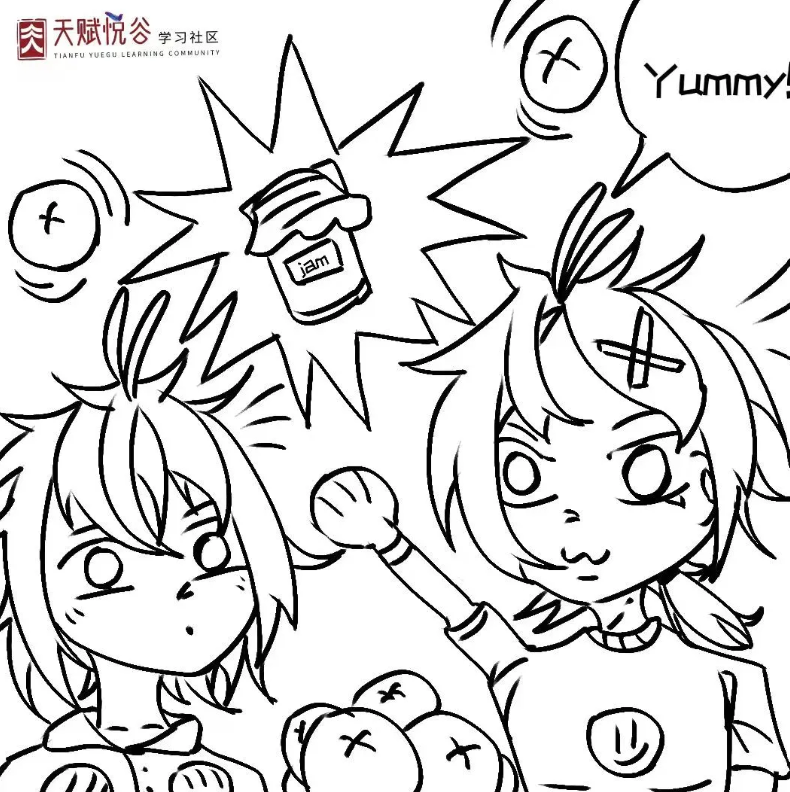
YY is an exceptionally talented manga artist. During the
first camp, the Foodie Club invited her to design the packaging for the
community’s homemade kumquat jam. We discovered that YY has a remarkable gift
for capturing the beauty in daily life. Everyone was absolutely charmed by her
hand-drawn illustrations for the packaging.
YY’s hand-drawn packaging illustrations YY’s hand-drawn packaging illustrations
During the second camp, the community invited YY to
represent the essence of our community through a series of illustrations.
Though the project is still a work in progress, she shared some of her initial
ideas with Shu Mei, a staff member. YY wanted to include the people of the
community but wasn’t quite sure how to approach it.
Shu Mei shared her own perspective: “What matters most
when drawing a person is the feel (the vibe or essence) that person
gives you.”
Inspired by this, YY began to observe the community members
meticulously, paying close attention to the unique feeling each person
radiated. She started striving to capture these “feels” in her
drawings and began sharing her observations and emotional insights with Shu
Mei.
When YY first arrived, she expressed discomfort around
children much younger than herself, even a sense of fear. I suspected it was
because young children can be so boisterous, and YY is sensitive to intense or
chaotic scenes.
However, during the camp, within our self-directed
environment, we witnessed YY showing immense love and extraordinary courage in
caring for and protecting those very children. As mentioned before, her offer
to join them for McDonald’s was solely to provide an extra pair of hands for
their care, and her sudden hundred-meter sprint to catch up with a child
demonstrated her deep commitment. Seeing YY protect these children in such a
way inevitably reminds me of Holden, the protagonist of The Catcher in the
Rye, who is of a similar age.
For a child like YY—so brimming with love, infused with the
courage to live, and so gifted at discovering the beauty in everyday life—her
parents truly have nothing to worry about.
Through these stories of YY, we can see how a self-directed
environment fosters a space where adults and minors play and communicate
together (after all, who is to say that work isn’t a form of play?). In this
setting, the flow of life experience is unhindered. Each individual can sense
and embrace every facet of their existence. When the “sunlight and
rain” of experience are abundant and well-balanced, life naturally grows
in its healthiest, most authentic form.
In such a diverse, age-mixed, and self-directed community,
and through the medium of free play, every life is gaining a rich tapestry of
experiences—no matter the direction.
Even as a child, I held this educational philosophy—and we
must never underestimate a child’s perspective: truly capable parents and
teachers do not criticize; they simply encourage a child to develop their
strengths.
A child is in a constant state of learning and growth. As
long as they continue to evolve in the direction of their interests, their
so-called “shortcomings” will naturally vanish as they grow. For
instance, when a five- or six-year-old truly wants to accomplish something,
they find a profound inner stillness. A child who typically seems scattered
will become focused, and one who appears careless will become meticulous.
A child’s life is just starting; they must seize upon a specific direction first—this is an essential requirement for growth. Without this, a life cannot truly unfold.
Adults might feel a child is clutching one direction too
tightly, that they lack “balance.” But they are just a child! As an
adult, are you balanced? In a rich, self-directed environment with ample
time and space for free play, a child will inevitably have countless
opportunities to encounter other experiences. There is no need for an adult to
point out a child’s so-called “shortcomings.”
Those “shortcomings” are often just the needs of
the adult, not the child. Yet, because adults are “stronger,” they
feel entitled to inflict this form of violence upon minors—simply because they
can.
Self-directed education: Adults and minors walking the path together
How Do Adults Make Progress?
As discussed, in a self-directed education community,
learning and growth are never just for the children. A human life is finite,
and everyone has their own lifelong “subject” or calling to fulfill.
To be able to complete one’s own life’s task within that limited time is
already a profound stroke of fortune.
In a self-directed environment, educators are granted a rare
fortune: to witness, through the children, the innate wholeness that
resides in every life from the very beginning.
Playing alongside children is, in essence, a reunion with
one’s past self. Without being in education, it would be difficult to recall
the growth experiences of decades ago. Throughout our own journeys, we have all
had good and bad experiences, positive and negative encounters. To engage in
education—especially self-directed education—is to grant oneself the
opportunity to grow all over again.
Life is not linear. In the process of growth, we find
ourselves in a constant reunion with our past selves.
During the first and second terms of our self-directed
education camp, every member of our adult team experienced significant personal
growth. While I can only speak for myself today, my own journey has been one of
rediscovering the “innate wholeness” of life.
Personally, I have experienced profound growth—not only in
the acquisition of various interests and skills but, more importantly, in the
evolution of my very being.
In terms of personal growth, I recall one afternoon when I
wanted to explore the surroundings by going for a run. I’ve never liked the
feeling of staying in one place for too long without forming a connection with
the environment.
Just as I stepped out of the school gates, two seven- or
eight-year-old children started following me, wanting to join in. Concerned
about their safety on the road with passing cars, I gave up my plan for a
long-distance run. Instead, I led them toward the trails heading up the
mountain.
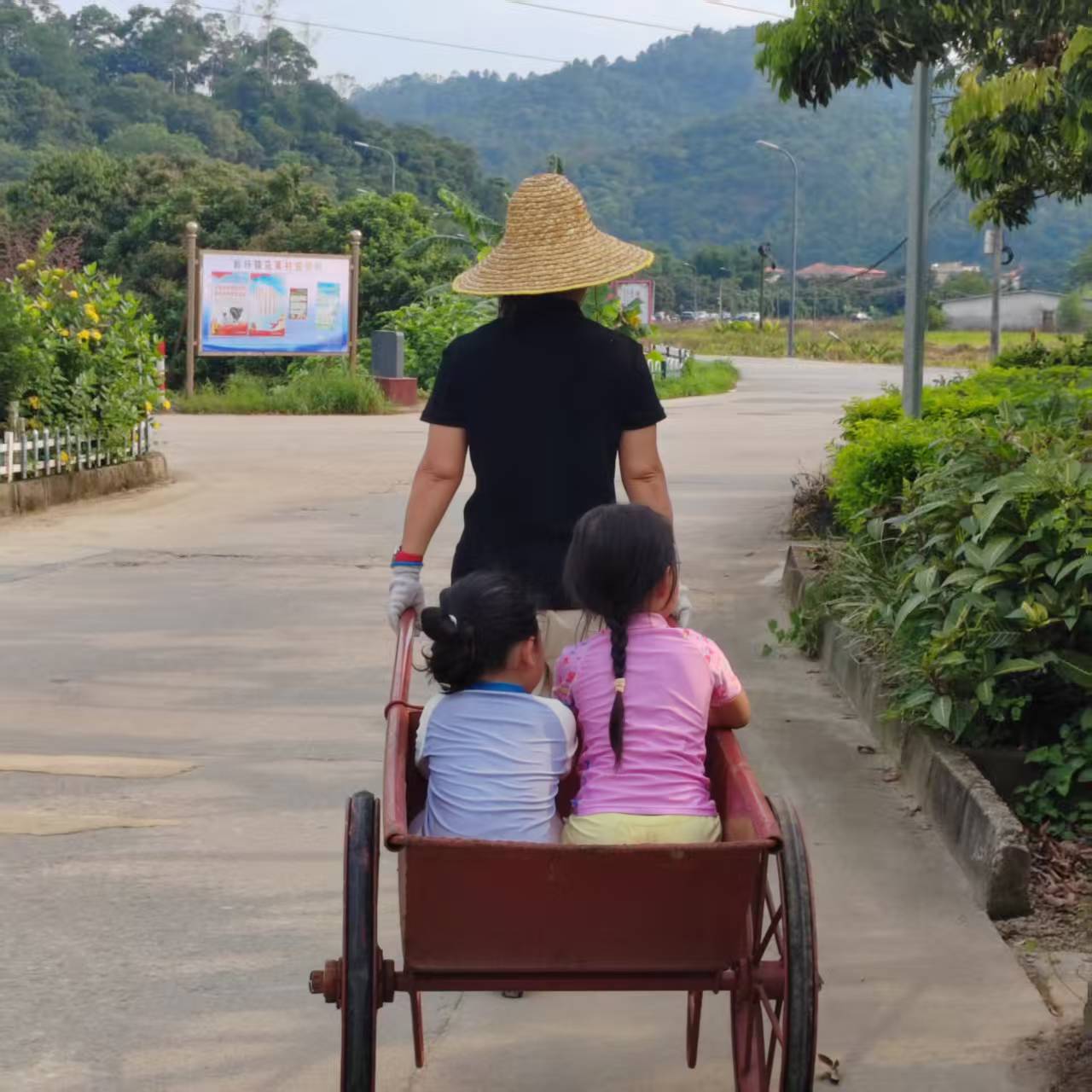
Two children, one from the city and one from the mountains.
Although the city boy was a year older and took on the role of the big
brother—caring for the little girl every step of the way—it was the younger
girl, the child of the mountains, who was the true leader of this adventure.
Watching these two children explore the wonders of animals,
plants, and all that nature offers, I am reminded of my own childhood
adventures climbing mountains with my brothers. Back in middle school, I even
wrote a lengthy essay recalling the various discoveries and beauties we
encountered during our hike.
As dusk fell and darkness began to gather on our return
journey, the two children moved forward—a mix of trepidation and
excitement—paving their own way through the fading light. Along the path, the
older brother began telling the younger girl a ghost story—one that wasn’t
frightening at all, but rather a comforting echo in the quiet woods.
This suddenly brought back the memory of hiking mountain
trails in the dark with my brothers. Walking and talking in the silence of the
wilderness—the stillness of the night intertwined with the warmth of human caring,
the thrill of adventure balanced by a steadfast confidence. Everything was so
vivid.
This is perhaps the ultimate meaning of free play: it offers a fundamental, grounding experience of life itself. In these moments, there is no “self” standing apart from the world, yet every life manifests with absolute clarity. Isn’t this precisely the “original innocence” that we have lost in modern education?
If it weren’t for playing freely with these children, it would be difficult for me to recall my own growth process. But being with them every day allows me to trace my development step by step, realizing: So this is how my life was formed!
Exploring the wilderness with them, I witness the growth
that nature’s beauty and abundance bring to the children, while simultaneously
confirming within myself everything that playing in nature as a boy gave me.
These are growths from the depths of being. As a manager with extensive
professional experience, I can clearly see the profound connection between
these childhood experiences and workplace skills—yet I know that most adults
remain blind to this.
There is at least one certainty: children who have played freely in nature possess a deep-seated belief that everything in this world is intimately connected and in a state of flow. To them, the world is yours to navigate.
Much of my confidence in design and creation throughout my professional career stems from this very foundation. I often wonder why others are so fragmented and rigid in their creative processes. Children with these experiences become active agents in their own lives; they possess the courage to face the unknown, firmly believing in their power to create their own destiny.
Furthermore, in the various activities with the children
I’ll mention later, I have an underlying goal: to experience what my oldest
brother experienced when he used to lead us. Although my younger brother was
always part of our circle, he and I are only two years apart—practically peers.
My oldest brother, however, was five or six years older, and that age gap
created a remarkably rich experience for all of us, him included.
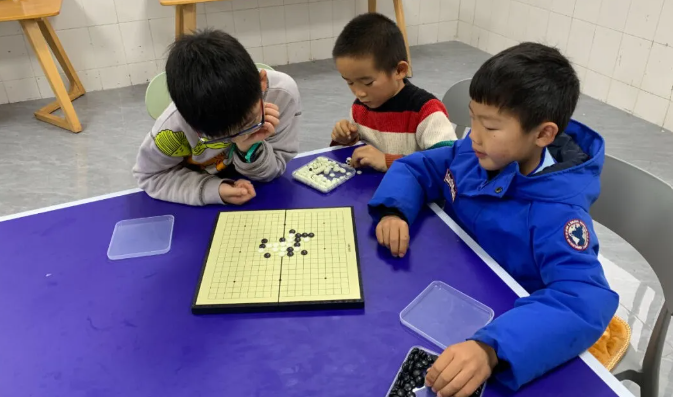
He was the one who taught us all our board and card games,
constantly inventing different ways to play. I remember him giving us a 9 or
12-stone handicap in Go, watching us joyfully securing our tiny little
territories, while he masterfully occupied the vast majority of the board.
This two-week immersion camp has fostered so much inner growth that, due to space constraints, I can only share a small fraction here. My primary goal is to help everyone sense how life naturally flourishes on its own within a Self-Directed Education environment. Next, I will discuss the learning and growth that occurs through various interests and hobbies; these are, truly, among the most beautiful parts of a life fully lived.
As someone who naturally loves sports, my busy schedule used
to limit me to just one focus: soccer. However, after a leg injury, I barely
exercised for over a decade. Last year, a bout of frozen shoulder left swimming
as my only option. In the city, finding the right people and facilities for
sports is never easy. But the sports facilities at Yangshuo Yuegu are
incredibly convenient—far more so than any other Self-Directed Education
community I’ve known. Having such a sprawling playground right there is truly a
unique and gifted advantage.
At a Self-Directed Education community like Yangshuo Yuegu,
unlike conventional schools, adults have ample time to play freely—one could
even say that free play is a fundamental part of the “job.” In an era
where children generally lack outdoor activity, it is profoundly meaningful for
adults to lead by example. By engaging in their own play, they naturally
inspire children to step out of their rooms, leave their computers or phones
behind, and re-engage with the physical world.
Consequently, whenever I started juggling a soccer ball on
the community field, students and staff would naturally gravitate toward the
action. Even YY, who rarely ventured into sports, took the initiative to come
over and try juggling. We’d all juggle and pass together, playing games like
“monkey in the middle” (keep-away) or jumping into matches. After
just a few days, I realized my old leg injury had completely healed. I used to
lack power in my passes, but now I can pull off long-range shots again! I feel
like my days of galloping across the football pitch have finally returned.
I had barely touched a basketball since elementary school,
even though I played constantly back then. The community provided the perfect
time and space for me to give it another try. Because my frozen shoulder hadn’t
fully healed, I struggled to find my strength at first; I had barely used that
arm for a year. Yet, perhaps thanks to the lighthearted spirit of free play, I
quickly regained my touch. Before I knew it, the frozen shoulder had completely
cleared up!
Beyond that, I also played ping-pong and badminton in the
community. I even improvised a unique “rustic golf” game exclusive to
Yangshuo Yuegu, combining the mechanics of golf with the way we used to play
glass marbles as kids.
Beyond playing on my own, I also played alongside the
children. There was no deliberate instruction; instead, we focused on letting
the children play and experience everything freely. Most of the time, the staff
simply modeled the activities through their own engagement, yet several of the
children’s skills improved by leaps and bounds during the camp! Based on my
past experience, if there were more opportunities for soccer matches, the
students could fully grasp how the game should be played simply through the
experience of playing the match itself.
For me personally, practicing these sports is actually a
form of Tai Chi practice. Tai Chi, after all, is meant to be applied to every
aspect of life.
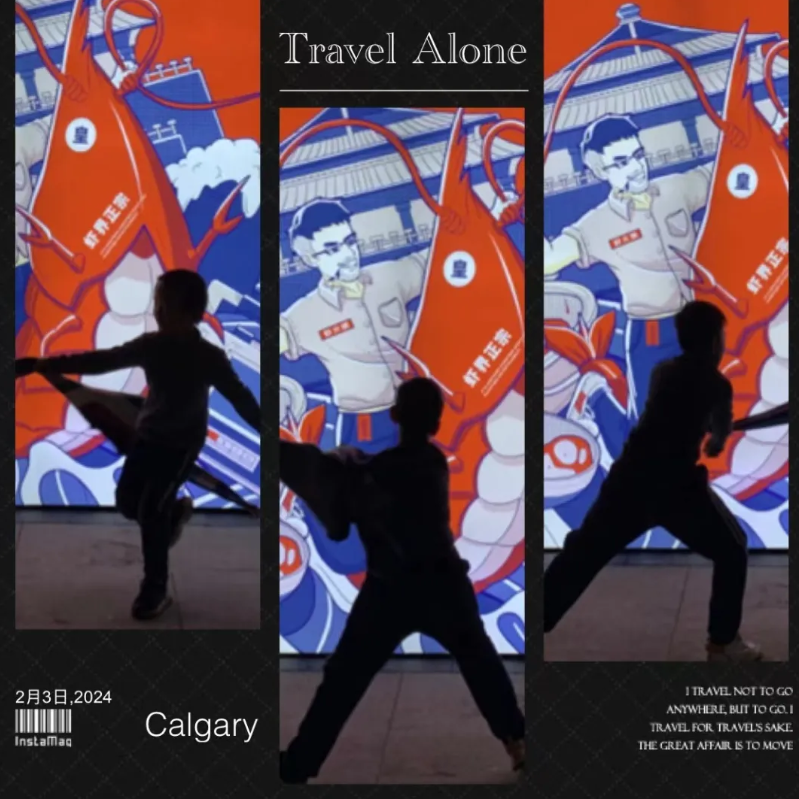
One evening after dinner, I was suddenly
“ambushed” by two children. Both of them love martial arts and
decided to use me as their sparring partner. Having loved “fighting”
with other kids when I was young, I felt a spark of interest to relive that
experience. Moreover, since Tai Chi requires practical application, I figured I
could use its principles to spar with them without causing any harm.
I essentially used only one hand, mostly parrying and
avoiding direct confrontation. My focus was on staying light on my
feet—retreating and dodging quickly—while waiting for the right moment to catch
their strikes in stride. I made a conscious effort to never let myself get
trapped between them. Later, I even took off my sweatshirt to use as a soft
restraint when the opportunity arose, which felt like a gentler way to manage
the “battle.”
Eventually, the kids escalated the “tournament” by
bringing out mop handles. I hesitated for a moment, but then grabbed a mop of
my own to “accept the challenge.” Even then, I avoided direct
clashing of the sticks. I used feints and dodges to create openings, lightly
tapping them on the back with the mop head whenever I saw a chance.
Children who loves martial arts
Looking back, as an educator in the community, this might
have been pushing the boundaries a bit, and I wouldn’t necessarily recommend
this style of play to everyone. However, I see it as being similar to how Lu Anke
(Eckart Loewe) used to frolic with the children in the rural mountains of
Guangxi—letting them grab and strike him without reservation. In a sense, this
was taking the mixed-age educational approach to its absolute extreme.
In fact, back when I was teaching myself soccer, I frequently played with people of all skill levels—from absolute beginners to those who were incredibly fast, technically gifted, or both. Competing against novices or masters with diverse playing styles allows you to sharpen your skills in different ways; it is all part of developing a living sensing of the sport.
During the second session of the camp, I also re-experienced
calligraphy and painting. For me, these were two hobbies that had essentially
been ruined by school. We had calligraphy in the first and second grades, and
art classes were a constant throughout my schooling. I was actually quite
interested in both, but calligraphy class was taught through mindless
imitation—the teacher never encouraged us to experiment or feel the strokes;
they only focused on grading us. Art class was even worse, forcing us to draw
perspective diagrams from textbooks rather than observing real objects to train
our eyes, our brush control, or our capacity for abstract expression.
As a professional programmer and architect, I have spent
years focusing on the construction of beauty and life. Through visiting museums
and galleries, I have developed a strong appreciation for aesthetics. However,
beyond programming (including graphic design) and photography, I’ve rarely had
the time to practice creating beauty in other fields. I have been searching for
the time and space to make these attempts for years. In a Self-Directed
Education environment, adults are fully empowered to pursue their own
interests—because your own pursuit and practice are, in themselves, the best
way for children to learn.
Re-experiencing calligraphy in the community allowed me to
finally accumulate my own significant experiences. Having self-taught so
many sports and skills over the years, I now possess a deep confidence and a
wealth of experience in self-directed learning. I’m no longer like that child
who could be intimidated by teachers or stuck in mindless imitation. Instead,
by drawing on my own firsthand experiences, I quickly developed a method to
rapidly improve. For instance, I initially focused solely on the mechanics of
the brush—the starting, moving, and pausing of each stroke—without worrying
much about the character’s structure. Only after mastering the “feel”
of the brushwork did I shift my focus to the structure. In essence, the way you
control the brush’s movement is identical to how you handle a paintbrush, while
the structure of a character is no different from the composition of a
painting.
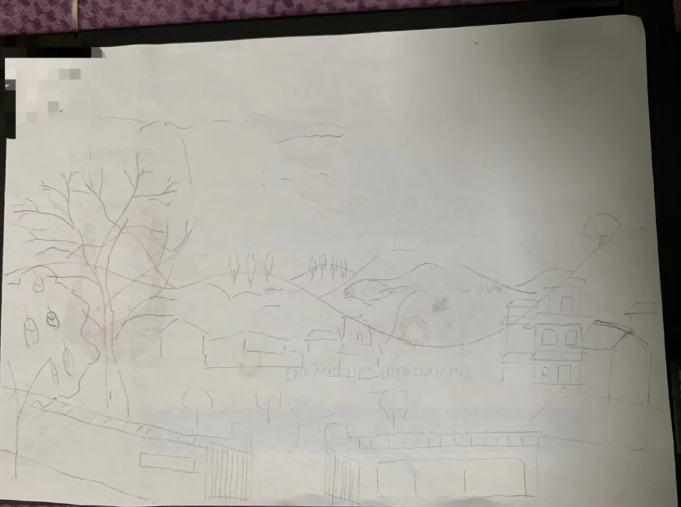
During the second session of the camp, I attempted to learn
painting through a self-directed approach for the first time. It started when
the weather cleared up; the scenery outside the school gate was so beautiful
that I felt a sudden impulse to capture it. Before even touching the paper, I
had already formed a mental draft, identifying the primary lines and the major
Life Centers, as well as their spatial and overlapping relationships. I kept
the relative heights and placements of the houses largely faithful to the
actual scene, while making subtle adjustments. I also abstracted the distant
trees and other elements, expressing their forms and positions at an abstract
level. While the real scenery is stunning—otherwise, it wouldn’t be so
moving—the goal of painting is to extract those elements of beauty that touch
you and express them through abstraction. It’s about simplifying and adjusting
based on one’s imagination, yet still ensuring the place is instantly
recognizable, because the inherent beauty of the reality is what gives the work
its soul.
First attempt at self-directed learning in painting
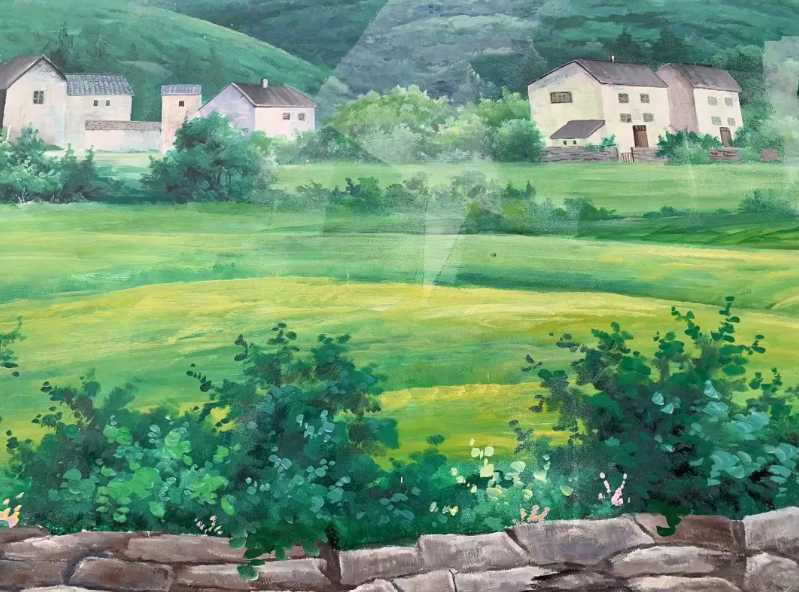
I had originally intended to add color, but after a brief
attempt, I realized I hadn’t quite grasped the technique yet. The next day,
while exploring a village along the Yulong River, I happened upon some oil
paintings on the walls of the houses. In that instant, I caught the
“feel” for how to apply color.
The oil paintings on the village house walls along the Yulong River
Therefore, the key to learning anything is to take action
and try it yourself. Only through trial and error can you accumulate your own significant
experiences and identify where your focus truly needs to be. Then, by
observing others’ work or by reading books, you will be able to find exactly
what you need.
Adults re-exploring their past interests is, in much the same way, an encounter between one’s positive and negative experiences. The true diversity of life can only be encountered through play.
Therefore, in a self-directed education community, the most
important element is free play—playing to one’s heart’s content. Growth and
learning are natural processes. The richer the play, the richer the learning
becomes.
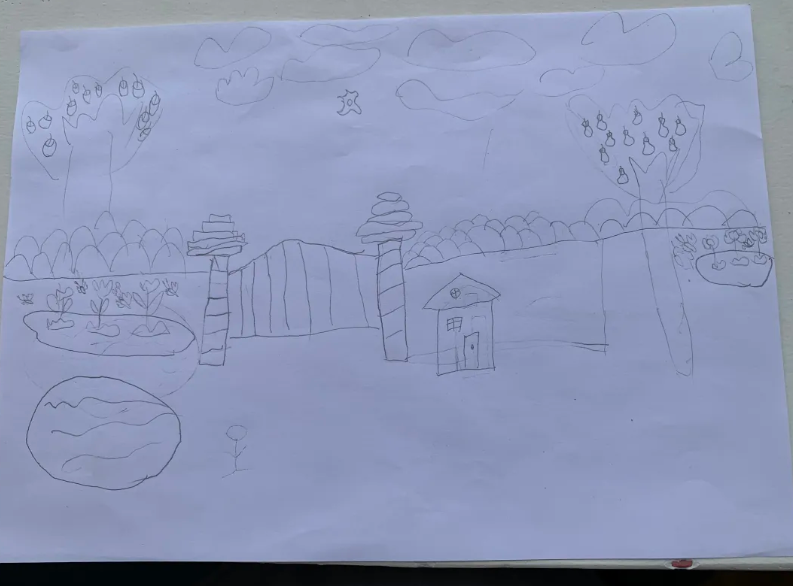
Even though it was only my first attempt at learning to
paint through self-directed methods, I had the courage to share my
“work” in the student group. Several children were very
interested—they even asked me to take them to the same spot so they could draw
too! And the way they draw has, in turn, given me so much inspiration.
Student Artworks Student Artworks
In fact, people naturally possess diverse interests and hobbies; pursuing them doesn’t need to be utilitarian. One should simply enjoy them as one enjoys the sunshine and the rain. We no longer live in an era of material scarcity, and human production is no longer just the mechanized output of a frantic manufacturing age. Today, social progress depends far more on the creative capacity of individuals and teams. This creative capacity stems from life experiences across multiple domains. These Life Centers are flowing everywhere, all within one world; in free play, they will always find one another. Only where free play is confined does the flow of these Life Centers stagnate, making the growth of life a difficult struggle.
As individuals grow, they become powerful. However, as mentioned in a film review by ZY after a community screening, this power can also bring a shadow side—unless that power is used to meet the needs of others or to support the community, society, and the world. Perhaps we can say that what is powerful is not the ego, but the love the world bestows upon you. You must return that love to the world; you are the world! This is the true meaning of growth, or what we understand as “progress.” Such growth does not isolate us from the world; instead, it ensures we remain constantly in touch with the truth of existence. At times, we need to build abstract models based on our significant experiences in play to help us better understand our surroundings. Yet, these models are our own creations rather than the standardized knowledge found in modern education. They arise with our needs and dissolve when those needs are met. We remain one with the truth of the world; all lives are very clear, yet there is no separate “I” splitting out from it.
During these two weeks of the second camp session, many
brilliant and moving life stories unfolded within the community. This article
tells only a few of them from a single perspective. I hope that in the future,
we will have the time to share more of these life stories with everyone from
diverse viewpoints.
Father and son
03 / Life, only when self-directed
All of the above are the inherent capacities and natural
states of every living being. As long as they are not damaged, we can see these
capacities and states in every child. The work of a self-directed educator is
to constantly attend to and protect these life capacities, to continually
reflect on whether one’s own actions might harm them, and to strive to
cultivate the soil—or rather, the play-ground—where these life
capacities can flourish fully, allowing life to always manifest its original
state.
Every life experience, even the painful ones, is a good experience; they all help us grow. (Of course, experiences like drug use are irreversible and numb the brain, so they do not count as good or valuable experiences.) In a self-directed education community, we are able to witness the immense courage children show in facing life. We, too, should possess such courage to embrace every experience life offers.
Self-directed educators do not care what a learner’s current interest is; all interests are good interests. Every interest deserves attention, as each one helps the learner gain more life experiences. The role of a self-directed educator is simply to help learners play better within their current interests to gain even richer experiences. Growth in any direction will inevitably lead to encounters with experiences from the opposite direction—and these are all precious opportunities for the growth of life. Therefore, as self-directed educators, there is absolutely no need to impose an adult’s will or the will of so-called authorities upon other learners. Just help every individual do what they truly want to do!
Yes, we pursue progress—but the way we pursue that progress is through the self-directedness of life!
Epilogue:
During the writing process, for reasons I cannot fully explain, a memory from years ago resurfaced. In the aftermath of the September 11 attacks, at a cross-cultural gathering, I shared these words:
“I feel your profound sorrow. I joined your vigils, standing with you in silent prayer. In this pain, everyone has become so solemn, so grave. But what I want to say is this: if you truly wish to be serious about your values, you should play again, just as you did before. Do not allow the terrorists to change the fundamental essence of who you are.”
When I first came to the United States as a graduate student in 2000, I attended a Biomedical Engineering seminar during my very first week. There, I witnessed an American colleague presenting his work with a sense of free, playful enthusiasm and a profound love for his craft unlike anyone I had ever seen. Seeing that pure passion was the catalyst; it sent me on a quest to find the one calling I could devote my entire life to. That was the moment I chose education.
To watch the videos, please refer to the Original Chinese Version.
Original Chinese VersionAbstract: To commemorate Christopher Alexander, one must mention the “New Science” he strived to pioneer. The science of the future should be one where all disciplines merge and flow together. Subjectivity and objectivity achieve unity at the “Life Center”; art and technology, the humanities and the sciences, become integrated and interconnected within the “Living Space.” Consequently, our education—from theory to practice—must inevitably be reconstructed upon the foundation of life.
Finally, as a tribute to Christopher Alexander, I must mention that life centers were proposed as a spatial concept. Alexander regarded the perception of space as the very foundation of human intelligence and wisdom.
As mentioned earlier, the process of modernization has mechanized humanity and alienated us from life. One consequence is that the humanities have blindly copied the research methods of the natural sciences, emphasizing the complete exclusion of human subjectivity. However, Christopher Alexander pointed out that the subjective can be objective, and what we call objective is also subjective. He consistently strove to establish a new science that unifies the subjective and the objective.
Science is constantly evolving, and the science of the
future will be one that merges and integrates all disciplines. Our subjective
world is also replicable and falsifiable, and thus, it is objective.
Subjectivity and objectivity achieve unity within the life center; art and
technology, humanities and science, converge and connect within the life space.
Consequently, our education—from theory to practice—must inevitably be
reconstructed on the foundation of life.
One of the most significant consequences of the dogmatic
adherence to natural science in education is the disproportionate value placed
on linear logic and mathematical reasoning. This has led us to overlook the
fact that spatial perception is the very foundation of human thought. Many of
the “logic puzzles” we struggle with can actually be resolved
instantaneously through spatial intuition, bypassing the need for cumbersome,
step-by-step reasoning.
We see a vast number of extracurricular programs claiming to
cultivate a child’s linear logical thinking, and even programming education
uses the development of linear logic as a primary marketing slogan. There is a
widespread belief that children who excel in STEM subjects do so because of
their superior linear logical reasoning. These are profound misunderstandings;
they are symptoms of how humanity has become increasingly mechanized through
the process of modernization.
By the same token, many educators believe that while traditional education is rigid and stagnant, it is easy to implement because everyone knows exactly what to do. This is only because we have become alienated from the feeling of life and have grown accustomed to an assembly-line mindset. Therefore, self-directed educators must deliberately reconnect with life and grasp the significant life experiences within their own journeys. I often say that a true educator is, by definition, someone focused on the growth of life. In reality, I have found that those who are truly passionate about education are deeply attentive to this organic growth. If self-directed educators maintain this intimacy with life, they will naturally be able to perceive and design their own self-directed learning environments.
If we study the process of biological evolution, we find
that the evolution of life is primarily an evolution of spatial perception. In
particular, it was the evolution of the eye that triggered the Cambrian
Explosion—a massive radiation of species.
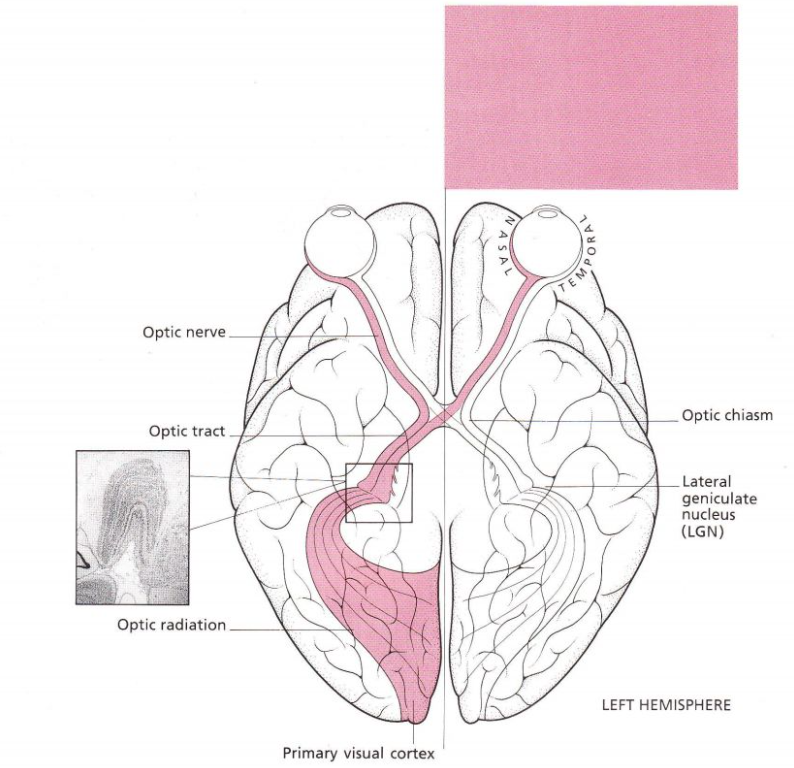
In fact, we can “see” even without eyes. What matters is not the eye itself, but the act of “seeing” performed by the brain regions connected to the optic nerve. Brain science has discovered that other senses—such as smell, touch, and hearing—all eventually converge upon these neural regions located behind the optic nerve; this is the visual cortex, and it corresponds to the perception of space. When you smell or hear something, your brain also generates images. Therefore, what we call “seeing” is simply the brain identifying a “life center.” The object being “seen” does not need to emit light; it can even be an entirely abstract entity.
The visual cortex is located in the back of the headVisual Cortex
I suspect that human “seeing,” or our capacity for spatial perception, has been enhanced by the development of language. Language enables the human neocortex to store significant experiences of living space and the abstract models built on top of them. This is why humans can “see” concepts such as numbers, length, weight, speed, society, history, and beauty.
In fact, animals also possess the ability to identify life
centers and abstract models; otherwise, they would be unable to recognize their
kin, their mates, or their natural predators. Lions and cheetahs, for instance,
must have an inherent perception of speed. As they prepare to leap, they are
already gauging their own velocity relative to their prey, intuitively judging
whether that single movement will secure the catch.
In the following animation, we can see that even fish—which
occupy a lower position on the evolutionary tree—possess an innate sense of
beauty. They are capable of recognizing and constructing intricate,
aesthetically pleasing geometric patterns.
The exquisite patterns constructed by fish on the seabed
The various patterns constructed by fish
Similarly, dolphins also experience the sense of play and
fun.
Dolphin tossing fragments of coral
Dolphin appreciating the way fragments of coral descend
Thus, we can see the progressive development of spatial
intelligence. What distinguishes humans from other animals is our ability to
use language to form visual concepts and perform visual compositions. This
allows us to store significant experiences and abstract models, transforming
them into knowledge within the human neocortex. Because of these capabilities,
we can engage in complex thinking and continuously discover new insights.
Consequently, humanity has been able to transcend other species—not by relying
on biological evolution, but through learning, which enables us to elevate our
spatial cognitive abilities throughout a single lifetime.
Even after the invention of software and the digitalization
of our world, we have failed to correctly digitalize the knowledge stored
within the human neocortex. Today, the digital representation of knowledge
remains constrained by the traditional format of paper; it remains
document-centric. We have yet to realize that we can now directly digitalize
the significant experiences and abstract models held within our minds.
For Self-Directed Education to be promoted throughout society, it is essential that we re-evaluate our understanding of knowledge. We should not abandon knowledge; rather, we must embrace “living knowledge.” Only when knowledge is truly digitalized can we fully unleash the potential of the Internet, allowing Self-Directed Education to rapidly emerge as the mainstream of future learning.
Christopher Alexander dedicated his entire life to helping
humanity rediscover the space of life and reshaping a new science—one that
unifies the objective and the subjective to include the essence of life itself.
Therefore, although this series has already become quite extensive, I have
decided to conclude by discussing the topic of Living Space. At the same time,
I believe that a thinker as profound as Christopher Alexander cannot be
commemorated with a brief essay; it requires a long-form work. His masterpiece,
The Nature of Order, spans four volumes, each over a thousand pages
long. Only a long-form article is truly fit to honor his legacy.
You are gone, and I have lost yet another kindred spirit.
Original Chinese Version
In the process of implementing Self-Directed Education, educators must possess an “intimacy with life”. Only then can they design a suitable environment for Self-Directed Education that resonates with their specific learners and their unique surroundings.
Equality of life, the omnipresence of life, richness, diversity, feel, individuality, design, in time, dynamics, interaction, and iteration—these are all attributes of life that we need to develop an “intimacy” with.
Equality of Life
Education is equality. If we can achieve a relationship of equality, then every place can become a place of education.
A crucial life experience from my early childhood is that the foundation of all human relationships is friendship—whether it be parents and children, siblings, or intimate partners. If a relationship cannot first be established as a friendship, it will lack a solid foundation. And friendship, in its essence, is the equality and conversation between living beings.
In the pervasive and equal life conversation within a
Self-Directed Education community, what an educator must focus on during the
implementation process is the single concept of equality. As a mentor, there
are two primary types of conversation between the mentor and the learner.
For learners who already know what they want to learn and are already exploring on their own, the conversation between the advisor and the learner is primarily exploratory. It is similar to the conversations between advisors and students in European graduate schools, or the exchange between an experienced player and a new player—it is a relationship of equality.
For learners who do not yet know what they want to learn or have not yet developed an interest in a specific field, the advisor primarily introduces interest through storytelling. I remember an elderly, white-haired teacher from my kindergarten who was an exceptional storyteller. Every time she began, all the children would immediately gather around her. It was from this teacher that I first heard the stories of the Journey to the West, with Sun Wukong (the Monkey King) and Zhu Bajie (Pigsy). This kind of storytelling is also a relationship of equality.
In the interest introduction phase of my programming classes
for teenagers, I also use storytelling. I tell stories about the development of
the internet and software, and stories of digitalization across various
fields—which are essentially stories of abstract modeling. However, I do not
linger in the storytelling phase. As soon as the learners develop the will to
explore actively, I immediately stop the stories and let them enter the process
of active exploration and modeling. This allows them to gain their own crucial
experiences and transition as quickly as possible into the first type of
exploratory conversation.
In an educational environment, the relationship between
teachers and students is inherently unequal, especially between adults and
minors. If equality cannot be achieved, it is very difficult for education to
truly occur.
Equality means that while the advisor possesses more significant
experiences or abstract models, they must acknowledge that the learner
possesses the same capacity for exploration in their life journey. As soon as
the learner is able to explore a field independently, the advisor must
immediately return the initiative to them, refraining even from continuing the
storytelling. The advisor must always be ready to dissolve their own
“authority” and return as quickly as possible to the relationship
between two equal players.
But in reality, what we often see is educators attempting to
teach students things that the educators themselves have never experienced. It
is as if anything, as soon as it is labeled with the halo of
“education,” must be accepted by the learners.
For example, if an educator feels they should teach music to
students, we must ask the educator: what is their own experience with music?
What specific experiences do they hope the learners will gain? These
experiences might be insights they gained at that age, or perhaps something
they deeply regret missing out on. Have they ever asked a musician what kind of
meaningful musical experiences ordinary people or children should have? It
shouldn’t be about playing classical music for students that the educator themselves
rarely even listens to.
If an educator hopes that students will develop hands-on
skills, collaboration, emotional regulation, resilience, and communication
through their courses, they should instead observe what the students are
already playing with. They should discover the hands-on skills, collaboration,
emotional regulation, resilience, and communication that students already
possess during their play. They should find these bright spots and offer
encouragement. This is the true meaning of equality.
Omnipresence of Life
Because a complex living system is composed of life centers,
the omnipresence of these centers constitutes the interconnection of all life,
owing to the existence of identical life centers within different lives.
Therefore, saying that life is omnipresent is the same as saying that life is
interconnected—but the omnipresence of life is the true essence.
From an educational perspective, the omnipresence of life is equivalent to the following two statements: Knowledge is omnipresent, and learning is omnipresent.
Because knowledge is living knowledge—knowledge based on significant experiences, which are our experiences of life—it follows that, like life itself, knowledge is omnipresent and interconnected. This is the foundation of our education discovery, and it is precisely where the old educational paradigm fails with its fragmented, categorized subject divisions.
Because knowledge and learning are omnipresent, the play of learners is learning itself. In sufficient play, everything can be learned. Educators with years of experience in Self-Directed Education communities should be able to see this clearly. Therefore, educators must be skilled at discovering the knowledge within these activities, providing appropriate guidance to support the growth of life. This, in turn, helps us build confidence in Self-Directed Education.
Specifically, if an educator hopes to teach students how to
draw, we must ask the educator what significant experiences in their own life
are related to drawing. Or, we must ask if the educator can discover which
activities the students are already engaged in that involve drawing-related
experiences—such as photography or an appreciation for images. An educator must
be able to discover the widespread drawing-related knowledge that exists in
daily life and recognize the rich experiences associated with it. Only then can
they create appropriate educational designs tailored to different learners.
And because life centers are omnipresent, all life is equal.
Knowledge is omnipresent; learning is omnipresent. These two
statements carry broad and profound significance within Self-Directed
Education. Due to space constraints, I will not elaborate further here.
Richness, Diversity, Feel, Individual, Design, In Time, Dynamics, Interaction, Iteration
Christopher Alexander pointed out that the process of
modernization has caused human mechanization and an alienation from life.
Modern education, which originated from industrial mass production, is
similarly mechanized and lacks life. Self-Directed Education is based on life
itself, and its practitioners should maintain a deep sense of closeness to
life.
Beyond the equality and omnipresence of life, let us examine
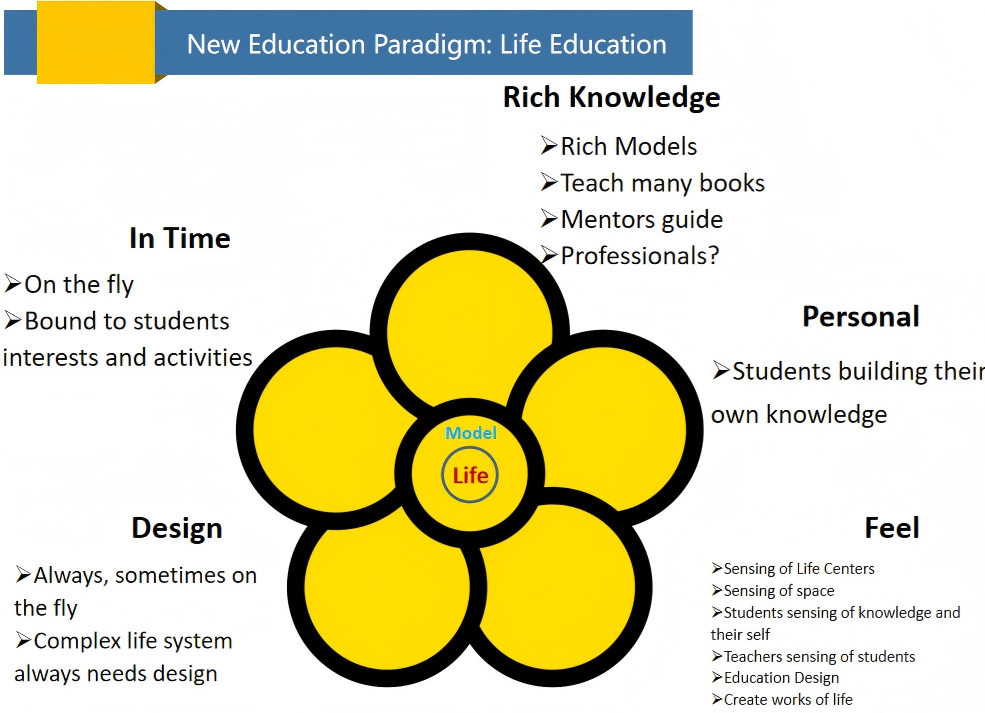
other attributes of life that we should be familiar with. The following diagram
illustrates the life attributes manifested by Self-Directed Education as a form
of life-based education. As we can see, these characteristics are entirely
different from the old educational paradigm.
Life is rich and diverse; therefore, we must feel it fully. Consequently, life is also individual. Life is full of design, and educational design must often be just in time and dynamic. These life attributes are all derived from the concept of life centers—they are the macroscopic manifestations of these centers, and thus, they are all grounded in significant experiences and abstract models.
For example, as mentioned earlier, once we clearly understand which significant experiences in life are related to music or drawing, and we identify which experiences we hope the learners will gain, as well as which experiences in their current play are already related to these fields—once all of this is laid out, we can design appropriate PlayGrounds for different learners. This allows learners to start playing and organizing themselves within these PlayGrounds. The educator’s role is then simply to facilitate the life discovery and help learners achieve their own life expression.
Due to space constraints, I will not explain these points in depth here. These topics have been discussed in detail in previous articles on my WeChat official account.
In this series:
Original Chinese Version
The three elements of the “New Educational Paradigm”
discussed previously—”PlayGround,” “Conversation,” and “Knowledge”—reflect the
core of our existence: we play in “Life Activities,” we learn through “Life
Conversation,” and we create “Life Knowledge.” From a more macroscopic
perspective—one rooted in the understanding of human life—these three elements
represent “Playing,” “Learning,” and “Creating,” forming a unified, triadic
whole of the human life.
In the following section, I will discuss how to master the implementation of “Self-Directed Education” as an educator. Put simply, this requires a fundamental “trust in life” and a deep “intimacy with life.”
To trust in life, we must understand the “capabilities of life” and the “drivers of life.”
The self-sufficient and inherent “capabilities of life.”
A core component of “capabilities of life” is the capacity for learning, which we possess from birth (or even earlier). This learning capacity is the ability to feel, explore, reflect, and create.
When conducting educational activities, teachers must be
able to sense the students’ inherent “capabilities of life” at any
moment. While different teachers may vary in this ability, at the very least,
they should not obstruct or suppress a student’s natural “capacity for
learning.”
Therefore, every one of us possesses this “capability
of life” to feel, to play, to explore, to reflect on the experiences
within play, and to create; this is an innate ability we are all born with.
Various “SDE” (Self-Directed Education) communities have already
proven this. They possess a rich body of publications; those who care about
education need only to read them carefully to reap immense benefits and gain a
profound understanding of the “essence of education.”
Where does this self-sufficient “capability of life” come from? We believe this capability stems from life’s ability to recognize the phenomena of life. Using the concept of “Life Centers,” this capability arises from our innate power to sense “Life Centers.”
The ability to interact with “Life Centers”
(“Playing”) and the ability to establish new “Life Centers”
(“Creating”) are both grounded in this fundamental perception. This
defines the relationship between “Learning,” “Playing,” and
“Creating.”
Recognition is both learning and creating; through learning,
we create new “Life Centers” within our minds. This act of
recognition is the uniquely human capability of “seeing.”
However, I must add that, as mentioned above, this recognition of “Life Centers” also stems from the experience of “playing.” Before we are able to recognize a “Life Center,” we have already played with it countless times.
Therefore, this is the foundation of the self-sufficient “capabilities of life”—an innate power derived from the triadic, unified life activities of “playing,” “learning,” and “creating” that we have engaged in since birth. Through these continuous activities, we perpetually exercise and strengthen these capabilities. Thus, we say that this power resides within every living being, and every child possesses this innate capability.
Therefore, when we “play,” we are simply flowing with the “Life Centers.” But how do you “see” these centers? That is where “learning” begins. Especially for those “Life Centers” that cannot be simply seen with the eyes or heard with the ears, you need to use your whole body to “see” them.
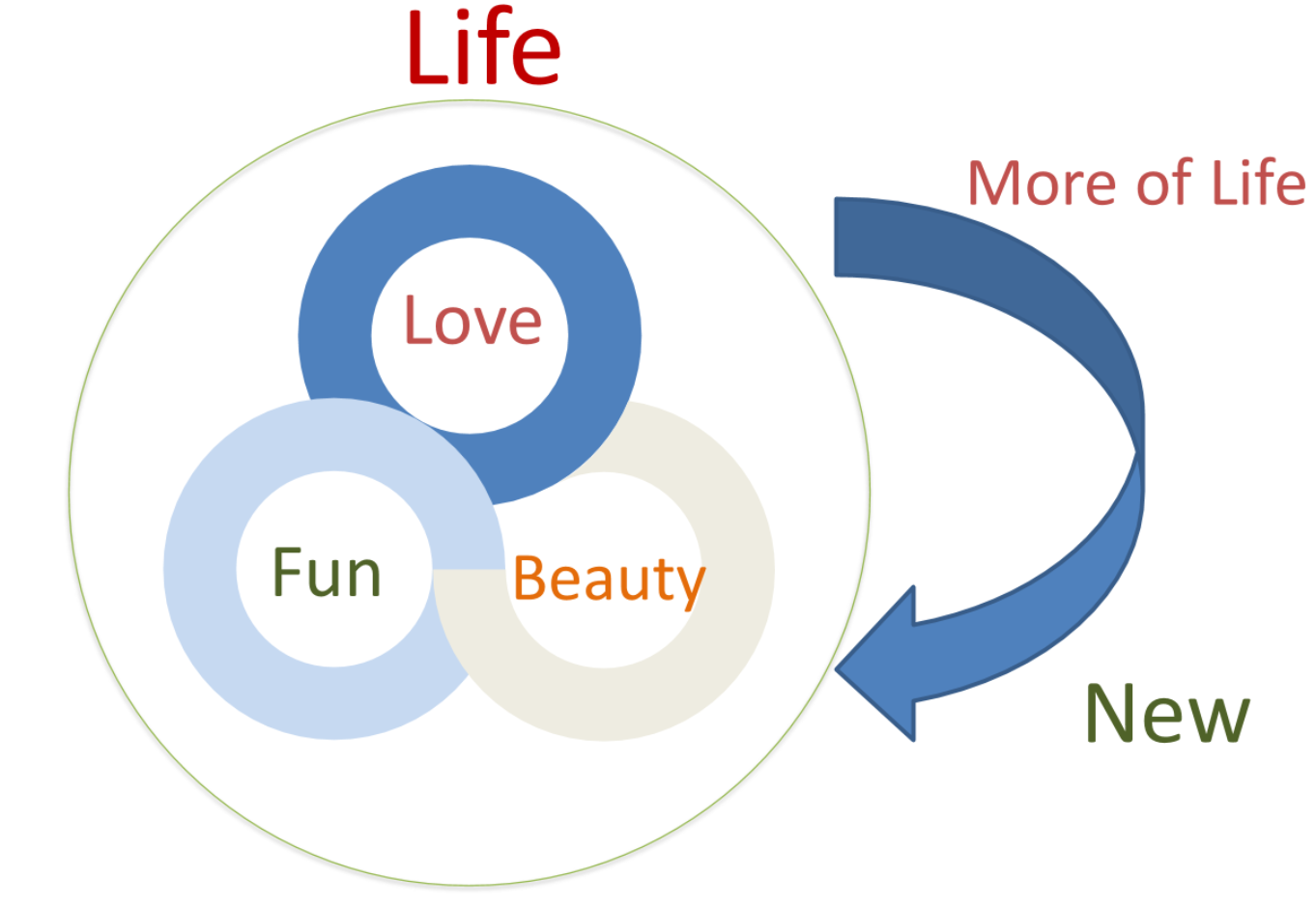
Why does life engage in such activities? What is the
underlying will or driving force? We say it is “beauty,”
“fun,” and “love.”
The Drivers of Life: The Pursuit of Beauty, Fun, and Love
“Beauty,” “fun,” and “love” are the inner “forces of peace” within every individual. It is these “forces of peace” that drive the progress of human history. We can view human history as a narrative where these “forces of peace” increasingly break through the powers of “weapons and capital” to manifest themselves. These “forces of peace” are the internal driving forces within each of us.
Our sense of “beauty” stems from our appreciation
of “Life Centers.” This is primarily related to the spatial and
positional relationships between these centers. The static “geometric
properties” of a “Life Center” have a profound impact on our
senses and emotions—such as “beauty,” “loneliness,” or
“hope.” I will not elaborate on the specifics here, as Christopher
Alexander has already provided extensive descriptions in his books.
“Life Centers” are both independent and powerful, yet they are interconnected, echoing, sacrificing for, and cooperating with one another to foster a greater whole—an even larger “Life Center.” Through the recognition of “Life Centers,” we come to understand the complex universe and our complex selves. The “self” is also a “Life Center,” and every individual, as a “Life Center,” serves as the basic unit of society. The prosperity of a society requires healthy and strong individuals, and it necessitates the cooperation between these “Life Centers.” Because of the emergence and disappearance of “Life Centers,” the complex universe is simultaneously simple and peaceful. “Life Centers” exist, yet they do not exist. The universe changes, yet it remains unchanged. Christopher Alexander also described this profound experience attained through the recognition and appreciation of “Life Centers” in his books.
The above primarily discusses our sense of “beauty.” It is more about the static “geometric properties” of “Life Centers,” constructing a feeling of beauty within our minds. On the other hand, our sense of “fun” or “play” comes from the dynamic interaction with “Life Centers.” This is an experience generated from our movement and engagement with these centers.
Our consciousness of“love” arises from the experience where the distinction between “subject and object” dissolves within our relationship with a “Life Center”—or, rather, from the mutual experience between the subject and the object.
three drives
In the process of appreciating the static “geometric forms” of “Life Centers,” they provide us with a sense of “beauty.” In the process of “playing” or interacting with “Life Centers,” they provide us with “fun,” a state where “subject and object,” or “subjective and objective,” merge. A high degree of “beauty” and “fun” then generates the feeling of “love.” Men and women are attracted to each other because of their “beauty” and the “fun” they can experience together. With “true love,” the “subject and object” fully integrate into one another—they disappear. The static forms of “Life Centers” can be viewed as our “knowledge or vision.” The dynamic interaction of “playing” with these centers represents our “action.” In our actions, we dissolve our knowledge; this is what is known as the “unity of knowledge and action.” Therefore, in static forms, the fusion of subject and object constitutes “beauty.” In dynamic movement, the fusion of subject and object constitutes “fun” or “playfulness.” These are the two forms of “love.”
Therefore, “beauty,” “fun,” and
“love” constitute our “sense of life” within complex living
systems. By participating in the life activities of “learning, playing,
and creating,” we generate more or better “Life Centers,”
thereby establishing a whole with a higher “Degree of Life.” (As
noted, “Degree of Life” is the specific term used by Christopher
Alexander.)
Understanding the innate “capabilities of life”
and the underlying “driving forces of life” is the foundation of our
confidence in Self-Directed Education (SDE). Many parents and educators are
dissatisfied with traditional education and have a preliminary resonance with
SDE; however, when faced with practical difficulties—such as a child playing
for extended periods—they often harbor doubts and find it hard to persevere.
Therefore, it is crucial to understand these innate capabilities and driving
forces to build a profound “trust in life.”
In fact, this transcends Self-Directed Education. Throughout human history, all constructive efforts of life and peace have originated from a fundamental “trust in life,” allowing the “forces of peace” to manifest. I felt this “power of life” firsthand in elementary school when my teacher organized us to build a self-managed book corner. Traditional schools rarely grant students the opportunity to improve their own surroundings. Yet, every Self-Directed Education community is defined by the learners’ “equal participation” in community building. The ability to feel one’s environment and strive to improve it is, in itself, the most important learning activity.
In the implementation of Self-Directed Education, educators
must possess an “intimacy with life” and a deep familiarity with the
“feeling of life.” Only then can they design a suitable environment
for Self-Directed Education that resonates with their specific learners and
their unique surroundings.
The next section primarily focuses on two attributes of life: the “equality of life” and the “omnipresence of life.” Both of these attributes, in fact, originate from the concept of “Life Centers.”
In this series:
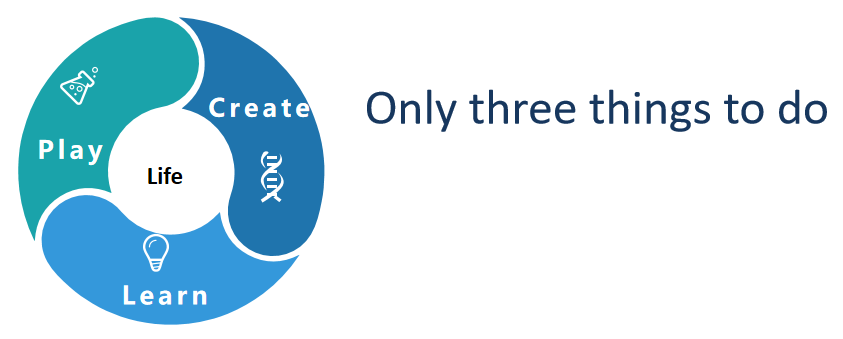
Original Chinese VersionLife activity, life conversation, and living knowledge constitute the three pillars of this new educational paradigm as I understand it. Or, more simply: the PlayGround, Conversation, and Knowledge. Now I will explain each of these three elements
Life Activity
I often say that in a day, or throughout a lifetime, there are only three things to do: Play, Learn, and Create. I also say that Learning, Playing, and Creating are a trinity of life activities—they represent the past, the present, and the future of Life.
Although we say that “Playing, Learning, and Creating” are a trinity, we can still view Learning as a retrospective engagement with the past. In its essence, Learning is about the experiences of the past; it is the act of reflecting upon our past significant experiences.
Similarly, although we say that “Playing” is inseparable from learning and creating, we can still view Playing as being primarily about the present moment—the now. When you are truly playing, you forget about learning; there is no “learning” in your mind. You forget the past, the present, and the future. Time disappears, time becomes eternity, and in that moment, you are simply playing.
Likewise, although “Creating” is the highest form of playing and demands the highest capacity for learning, we can still view Creating as being primarily about imagining future space and predicting the transformations within that space.
Just as the present is embraced by its parents—the past and the future—Playing is embraced by its parents: Learning and Creating. True playing always maintains a close relationship with learning and creating. Playing is the present, the only real existence; without the spark of playing, learning has no life to reflect upon. Therefore, without playing, there truly is no learning.
Therefore, playing is not the problem; the lack of playing is the real problem. True playing is always inseparable from learning and creating. If there is nothing new to learn, then continuing to play loses its joy. Furthermore, playing always contains an element of creation. Naturally, then, playing, learning, and creating are not separate—not in the slightest.
By engaging in the trinity of Playing, Learning, and Creating, learners gain a wealth of first-hand significant experiences. These significant experiences then serve as the very foundation upon which they construct their own knowledge.
This is something that various Self-Directed Education
communities are already doing, and it has reached a significant level of
maturity. Examples include study tours, watching films, reading novels,
writing, playing board games, learning culinary arts and meal preparation,
personal financial management, and urban exploration. There are even
organizations and institutions abroad dedicated specifically to providing these
types of services.
Why have I long dreamed of schools like Sudbury, and why do I hold such a deep conviction in the Sudbury model? I often say: let us stop talking about “education” and talk only about “learning.” Let us first clarify what learning actually is. To do that, we must return to our own learning—looking at everything we have acquired and examining how we actually learned it. The greatest problem with modern educators, including the “experts” in colleges of education, is that they themselves do not learn. They are profoundly lacking in the “Significant Experiences” of learning.
The most vital learning experiences of my life came from playing with a large group of children when I was young. Often, all the children would be playing the same thing together. After a while, something new would emerge, and everyone would shift their focus to that new pursuit. Because every child was unique and came from a different background, our collective play was incredibly rich and diverse. In that environment, I could feel myself learning an immense amount.
In contrast, from the very first day I started school in the first grade, I began to doubt whether this place called “school” was truly meant for learning. I could sense, even then, that I wasn’t actually learning much at all in school.
It is precisely because I carry these fundamental, vital
experiences of learning and growth that I felt an immediate, profound resonance
with Sudbury Valley School. It felt instantly familiar—as if I had found a
place that finally matched the truth of my own life.
Therefore, a large group of people playing together is the
ultimate form of learning. For adults, society itself is the greatest “PlayGround.”
But for children, due to safety concerns, we cannot simply release them into
society to learn. They need a safe environment where they can play freely. This
is why Self-Directed Education communities like Sudbury are so essential.
I use the term “PlayGround” to describe a field of freedom—a place for freely sensing, interacting, choosing, and exploring. This environment can be a physical site or a virtual digital space. The true responsibility of the educator is to architect these PlayGrounds, ensuring they support the trinity of life activities: playing, learning, and creating.
Within a rich PlayGround, there are abundant life activities to engage in, thus completing the two tasks of education, one is life discovery as an input to education, and the other is life expression as an output of education.
We recognize that life is diverse, and every individual begins at a unique starting point. Rather than forcing children into the narrow boxes of modern education—such as standardized extracurricular classes—we must flip the paradigm. The mentor’s role is to observe where a child’s natural interests lie, or better yet, to provide a rich PlayGround where children can discover those interests for themselves. In a truly rich PlayGround, every child will find something that resonates with their soul.
The growth of life is interconnected; it does not exist in isolated categories like the subjects of modern education. When we realize that knowledge is built upon significant experiences, and we observe from that perspective, we see that every life activity encompasses a multitude of experiences. When different children play together, it is a process of these diverse experiences colliding and merging. A mentor, as an educator, should be able to see what is happening at the level of significant experiences, guiding the continuous growth of each child’s life accordingly.
I have encountered many such cases in my practice with youth
programming education. Children who love building and animation often discover
the importance of programming through their play, gradually developing a
genuine interest in the field. Conversely, children who enjoy programming can
also discover that building and animation can cultivate programming thinking
and are a part of programming skills. Given the length of this article, I will
not recount those stories here, though I have shared them in my previous
writings.
An essential task of education is to facilitate this process of “Life Discovery,” which serves as the input of education. Another vital task is to help learners achieve “Life Expression.” This expression can take the form of a “Life Work” or other manifestations, including the act of teaching other learners; this constitutes the output of education. “Life Works” hold a critical position in education: it is through the exceptional Life Works of others that learners absorb the essential elements and nourishment for their own lives.
Life Conversation
Secondly, after gaining significant experiences from these life activities, there must be equal and diverse opportunities to exchange them—what I call “Life Conversation.” Mimsy, one of the founders of Sudbury Valley School, often spoke of the ubiquitous conversations that define the school. This conversation can happen between two learners, among a group (Sudbury even has dedicated discussion rooms), between learners and staff, or even as a dialogue with oneself—for at Sudbury, “being with oneself” or “staring into space” is also recognized as vital learning time. In other SDE communities, Life Conversation manifests as sharing one’s work or giving presentations. These conversations are always egalitarian. For instance, an interaction between two learners is like two gamers talking; even if one is a veteran and the other a novice, they interact as equals. The veteran simply points out where the fun is or demonstrates a few “pro tips,” rather than maintaining the power imbalance of a traditional teacher-student relationship.
Conversation acts as a “developer.” Significant experiences are often vague and subjective at their onset. Through “Life Conversation”—whether by presenting one’s work, engaging in debate, or teaching others—learners are compelled to “verbalize” or “logically structure” these nebulous experiences. It is precisely within this process of conversation that experiences solidify, transforming into communicable and expandable knowledge.
This is, in essence, a
“P2P” (Peer-to-Peer) protocol. Traditional schools follow a
“Client-Server” architecture; if the “Server” (the teacher)
crashes or suffers from insufficient bandwidth, the entire system becomes
paralyzed. In contrast, a Self-Directed Education community is a
“P2P” architecture where every learner is a node. The more frequent
the exchange, the higher the “knowledge bandwidth” of the entire
network. This egalitarian and “decentralized”—or rather,
“multi-centered,” where anyone can become a center—exchange protocol,
together with the content that is exchanged (the significant experiences, the
true raw material for constructing knowledge), is exactly why SDE communities
can generate “true knowledge” more efficiently than traditional
schools.
In China’s Self-Directed Education (SDE) community, I have also noticed that writing and art have been used to help students dig deeper into their personal experiences and have rich conversations around those experiences.
Overall, psychology is playing an increasingly important
role among young people in China, especially among young educators. If we look
at the methodology of psychology, its core is to use various methods to explore
a person’s experiences. Therefore, the writing or art classes in Self-Directed
Education communities may be influenced by psychology.
The same approach is used in parenting in these communities.
Parent education is an important part of these communities. I’ve noticed how
these parents struggle to dig deeper into their own experiences with writing
and how this profoundly changes their old thinking patterns and improves their
understanding and communication with their children. I think it helps a lot in
their professional work as well.
Life Knowledge
The third element is the “Construction of Knowledge” built upon the previous two. Knowledge is alive. Our cognitive growth should be organic; we must construct our knowledge based on our “significant experiences,” allowing knowledge to form its own interconnections.
Because this
knowledge is grown from “significant experiences,” it is
deeply rooted and far more resilient than the “stored information”
found in traditional schooling. It becomes a part of the learner’s identity,
not just something they “know,” but something they “are.”
In many current Self-Directed Education (SDE) communities, there is a certain degree of neglect toward “knowledge.” On one hand, people strongly disagree with the categorized subject-based knowledge structures of the old educational paradigm. Since many are currently focused on “breaking the mold,” “knowledge” is often placed in an adversarial position by innovative educators. On the other hand, the diverse forms of knowledge found in the richness of life remain difficult for many to “grasp” or “handle.” After all, traditional paper-based formats—and even the digital documents that emerged after the rise of software and the internet, which remain limited by the concept of “paper”—struggle to represent knowledge that flows and connects everywhere. The Sudbury model is one that handles knowledge relatively well; almost every wall at Sudbury is a floor-to-ceiling bookshelf, filled with books.
The lack of focus on “knowledge,”
or the inability to effectively express it, is the most common criticism of
Self-Directed Education from those within the old educational paradigm. It is
also a major reason why many parents still find it difficult to
“embrace” SDE.
The old
paradigm uses “standardized testing” as its yardstick. When
Self-Directed Education (SDE) communities fail to provide these easily
quantifiable “report cards,” the outside world assumes that no
knowledge is being produced.
As previously
mentioned, if we lack new media to express “interconnected and flowing
knowledge,” the learner’s growth effectively becomes a “black
box.”
This neglect of “knowledge
construction” is not limited to Self-Directed Education; it exists across
the broader landscape of innovative education, including popular approaches
like “Project-Based Learning” (PBL).
Why does PBL
also fall into the trap of “neglecting knowledge”?
The Trap of ” Doing for the Sake of Doing “: In many PBL cases,
children may be busy with crafts, editing videos, or organizing events. While
things look bustling and vibrant on the surface, the “knowledge
architecture” supporting these actions remains thin. If a project is
merely completed without the “developing process” of transforming
“experience” into “knowledge” in the mind, the learning
remains superficial.
“Fragmentation”:
PBL often revolves around a specific, narrow goal. If the element—”organic
knowledge interconnections”—is missing, the knowledge points acquired are
like scattered pearls without a string to hold them together. Once the project
ends, this knowledge tends to dissipate over time.
Lack of
Conversion for “Significant Experiences”: As mentioned earlier, if
PBL turns into a “prescribed task” assigned by a teacher, it loses
the essence of “Life Discovery.” A project without internal drive is
merely a complex, expensive “large assignment,” rather than a true
“Life Work.”
If we can recognize that knowledge is a
“living entity” rooted in “significant experiences,” this
understanding aligns perfectly with the practice of Self-Directed Education.
Our life activities are dedicated to gaining a wealth of “significant
experiences,” upon which we engage in “Life Conversation.” What
we currently lack are effective “digital formats” to support these
knowledge-based activities within SDE—tools that can construct “visualized
knowledge” based on “significant experiences,” allowing it to be
shared, discussed, and eventually transformed into traditional document
formats.
Beyond supporting offline “Life
Activities” and “Life Conversations” within SDE, the digital
expression of “Life Knowledge” allows Self-Directed Education to
flourish online as well. In this way, outstanding professionals from across the
country—and even the globe—who possess rich learning experiences can become
mentors in their spare time. With the assistance of software, they can
effectively teach or provide “Learning Guidance” based on SDE
principles.
Another benefit of the digital expression of “Life Knowledge” is that it solves the “exit problem” of Self-Directed Education. Because learning becomes visualized, stored online, dynamically constructed in real-time, and capable of being expressed, shared, and interacted with, it offers an “unparalleled advantage” over traditional test scores when employers are hiring. Students in the old educational paradigm simply cannot produce such a wealth of “significant experiences” and “abstract models.” In fact, teachers within the old paradigm often lack their own “significant experiences” and “abstract models” of learning themselves.
Next, I will briefly explain what kind of “living
entity” this “Life Knowledge” actually is.
In today’s age of information explosion, there is a vast ocean of books to read. How do you absorb so much knowledge? Do you plan to read them one by one? You must have a way of exploration—a mechanism for filtering and absorption. To explore is to treat all knowledge as a “complex living system”; learning is “navigating” through it. You must rely heavily on your own sensing and courage to guide this navigation. Your filtering mechanism, to a large extent, depends on your “significant experiences.” Take study tours as an example: I often find that only after visiting a place and gaining “significant experiences” within that physical space do I suddenly find myself able to truly understand the books and films about it. Therefore, after traveling, I usually spend time exploring relevant high-quality books, movies, and even top-rated discussions on platforms like Quora. This is a method for the “rapid growth of knowledge.”
The rapid growth of knowledge
is actually an iterative process:
Cruising: Broadly perceiving and sensing the world.
Anchoring: Generating “significant experiences.”
Absorbing: Engaging in targeted reading, viewing, and interaction (such as exploring top-rated discussions on Quora) fueled by those experiences.
Constructing: Forming your own “Life Knowledge.”
In fact, in my own learning, I place great emphasis on
growing my knowledge around my own “significant experiences.” Many
learning methods can be derived from this approach, though due to space
constraints, I will not elaborate on them here.
“Significant experiences” are the basic units of knowledge; they are the “Life Centers” of knowledge that we have to capture in our learning. The world we face consists mostly of “complex living systems,” such as society or education. How are these systems structured? “Life Centers” form “abstract models,” and these models, in turn, become the “Life Centers” for the next level up. This iterative process continues, constructing the “complex living systems” we see. Therefore, our learning process must be based on abstract modeling on top of our significant experiences, continuously constructing complex living systems and creating our own knowledge.
When we say a “significant
experience” is a “Life Center,” we mean that it possesses
“centripetal force.” It is not an isolated point, but a
“core” that allows other scattered pieces of information—such as
books, conversations, and observations—to coalesce and find their place.
The essence of the “Life
Center”: It creates a “centripetal force” that allows knowledge
to coalesce.
From Passive to Active: In the traditional educational
paradigm, information is “fed” or “poured” into the
student. In this new paradigm, information is “drawn in” by the
centripetal force generated by the “Life Center.”
A Magnetic Field of Meaning: This centripetal force stems from
the authentic needs of a life. Because you have had that “significant
experience,” when you read a certain book or hear a particular
sentence, you experience an instantaneous “resonance”—a feeling
of: “This is exactly the answer I have been searching for.”
a process of “Crystallization”: scattered information
is like the solute in a supersaturated solution. Without a “Crystal
Nucleus” (a “Life Center”), it remains nothing more than a
cloudy liquid. However, once this “Core” exists, knowledge rapidly
crystallizes and grows around it, forming a stable structure. This explains why some people read extensively but still lack
original thought—they lack sufficient “Life Centers” to integrate
those scattered points.
According to Christopher Alexander, a “Life Center” is both objective and subjective. It can guide us away from the path of “human mechanization” caused by modernization, leading us back to our “fundamental humanity.”
Everything we humans can perceive is life, composed of “Life Centers.” Larger “Life Centers” are built from smaller ones. When smaller “Life Centers” establish a larger “Life Center,” we can call this an “Abstract Model.” The various levels formed by many “Life Centers” constitute a “Complex Living System.” Therefore, a “Complex Living System” is a multi-layered structure of “Life Centers.”The Life Centers of a teapotThe “Abstract Model” of teapots is composed of the same “Life Centers.”The “Life Centers” of Notre-Dame de ParisThe “Life Centers” of a tree
If we look around us, we can see that we are surrounded by
“Complex Living Systems” everywhere. In reality, “Complex
Thinking Skills” are entirely about the cognitive ability to engage with
and process these “Complex Living Systems.”
For very “Complex Living Systems,” there are usually a vast number of similar “Life Centers” that recur as “basic units.” For example, in biological organisms, the “basic unit” is the cell.
Knowledge is also a “Complex Living System.” For
knowledge, these “basic units” are what I call “significant
experiences.” Knowledge is an “abstract model” built upon these
“significant experiences.”
We humans share very similar “significant experiences.” These “significant experiences” can be shared, interconnected, and discussed. They are limited in number and are objective in nature. As human beings, although each of us is unique and lives in different cultures, we experience life in the same fundamental way.
When we say we “know” something, it means we have a relevant “abstract model” within our consciousness. For example, a child knows the object in front of them is a “cat” because, after seeing cats multiple times—or as we might say, after cats have appeared and disappeared before them many times—the child has already constructed an “abstract model” of a cat in their consciousness.
The model of a “cat” may be simple, yet there are all kinds of cats. Similarly, the model of a “stool” may be simple, but by adding other elements—other “Life Centers”—to that model, we can create a vast variety of stools. This introduces the concept of a “Minimal Model,” which we can enrich by adding extra “Life Centers.” This has profound implications for both our pedagogical methodology and our approach to handling “Complex Living Systems.”
The “Minimal Model” of a stoolAdding more “Life Centers” to the “minimal model” of a stoolAdding more “Life Centers” to the “minimal model” of a stoolAdding more “Life Centers” to the “minimal model” of a stoolAdding more “Life Centers” to the “minimal model” of a stool
Therefore, “Life Centers” give rise to everything. All the subjects we study in school are essentially about “Life Centers.” In particular, Computer Science is the science of studying “Life Centers.” Thus, Computer Science is, in reality, a “Life Science.” Much could be said about how Computer Science is a “Life Science”; however, for our purposes here, we shall keep it brief.
The same holds true for Biology, Physics, and Mathematics.
This is even more evident in the Humanities, Psychology, Sociology, and
Management. They are all composed of “Life Centers.”
Therefore, Art and Science are unified through “Life Centers” or a “sense of space,” just as the subjective and the objective are unified.
An artistic perception of “Life Centers” exists in everything we do; it is omnipresent in our daily activities. Therefore, no matter what your profession is, everyone is an “artist.”Attributes of the “Life Center”:
Independent, bounded, fully functional, and
possessing strong perceptibility;
Self-explanatory, with a friendly interface that
is easy to interact with or play with;
Larger “Life Centers” are composed of
several smaller “Life Centers”;
Different layers remain relatively independent;
“Life Centers” are equal, mutually
supportive, and serve the whole;
Repetitive or recursive structures within
“Complex Living Systems” (where a “Complex Living System”
can itself be treated as a single “Life Center”).
We can apply these attributes to various fields to help
identify their respective “Life Centers.”
All disciplines are knowledge about “Life
Centers,” and every subject is built upon “Life Centers” or
their combinations—which we call “Abstract Models.”
For example, language learning consists of layered “Life Centers.” When tackling a foreign language, most people pour their energy into memorizing isolated words. In reality, “lexical chunks”—natural, short phrases—are the true “Life Centers” of language; they are where our focus belongs. Above these chunks, the next level of “Life Center” is the “subject-matter context” or “thematic cluster.” When studying a foreign language, one should read several articles on the same topic at once to absorb the recurring phrases within that theme. By immersing yourself in ten or so articles on a single subject, you naturally internalize its core expressions, which translates directly into fluent writing and speaking. If individual words are treated as the “Life Center,” they fail to form the kind of fluid and interconnected center, resulting in a profound sense of fragmentation within language learning.
Mathematics is fundamentally about “Life Centers.” Arithmetic is the act of counting these centers; addition is built upon counting, and subtraction is its inverse. Upon this “Minimal Model,” we construct higher-level mathematical structures, such as exponentiation and logarithms. In fact, nearly all mathematical models in primary and secondary education are layered atop this minimal model.
In software engineering, the two most critical data
structures—”Lists” and “Dictionaries”—are essentially tools
for managing “Life Centers.” Roughly 80% of programming involves
using these two structures to process various “Life Centers.”
If we build our knowledge based on “significant
experiences” and “abstract models,” we will discover that the
richness of knowledge far exceeds the sum of all school subjects or university
majors combined.
The foundation of a “New Educational Theory”
should be capable of serving as the foundation for all other fields of
knowledge. Our current educational theories—such as most modern educational
frameworks—largely consist of simply applying concepts borrowed from other
disciplines. However, shouldn’t educational theory be rooted in the very
concept of “knowledge” itself? And shouldn’t this concept of
“knowledge” also serve as the foundation for all other disciplines? I
believe this is what a new, sound educational theory must possess.
The core of a “New Educational Theory” should serve as the foundational basis for all academic disciplines.
This “New Educational Theory” based on “Life
Centers” is indeed capable of connecting with all other fields; “Life
Centers” can truly serve as the foundational basis for all knowledge.
The preceding discussion focused on knowledge acquisition
across various fields. Today, many innovative educational models emphasize the
mastery of “complex cognitive skills”—such as problem-solving,
diagnostics, design, learning, mentoring, and management—rather than the
acquisition of “specific knowledge.” Therefore, let us now examine
these “complex cognitive skills” through the lens of “Life
Centers.”
Complex cognitive skills are, in essence, the management of complex living systems; their fundamental capacity lies in the identification of “Life Centers.”
If we examine these skills through the lens of “Life
Centers” (or “significant experiences”) and “abstract
models,” we gain a highly systematic and consistent methodology across all
these cognitive skills. This allows us to understand these cognitive abilities
much more effectively as a unified whole.
The ability to perceive and recognize “Life Centers” is the foundational capability. This foundation gives rise to a set of basic higher-level skills, including “Synthesis/Understanding,” “Deconstruction/Analysis,” and the skill of “Expressing Abstract Models” through various media (text, sound, images, etc.). These higher-level basic skills, in turn, serve as the foundation for the “complex cognitive skills” commonly discussed in various professions—such as problem-solving, diagnostics, critical thinking, design, learning, mentoring, and management.
Applying “significant experiences” and “abstract models” to various cognitive skills
Once we discover that knowledge consists of “abstract
models” built upon “significant experiences,” and that learning
is itself a “process of abstract modeling,” a new set of
relationships emerges among the various roles within this new educational
paradigm. This serves as the foundation for a dialogue between
“Self-Directed Education” and traditional education, illuminating how
the familiar relationships of the old paradigm are transformed under the new
one. The specifics are illustrated in the diagram below:
The three elements of the “New Educational
Paradigm” discussed above—”PlayGround,”
“Conversation,” and “Knowledge”—reflect the core of our
existence: we play in “Life Activities,” we learn through “Life
Conversation,” and we create “Life Knowledge.” From a more
macroscopic perspective—one rooted in the understanding of human life—these
three elements represent “Playing,” “Learning,” and
“Creating,” forming a unified, triadic whole of the human life.
In the next section, I will discuss how to master the implementation of “Self-Directed Education” from the educator’s perspective. Put simply, this requires a deep “trust in life” and an “intimacy with life.”
In this series:
Original Chinese Version
Note: This is a lengthy piece; however, anything less than
an exhaustive article would fail to do justice to Christopher Alexander, a true
titan of thought. It serves as a relatively comprehensive exploration of the
“Life Framework” theory—rooted in the concept of “life
center”, a point of intensity that gives a system its vitality and
wholeness and a building block of a “living structure”—and its
significance for self-directed education and the future of learning.
Christopher Alexander (1936-2022)
Christopher Alexander left us last month. Following John
Taylor Gatto in 2018 and Daniel Greenberg in 2021, yet another titan of thought
has departed. This brings me a profound sense of sadness. Some endeavors
require the collective effort of many generations; as the previous generation
passes on, can our generation take up the torch from their hands and continue
to light the path ahead?
School or Factory?
In 2004, I attended a three-hour lecture by John Taylor Gatto in our college town. Gatto’s meticulous, layer-by-layer analysis of the history of modern education spared us from spending countless hours tracing the intricacies of that history on our own. At a time when I felt utterly disillusioned with internet-based education research in both academia and industry, his insights made me feel as though I had finally found an ally. His passionate recommendation of the Sudbury Valley School revealed to me that the school of my dreams had already existed for a long time.
Sudbury Valley School
Daniel Greenberg, the founder of Sudbury Valley School,
through the Sudbury Model he practiced and articulated, has proven the
feasibility and superiority of Self-Directed Education. He demonstrated that
Self-Directed Education is, indeed, suitable for everyone.
The work remaining for us is to figure out how to scale
Self-Directed Education to society at large, rather than leaving it as a rare
opportunity available only to a fortunate few. In addition to continuing to
build more Sudbury Valley schools or similar Self-Directed Education
communities, we must also work on two other levels.
First, we need to propose a theoretical framework for a new educational paradigm—a new theory of education that can articulate the rich practices and methodologies of SDE communities through a simple framework. This will allow us to engage in a meaningful dialogue with traditional modern educational theories and, furthermore, truly establish education as the foundation of all knowledge.
Second, we must achieve a true digital representation of knowledge, properly digitizing the learning process to finally unlock the internet’s full potential for education.
In both of these areas, I have benefited immensely from the
ideas of the architect Christopher Alexander (CA). Rather than dwelling in the
sadness of losing one of history’s greatest thinkers, it is better to continue
the work of sharing and exchanging these ideas.
In his books and lectures, Christopher Alexander repeatedly pointed out that the process of modernization has made us mechanical, distancing us from the experience of life and giving rise to various problems in modern society. He proposed the concept of “life center” (more precisely, CA talks about Center and Degree of Life), suggesting that our recognition of these centers forms the basis of our appreciation for beauty—both in the natural world and in human creations. He explored how we can build beautiful, living architecture through our perception of these life centers.
I have extended the concept of the “life center” to all domains of human experience, including our understanding of human knowledge, because all experiences are experiences of life. I believe Christopher Alexander would have agreed with this approach—in fact, I believe it was his original intent.
Therefore, based on the concept of “life” or “life centers,”
we have constructed an understanding of a new educational paradigm and a new
theoretical framework for education.
Traditional education is a linear, step-by-step form of “learning.” However, true learning—much like life itself—should be interactive and iterative. To transform linear education into an interactive process, we need centers that facilitate interaction. “Life centers” are precisely these centers.
So, what does this new educational paradigm encompass?
First, playing/learning/creating, a trinity of life activities that allow learners to gain significant experiences from rich life activities.
Second, ubiquitous and equal life conversation based on these significant experiences.
Third, creating our own living knowledge based on these significant experiences. Knowledge is alive, organic, and must be centered around significant experiences.
Looking at the current state of Self-Directed Education globally, the first two points—life activities and life conservation—are performing well; they are relatively mature and have even achieved a certain degree of scale. However, there is a significant void regarding the third point: “living knowledge.” This includes even the popular Project-Based Learning (PBL) found in many innovative education models. The focus remains largely on dismantling the old system; because traditional schooling is seen as the root of the problem with “knowledge learning,” many innovative educators have developed a subconscious tendency to reject “knowledge” altogether.
In reality, if we recognize that knowledge is living—an
organic structure rooted in significant experiences—then this living knowledge
becomes completely integrated with SDE practices. It is precisely what we want
learners to strive toward through Self-Directed Education. The lack of this
component in current innovative education creates a barrier to meaningful
dialogue with traditional paradigms. Critics of innovation argue that these
models produce no visible outcomes, unlike the grades, degrees, and
certificates of subject-based testing. This makes it difficult for parents to
fully embrace Self-Directed Education.
How to turn the living knowledge that is in our brain into something that is visible to everyone? The conventional paper based knowledge format isn’t sufficient. This is precisely where we need software. By making the living knowledge visible, software makes the self-directed learning visible. Only software that correctly digitizes knowledge can truly harness the potential of the internet and scale Self-Directed Education to society at large.
Life activity, life conversation, and living knowledge constitute the three pillars of this new educational paradigm as I understand it. Or, more simply: the PlayGround, Conversation, and Knowledge. In the following articles of this series, I will explain each of these three elements and discuss how staying close to the nature of Life helps us better design and build local Self-Directed Education environments from a practical implementation perspective.
As we reach the one-year anniversary of the founding of PlayGround Education, it is the perfect time to reflect on our progress and share our vision. Traditionally, the landscape of Self-Directed and innovative education in China has been characterized by the exclusion of parents—a significant departure from Western democratic models where parents are seen as vital stakeholders. PlayGround takes a different approach. We view parents as essential partners, fully integrating them into the reform process to learn and practice alongside us. Crucially, our model is designed to ensure that a child’s right to self-directed learning is protected from interference by both educators and parents alike.
The Practical Dilemmas of Domestic Education
The Chinese educational landscape is defined by an unparalleled level of academic pressure, largely driven by a rigorous exam-oriented system. This environment has contributed to a surge in “school-aversion” among students, with youth depression rates reaching alarming, unprecedented levels.
However, the domestic landscape for Self-Directed and innovative education is currently hindered by a high barrier to entry. Prohibitive costs have effectively restricted access to a small demographic: either high-income families or those whose children face severe psychological challenges and require urgent intervention.
Even more significant is the systemic exclusion of parents from the management and operations of most Self-Directed Education (SDE) institutions. While a few high-quality SDE communities do offer parent-focused programs, their fees are often equally prohibitive.
Compounding the issue of cost is a systemic lack of transparency that allows commercial interests to overshadow educational integrity. When institutional practice drifts away from its founding vision, the disconnect becomes irreparable. Even the most dedicated parents and educators, initially drawn by the promise of change, are often left to navigate the wreckage of their own shattered expectations.
PlayGround Beijing
The Unique Advantages of Chinese Innovative Education
Despite the numerous challenges, China possesses a unique advantage in the field of innovative education: a population density that far exceeds the West. In major urban centers, this has created a highly concentrated demographic of high-caliber professionals—a concentrated force capable of driving real change.
In cities across the nation, a unique phenomenon is taking shape. We see a rising number of students needing a different way to learn, met by a generation of parents who are not just observers, but experts in their own right. These parents are leveraging their professional backgrounds to pioneer new educational frontiers. For many at PlayGround Education, their journey began with this same spirit of independent inquiry—turning their personal search for a better education into a collaborative movement.
Disseminating Self-Directed Education shouldn’t happen in a vacuum. It requires deep engagement and shared growth with families. Translating complex educational theories into clear, actionable insights for parents is more than just a goal—it is the only viable path forward for the SDE movement.
Long-time followers of this account know that “Open Source Learning” has always championed professional engagement in education. Our core premise is that the educators of the future should be experts from diverse industries who contribute their real-world experience without leaving their careers. By dedicating their spare time to educational practice, they become the mentors best suited to modern student needs. Today, the intense pressure of the exam-oriented system, combined with a growing public consciousness and the high density of urban talent, has created the perfect conditions to turn this vision into reality.
PlayGround Shenzhen
PlayGround Education: Pioneering the Co-constructed Learning Ecosystem
In light of the unique dilemmas and advantages within the Chinese educational landscape, we believe that domestic Self-Directed Education must strategically play to its strengths. Rather than isolating parents behind institutional walls, the movement should empower them to grow alongside their children. By integrating parents into the governance of these organizations, we can leverage their oversight to safeguard a non-profit mission, ensuring that the institution remains truly responsive to the needs of the child.
This principle forms the foundation of PlayGround Education’s core model: Parent Co-construction. We invite parents who align with our philosophy to engage with the community in a way that fits their lives. Participation is designed to be flexible—ranging from full-time, campus-based involvement to contributing during weekends or leisure hours.
PlayGround Shenzhen
Deep alignment with educational philosophies is not achieved overnight; it is the result of sustained dialogue and shared experience. To facilitate this, PlayGround Education maintains a free, open WeChat community as a primary platform for parent engagement and mutual learning. Many families are initially drawn by the “PlayGround” vision, but it is through daily discussion and collective inspiration that these concepts are put into practice. This commitment to free parent education is a strategic priority for us. By investing significant energy into this open dialogue, we ensure that parents are partners rather than obstacles—bridging the gap between theory and home life to ensure the successful implementation of Self-Directed Education.
It is important to note that the caliber of discourse within the PlayGround community is exceptional, particularly when contrasted with the broader landscape of domestic educational groups. Having participated in numerous online forums, I have found that many are either saturated with marketing or lack meaningful substance. Often, high-level exchanges are hidden behind a paywall. In contrast, PlayGround fosters a space for genuine, rigorous dialogue. Below, I have compiled a summary of our recent high-quality discussions for your reference
Strategy over Struggle: Why Choice Outweighs Effort and Credentials
Knowledge is Power, but Source Knowledge is More Powerful—Revisiting “Systematized” Knowledge
Why Do Children Today Grow Up Slowly and Mature Late? Children Who Are Managed Too Much Are Generally Late Bloomers
AI Makes Active Learners “Super Learners,” while Passive Learners Are at a Loss—The Shock Brought by ChatGPT o3
Do Not Use Grades to Help Children Build Confidence; Only Blind Confidence is True Confidence
How I Went from a Sports Underachiever to a Fitness Expert: How to Clear Out “Physical Education Class Thinking”
PlayGround Huizhou
In cities throughout China, a major challenge for families is finding consistent playmates and spaces where children can play freely. PlayGround Education addresses this directly by making free play a core value. We offer flexible visits so families can see our model in action without a full-time commitment. We understand that walking away from traditional schooling is a significant leap that many aren’t ready to take all at once. Unlike other SDE centers that require full-time enrollment, PlayGround provides a valuable “third space” for children to enjoy self-directed learning during their weekends and scattered daily hours.
PlayGround Shenzhen
Families who have frequently engaged with PlayGround and feel a deep alignment with both our philosophy and practice—and who are ready for a more significant commitment—can transition into the resident contract stage.
While inspired by the American Sudbury model, PlayGround Education introduces two distinct adaptations. First, we have significantly strengthened parent participation; while Sudbury’s Assembly allows for parent involvement, PlayGround integrates parents more deeply into the operational fabric. Second, we offer a flexible participation mechanism with no mandatory residency, allowing families to engage on weekends or a part-time basis. This flexibility is essential for meeting the current needs of Chinese families. Once a family enters the resident contract stage, the core pillars of the Sudbury model—including the School Meeting, Judicial Committee, and School Manual—are fully implemented. For instance, our “PlayGround Consensus” protects children’s autonomy from parental interference, while our School Manual is co-authored by the parents themselves. In the spirit of Sudbury, these frameworks remain open-source, embodying our commitment to “Open Source Education”.
Accordingly, parent engagement at PlayGround Education is structured as a three-stage progression: beginning with entry via our online community, moving to weekend field experiences, and culminating in resident contract co-construction. This tiered design reflects our unwavering commitment and the strategic patience required to advance Self-Directed Education alongside parents. It is a journey of mutual growth, designed to build the trust and alignment necessary for true educational reform.
PlayGround Shenzhen
The PlayGround Education Solution: An Self-Directed Education Path Adapted to the Chinese Scene
We believe the PlayGround Education Parent Co-construction model offers a premier Self-Directed Education solution, specifically tailored to the unique dynamics of the Chinese landscape. Its core advantages are defined by three key dimensions:
First, the model features a low barrier to entry. Financial operations are fully transparent, with a publicized cost structure and affordable fees designed to welcome any family that aligns with our mission. This alignment is rooted in a comprehensive cognitive system that bridges theory and practice—a reflection of our core belief that “Knowledge is an Organic Living Being.” Consequently, the only true “threshold” for participation is a deep resonance with the PlayGround philosophy. This is not a static requirement but a dynamic learning process; as parents participate and grow, their collective insights contribute to the benign, ongoing evolution of the PlayGround knowledge system itself.
Second, the model integrates parents into a system of diverse oversight and protection. Due to its co-constructive nature, financial transparency is a structural necessity. Parents and youth participate as equals in the community’s operation and management, creating a self-regulating mechanism of checks and balances. This prevents any single party from exerting undue influence, effectively safeguarding the rights of minors to pursue self-directed learning without improper interference from adults.
Third, the model establishes a robust platform for practical learning. For China’s highly skilled and passionate professional demographic, PlayGround offers a clear trajectory—a “learning path” that moves from theoretical inquiry to real-world implementation. As participants deepen their involvement, the platform evolves from a space for observation into a venue for co-creation. Here, learning, play, and creation are seamlessly integrated, allowing parents to contribute their professional expertise to a dynamic, open-source educational ecosystem.
PlayGround Shenzhen
From Practice to Philosophy: An Iterative Process of Dynamic Modeling
At the heart of the Sudbury philosophy lies the conviction that “participating in the construction of the community is the ultimate form of learning.” PlayGround Education brings this claim to life by ensuring that both parents and children participate as equal agents in the building and evolution of our ecosystem.
The philosophy of PlayGround Education is deeply rooted in the core tenets of the Sudbury model. Our shared knowledge base—a consensus system regarding our educational approach—is detailed in the following articles:
Education is Building a Better PlayGround!
Sudbury is an Education Based on PlayGround
Play, Learn, Create
Knowledge is an Organic Living Being
Flipped Education: General Introduction
We Progress, But We Are More Self-Directed (Theory Edition)
How Do Children Play in the PlayGround? Playing is the Most Serious Learning
Why Do Children Today Grow Up Slowly and Mature Late? Children Who Are Managed Too Much Are Generally Late Bloomers
PlayGround Shenzhen
The parent co-construction model described above was pioneered and developed by Wu Jia and Yan Zi. Our partnership began with a series of deep philosophical dialogues in Yangshuo and Dali, where we discovered a profound alignment in our educational visions. As highly skilled professionals and experienced entrepreneurs with a deep passion for education, Wu Jia and Yan Zi bring a unique expertise to this project. What is most remarkable, however, is the synergy of their personal growth and their capacity for “playful cooperation“—a form of collaborative symbiosis essential to Self-Directed Education. Their rapport inevitably mirrors the deep intellectual and personal partnership of Sudbury founders Daniel and Hanna Greenberg.
Yan Zi once shared a resonance she feels with Wu Jia: they often reach a stage where they experience a breakthrough in growth, as if pushing open the doors to a world they had never set foot in before. With each threshold crossed, their self-knowledge deepens. Yet, soon after, they discover an even broader horizon and a deeper space for growth; this process of exploration and advancement is a perpetual, repeating cycle.
It was precisely this commitment to self-directed learning and collaborative growth that gave me such early confidence in their vision for PlayGround Education. Through our subsequent partnership, I discovered that both Wu Jia and Yan Zi also possess an extensive background in free play—a vital practical foundation for our model. Interestingly, I have observed a similar pattern among the founding couples of the Shenzhen and Huizhou PlayGrounds.
There is no prefabricated blueprint for implementing PlayGround Education; it depends entirely on hands-on, practical exploration. For this reason, following our initial strategic alignment, I have intentionally stepped back from the day-to-day construction over the past year. By placing full trust in Wu Jia and Yan Zi’s capacity to explore and design, I allowed the model to emerge organically from their local practice rather than imposing a top-down solution.
Wu Jia and Yan Zi have dedicated immense energy to this vision, attracting hundreds of families to the PlayGround community and organizing weekly offline play sessions across Beijing. This momentum allowed them to transition from mobile venues to a permanent, dedicated space. Crucially, this was a collective endeavor; many other parents stepped forward to play vital roles in the model’s implementation. This open, co-constructive process perfectly mirrors the founding of the Sudbury Valley School, as documented in Starting a Sudbury School. I am deeply gratified to see this model flourish in China, proving that our professional parent demographic can and should be the backbone of educational innovation. The “Beijing Template” now serves as a blueprint for new PlayGrounds in cities like Shenzhen, offering a proven path for local parent-led initiatives.
PlayGround Beijing
In the early stages, Wu Jia and Yan Zi worked diligently to cultivate the community, fostering a high-quality environment for dialogue. Today, the PlayGround WeChat group has achieved autonomous operation; even without direct oversight, parents spontaneously initiate deep educational discussions. This vibrant local hub has since catalyzed the growth of PlayGround communities in Shenzhen and beyond, evolving into a nationwide network of philosophically aligned communities.
To date, PlayGround Education has successfully launched in multiple locations, including Beijing, Shenzhen, and Huizhou—all of which I have personally visited. The initiators of these three branches share a common heritage: extensive experience in free play and a long-time practice of self-directed learning. This background is not only the source of their alignment with our philosophy but also their primary advantage in practicing SDE. Furthermore, new PlayGround initiatives are currently emerging in Shanghai, Wuhan, and other cities. While I have yet to visit these sites in person, I look forward to exploring their progress as they develop
The various PlayGround locations maintain a decentralized, collaborative relationship. Each local team organizes activities autonomously, rooted in their own interpretation of the PlayGround philosophy. Despite this independence, the communities remain unified by a shared vision; their dialogues often intertwine, creating a vibrant exchange of information and collective insight across the entire network.
Specifically, the facilities at the Beijing and Huizhou PlayGrounds are ideally suited for the “Original Sudbury” model—a framework that adheres to the core principles of the American Sudbury model while remaining accessible to non-resident families. Those interested in exploring the Original Sudbury approach are encouraged to contact Yan Zi at Beijing PlayGround or Zhong Xun at Huizhou PlayGround (contact details are provided at the end of this article).
PlayGround Education’s philosophy is built upon the real-world experiences and modeling of those actually doing the work. In this ecosystem, we are all creators of knowledge. Through open exchange, we offer our insights to the global community, inviting other educators to test, challenge, and validate our practices in their own unique contexts.
PlayGround Huizhou
A Sincere Invitation: Co-constructing the Future Educational Ecosystem
I have always maintained that Self-Directed Education is essentially the application of high-level organizational and management principles to the field of learning. I believe that the active involvement of a vast number of highly skilled professionals will become the new standard for the future of human education.
The heart of PlayGround Education lies in responsive planning—the ability of educators to dynamically design the “playground” based on what learners actually need. The parent co-construction model pioneered by Wu Jia and Yan Zi is a perfect example of this: it is a strategic response to the educational demands of modern Chinese families. Put simply, these two seasoned entrepreneurs are empowering the field of innovative education by applying their design capabilities and professional experience. Furthermore, their personal commitment to supporting their own children’s self-education serves as a powerful inspiration for parents nationwide.
We invite more families and professionals to join the PlayGround Education movement, particularly those who can offer venue support across our growing network. In major metropolises like Beijing and Shenzhen, a single location is merely a starting point; the ultimate goal is for every district to host its own PlayGround. We envision a future where every family has access to a dedicated space for free play within their own local community.
At this stage, the practice of PlayGround Education in China remains a journey of continuous exploration. We sincerely invite parents and professionals to join us in this mission—to explore together, to grow together, and to co-create spaces where children can thrive through free play and equal participation.
I have always firmly believed that education is the most profound path for exploring the self and the nature of existence—often surpassing traditional spiritual practices in its depth. Therefore, I invite parents and professionals to join us, not just to build a school, but to achieve personal growth and uncover the truths of life through the active exploration of education.
PlayGround Beijing
Note: The following is a draft proposal for the Self-Directed Education (SDE) Forum in China. If you are interested in sponsorship opportunities, please contact us for further details.
Dear ______:
Dates and location of the forum planned…
The main goal of this Self-Directed Education (SDE) Forum is to organize and deepen the understanding of Self-Directed Education based on existing, rich practices. It aims to guide further practice and encourage more people to join the movement for educational change.
Below are key modules of Self-Directed Education in theory and practice, initially outlined by the forum’s preparation team. We hope that educators from across the country will come together to share their practical experiences, reflect and communicate with each other, and explore through Self-Directed Education to develop a better understanding and actionable direction for both Self-Directed Education and human education as a whole.
Self-Directed Education Theory
Self-Directed Learning
Proposed discussion time: day 1 (Morning)
First and foremost, learning is an inherent ability in all living beings. Can children learn everything they need through free play? What exactly needs to be learned? And how can educators help children in their learning? Many domestic Self-Directed Education communities may offer answers to these questions.
Self-Assessment
Proposed discussion time: Saturday, day 1 (Afternoon)
Intrinsic motivation is the most important factor in learning, not external evaluations. Self-assessment is the most fundamental and essential evaluation for learners. Why is self-assessment so important? Is external evaluation still necessary? Can learners who grew up in Self-Directed Education communities adapt to a society filled with external assessments?
Boundaries of Rights and Responsibilities, Community Building, and Protection Mechanisms
Proposed discussion time: day 1 (Afternoon)
Compared to other industries, most educators in traditional education lack the necessary professional qualities and management experience, especially in understanding rights and responsibilities. However, Self-Directed Education must fully respect the rights minors have in both learning and community management. If educators themselves lack awareness and practical experience in these areas, they cannot serve as role models in community building, nor help minors navigate rights and responsibilities or become independent, collaborative individuals. This may instead lead to confusion and boundary issues for minors. Therefore, understanding and practicing the boundaries of rights and responsibilities is a core element of Self-Directed Education.
The Sudbury model takes this further by granting both minors and adults equal community management rights, ensuring that minors’ learning rights are not interfered with by adults. The Sudbury Valley School(SVS)’s 57 years of educational practice have proven not only that children have the ability to self-direct their learning, but also that they have the capacity to participate in community management and development. They actively contribute to building and maintaining protective mechanisms (of children’s rights), gaining valuable learning and growth in the process.
Life Education
Proposed discussion time: day 1 (Afternoon)
At its core, education is life education. Education is a complex life system. We must return to the level of life to understand all aspects of education in a new light. Only when we return to life, play, and love, can we experience true flexibility and richness in education.
What is Knowledge?
Proposed discussion time: day 1 (Evening)
Innovative education is a reflection and breakthrough of modern, compulsory education, but different educational practices treat the place of knowledge in learning in various ways. Some advocate abandoning the concept of knowledge entirely in favor of cultivating skills, while others still categorize knowledge within traditional educational systems without recognizing that knowledge is something each individual creates based on their own experiences. Do we still need to learn knowledge? What commonalities exist across different fields of knowledge? How can we bridge the gap between knowledge and skills? How do we learn and master the vast body of human knowledge? Can we cultivate a modern-day Da Vinci? And how do we confront the challenges posed by artificial intelligence?
Self-Directed Education Practice
The educational philosophy and relevant modules outlined above form the foundation. In practice, Self-Directed Education is equally comprehensive.
Full-Time Learning Communities for Minors
Proposed discussion time: day 2 (Morning)
Full-time learning communities provide children with a safe environment where they can freely play and participate in community building with adults. This is an important aspect of Self-Directed Education practice.
Family Education
Proposed discussion time: day 2 (Morning)
Before Self-Directed Education becomes mainstream, most minors are still educated in traditional, compulsory environments. Therefore, non-full-time family education aimed at minors can reach a wider group of children, allowing many families to experience Self-Directed Education. This is essential for the development of Self-Directed Education.
By practicing Self-Directed Education in areas like reading, writing, English, programming, and sports—fields that families are more likely to accept—children are given the freedom to learn in self-directed ways, while parents actively participate and experience Self-Directed Education beyond just books and verbal teaching. This is an important step forward in family-based Self-Directed Education.
We, as Self-Directed Educators, encounter many children and families in need of support. Many great mothers and fathers, especially mothers, are ready to give everything for their children at any opportunity. They deeply need the support of Self-Directed Educators!
Family education is the first environment each person encounters and has a lifelong impact. How can we best implement family education? Let’s explore this together.
Self-Directed Education for Adults
Proposed discussion time: day 2 (Morning)
We know that barriers to children’s education often come from adults, who block children’s autonomy in learning and strip them of their right to learn. Therefore, understanding how adults view learning and education is critical to changing the educational landscape. Many educational practices aimed at adults, such as Slow School, help adults reawaken their understanding of learning through socialized learning, both online and offline. Only by re-understanding learning can true educational transformation occur.
Slow School, in particular, emphasizes creating personal knowledge through awareness of life, bridging the gap between life awareness and knowledge acquisition. Through online and offline community building, it serves as one example of Self-Directed Education for adults and has significant impact for transforming adult perceptions of learning and education.
Self-Directed Education in Traditional Schools
Proposed discussion time: day 2 (Afternoon)
Self-Directed Education is life education, and it exists wherever life exists. Even in the most barren places, as long as there is a little soil, life can sprout. Even under heavy stones, if there is a small gap, life can grow. Traditional schools are also places where Self-Directed Education can be practiced. How can we practice Self-Directed Education to its fullest within the current compulsory educational system?
Even in traditional schools, most people have encountered one or more exceptional teachers who teach with passion and commitment. Among those entering the education industry for profit, there are companies with a long-term vision, striving for true educational value and working towards the future of education. These forces are trying to loosen the rigid educational system, remove obstacles, and give life some room to breathe, minimizing the harm caused by compulsory education.
Self-Directed Education in Corporate Management
Proposed discussion time: day 2 (Afternoon)
In the future, every company must become a learning organization, with learning ability being its greatest competitive advantage. Self-Directed Education will redefine corporate management and become its core. A strong team is made up of strong individuals, and these teams will continually create new life, solve social problems, and serve the real needs of society.
Post-Forum Immediate Review
All speakers and VIPs will participate. Proposed discussion time: day 2 (Afternoon)
Above is an initial overview of Self-Directed Education as outlined by the forum preparation team. We hope that the first National Self-Directed Education Forum will bring together efforts from all directions—both theory and practice—forming a collective understanding and sharing it with the public. This will help guide society, including a wide range of educational innovators and families, to push forward in these directions and lead humanity toward the future of education!
Education is first and foremost a public service, and those involved in education should have a strong sense of public responsibility. We hope that education change makers will remain open-minded, actively share and collaborate on their educational discoveries and designs. Through “Open Source Education,” our local explorations can become replicable educational models for others. Together, we create a “PlayGround” for Self-Directed Education. We are all part of a larger organization—a true “teal organization.” How we collaborate openly will determine whether we can bring about large-scale educational change and make Self-Directed Education the future of learning. What we aim to flip is not just the classroom, but the entire educational system! Let’s work together!
Based on this understanding and your outstanding work in the field of Self-Directed Education, we sincerely invite you to participate in this forum and look forward to exchanging ideas with you!
Please note, this forum will also be a grand experience of Self-Directed Education, with numerous self-learning activities and designs integrated into the entire forum.
Original Article
I have introduced the Sudbury Judicial System before (see the description of the “Judicial Committee” in the article Experience Sudbury). For most educators, the Sudbury Judicial System is a very unique existence, inextricably tied to the Sudbury model.
In fact, the Sudbury Judicial System should be suitable for all schools. I do not know if setting up a Sudbury Judicial System in conventional schools would present special difficulties (on second thought, it seems feasible; after all, don’t many conventional schools host Model United Nations conferences?). However, it is certainly feasible in innovative schools. The key is for everyone to realize that the Sudbury Judicial System is not unique to Sudbury; rather, it should be a universally available and excellent mechanism for resolving child conflicts, and this mechanism carries very important and extensive educational significance.
As a conflict resolution mechanism, the Sudbury Judicial System is completely applicable to all innovative schools. Therefore, this article hopes to recommend this model of resolving student conflicts to all innovative educational organizations.
The traditional way most schools resolve conflicts between children relies on the intervention of adults. The adult acts as an arbitrator, striving to clarify the facts, determining who is at fault, and attempting to provide educational persuasion—using the opportunity to help children understand certain principles. It should be said that the conflict resolution mechanisms of most schools generally fall within this scope.
Problems
Child Dependency on Adults: Because of this approach, children naturally view adults as the authority. When listening to an adult’s reasoning, they have no choice but to comply, even if they disagree. Furthermore, everyone develops a mindset of “pleasing authority” because doing so is likely to be personally beneficial. Consequently, such a mechanism naturally forms a dependency on adults. In this closed state of mind, the child’s own perception system is not open, and the teacher’s well-intentioned educational persuasion is mostly ignored.
High Burden on Adults: Adults are also very exhausted in this process. If they are responsible, they need to figure out the sequence of events, judge right from wrong, and perform the work of persuasive education.
Loss of Opportunity for Self-Education: As a good educator, I believe one of the principles is that as long as students can do something, we should let them do it themselves as much as possible. Only in this way can students receive more comprehensive development.
The Feasibility of the Sudbury Judicial System as a Universal Mechanism
Do students have the ability to achieve this? The half-century practice of the Sudbury Judicial System has proven that minors can do it. Of course, in the beginning, the role of the judge can be held by an adult to establish the procedures for complaints and hearings—including the fact-finding stage, the stage of determining if a school rule was violated, and the final stage of determining the punishment. ( Contrary to prevailing assumptions, I believe children—provided they are able to express themselves clearly—often exercise better judgment than most adults. )
Once the system is mature, older students in the school can volunteer for the position of judge. (Consider having three judicial positions so that when some students are absent, others can serve; or through rotation, everyone gets an opportunity to practice. At the same time, the three people act as a learning group, continuously improving their abilities by reviewing each “case”). When one person acts as the judge, the other two can take on the roles of clerk and investigator (such as going to the scene to collect evidence). Each stage requires a vote by the three members. However, at least one adult must be present at every “hearing.” The adult acts as a mentor and basically remains silent during the trial, only helping the judges learn and improve during the post-trial review.
Advantages Over Traditional Mechanisms
A Guarantee of Fairness and Justice: This type of trial process—from complaint to hearing—is public. Complaints are posted, and anyone can voluntarily observe. In this way, all children will recognize this as a fair and just process, rather than feeling that their fate depends on the judgment of a single teacher—who might handle things hastily because they are too busy that day or in a bad mood. After all, handling such matters may not be within their regular work plan, and spending too much time on them can be a thankless task.
Reducing Teacher Workload and Formalizing Conflict Resolution: The establishment of the Sudbury Judicial System model makes it a legitimate part of the school’s work. The teacher serving as a mentor naturally has the mental energy to invest in it. Moreover, the teacher is freed from the role of arbitrator and only ensures there are no issues with the process. Teachers no longer need to spontaneously think about what was improper in a child’s behavior or how to conduct persuasive education. Everything only requires the students to judge according to the school rules; transparent and open rules naturally become a “Common Covenant” shared by all.
Universal Educational Opportunity: Because the entire judicial process is public and the final results are posted, everyone undergoes an educational process regarding the school rules. It is not just the individuals involved receiving education in a teacher’s office. The Sudbury Judicial System makes every complaint an opportunity to educate everyone. Only then will the concepts behind the school rules have educational significance and truly become a code that the community follows consciously.
Developing Logical Thinking and Expression in Complex Systems: The trial process itself is a very important educational journey. Moving from fact-finding to identifying the violated rule and finally to determining the punishment is an exercise in logical thinking and expression. Therefore, judges are generally older students who have participated (as observers) in many trials and are interested in public affairs. This process is very rigorous and mirrors the normal operating mechanisms of society outside the school walls. Even adults who lack practice may not possess good logical thinking or expression skills. However, if a school has a judicial mechanism, minors can master these skills through a period of practice. Thus, this is a vital educational process.
Final Thoughts
The Sudbury Judicial System carries universal and important educational significance; its use is not limited to “Sudbury-style” schools—all innovative schools can adopt it. The form of the Sudbury Judicial System is simple and easy to operate; doing this well already provides immense educational value. Conflicts among students in schools are generally simple and not overly complex, unlike many cases in society. Therefore, there is no need to introduce overly complex systems like defense attorneys or juries. This is why Sudbury, founded over 50 years ago, has kept its judicial model in this very simple form. For innovative education in China, it is important to first do the simple things well and fully digest their educational meaning.
If innovative schools are interested in trying the Sudbury Judicial System as a conflict resolution mechanism and need assistance with operations, they can contact Open Source Learning.
Image Source: Sudbury Official Website
Original articleAll images in this article are from the official Sudbury Valley School website.
This article introduces Self-Directed Education (SDE) and the Sudbury model. While this account has published introductory articles before, explaining these concepts is never easy because there are so many educational ideas to untangle. I will start from a vital point that is easy for everyone to grasp; through this, you should quickly understand what SDE and the Sudbury model are all about.
I believe it has become a consensus that inner drive (intrinsic motivation) is the most important factor in learning. Innovative educational organizations emphasize this in their promotional materials. I recently heard a Waldorf principal emphasize the importance of a child’s inner drive, and even the traditional state system in China is beginning to highlight it.
While every educational organization might agree that “inner drive is paramount,” the real distinction between models appears when we ask two follow-up questions: “Which behaviors destroy a child’s inner drive?” and “How do we truly protect and guarantee that inner drive?”
Which Behaviors Destroy Inner Drive?
To answer the first question, I will start with a somewhat absolute statement: “All teaching is harmful.” How do I explain this? Perhaps I can use the study of Buddhism as an example. Learning Buddhism is a lifelong pursuit. For many, after decades of study into their eighties, they may only have a sliver of realization. Indeed, with the Buddha’s teachings, countless scriptures, and commentaries by later teachers, learning “should” be easy. Yet, perhaps because there is so much material and instruction, true learning becomes difficult. I often ask myself: if these books didn’t exist, and I had to discover and think for myself, could I find the fundamental contradictions in my own logical system? How would I explore and resolve them? This kind of thinking allows one to exercise their awareness at a deeper level to learn better.
When I read, I usually stop once I grasp a significant framework. I prefer to think through things within my own practice, filling in the framework with my own vital experiences to construct my own abstract knowledge model. Only after I have built my own model do I return to the books to see how others’ models differ.
The most important part of inner drive is this capacity for perception or awareness. Awareness is an omnipresent, constant ability—the so-called “Seeing”. We talk about educational equality because, fundamentally, everyone’s capacity for awareness is equal and constant. I divide this into two parts: Perception (sensing the core of life or vital experiences) and Creation (combining those experiences to build abstract models so that we may “see”). This awareness is inherent in life.
The foundation of Self-Directed Education is an absolute belief in this capacity for awareness—a belief in life itself. It is not a 50% or 90% belief; it is absolute. The Sudbury model, as the complete form of SDE, is the most protective form of SDE, guaranteeing this protection through its institutional structure.
If we ask “Which behaviors destroy inner drive?”, it is equivalent to asking: “Which behaviors destroy a child’s capacity for perception?” This includes perception of the self and the environment. Let’s look at the perception of “learning needs.”
Classes
Sudbury has no curriculum. There are no grade-level subjects set by authorities, nor are there teacher-led “themed” courses. Only when a student feels they want to learn something and wants a knowledgeable adult to teach them can they “request a class.” The frequency and duration are determined by the student’s needs. Once the need is met, the class ends immediately; there is no rigid requirement to span a full semester.
However, during my 2016 visit to Sudbury, I found that even these requested classes had nearly vanished. I asked a staff member (Sudbury has no “teachers”) about this. She noted that because of the internet, students now find resources themselves. They might talk to an adult when they have a specific question, but they no longer request formal “classes” as they did in the early years.
“Bravo!” I thought. The Sudbury model naturally adjusted to the internet age. In other models, it might take years for authorities to recognize the shift and slowly adapt.
Many other self-directed education organizations have teachers and students work together at the beginning of each semester to design a curriculum based on the students’ learning needs. Students can then freely choose from these courses. In even more SDE oriented organizations, students are allowed to not choose any of these courses at all, and instead study whatever they wish. Compared to traditional state-system education or many other forms of innovative education (which still contain strong compulsory elements), these methods are undoubtedly far more self-directed. For students living in a broader social environment dominated by compulsory education, being in such a setting already represents a tremendous liberation.
However, the cross-semester nature of these courses is inherently rigid. They do not align well with the shifting learning needs of students and can easily foster a mistaken subconscious belief—that only this kind of relatively “formal” study counts as real learning.
Sudbury has no such cross-semester courses. Yet, when reading interviews or memoirs of Sudbury graduates, one can sense that they possess a powerful ability to explore their lives at a very fundamental level. As I mentioned earlier: if the classics did not exist, how would you explore those questions yourself? This model forces you to perceive and think from the very bedrock of your existence.
Therefore, in terms of protecting a child’s inner drive, the Sudbury model could be called the most “conservative” among various self-directed education models. Of course, one could also say the Sudbury model is the most “radical,” because proposing such a model in the current educational climate is undeniably an act of extreme radicalism. When we later discuss the institutional guarantees Sudbury provides for a child’s inner drive, this “radicalism” will become even more apparent.
Everyone’s way of perceiving is different, and the perceptual ability in specific areas follows a developmental process, but the awareness of life itself is constant and unchanging.
External Assessment
Assessment is a theme frequently encountered in education. So, what kind of damage does external assessment do to a child’s inner drive?
The examinations in conventional schools are, naturally, a very rigid form of external assessment. However, even the so-called “diverse assessments” found in various innovative educational models are something Sudbury strives to avoid. Sudbury believes that everyone is capable of self-assessment, and it is self-assessment that truly matters. The founders of Sudbury go to great lengths to prevent any adult assessment from exerting an external influence on a child’s learning. Sudbury’s extreme persistence in this regard was so absolute that for many years, the school had no graduation ceremonies or graduation defenses. It was only at the request of many students—who felt the need for the sense of ritual marking their transition into adulthood—that Sudbury finally introduced the graduation defense. Students who feel they are ready to graduate submit an application and must then present at their defense why they believe they are ready to face adult society independently and responsibly, while accepting questions or challenges from the community.
Even with the introduction of the graduation defense, the founders of Sudbury still insist on not writing any comments or recommendation letters for students. Sudbury graduates who wish to attend university prepare for the SATs on their own and find other people to write their recommendation letters.
The Problem of “Integrating into Society”
Of course, at this point, many will ask: how do students from a model like Sudbury integrate into external society after graduation? Facing this question, many innovative educational models feel they should implement assessment systems within the school that mimic society to help students adapt to the outside world.
This question is somewhat beyond the scope of this article. However, because so many people ask it—leading them to doubt self-directed education or the Sudbury model—I will briefly share my thoughts here. In our society, regardless of the country, external assessment is omnipresent. It’s not just in schools; even at home, parents or surrounding adults constantly assess children. One could say that assessment is everywhere in society; even Sudbury children will undoubtedly encounter a vast amount of others’ assessments once they step outside the school. But finding a place that is completely inclusive, free of external assessment, and relies entirely on one’s own internal assessment is exceedingly difficult.
If a person first establishes a fundamental experience of life and builds confidence in life itself before facing the various imperfections or even “perversions” of society, it will be much easier for them to recognize and adapt. Conversely, if one’s perception and understanding of life are distorted from the beginning, it becomes extremely difficult to rediscover the self and life itself within a complex society.
Of course, I am not saying that the initial educational environment must be “perfect” or “pure” to the point where one never encounters anything negative. In fact, I oppose such a view. However, I believe that in the early stages, there should be authentic contact with life; once that contact and experience exist, life itself will possess the discernment to face different scenarios. When I was involved in part-time self-directed education, I often told parents: even if your children still have to attend school and take exams, or even if you’ve enrolled them in various classes so they are studying non-stop seven days a week, you must ensure the child has at least one or two major interests that they explore and learn entirely on their own. If children have these experiences, they will reflect on and identify the “bad things” in other environments themselves. But you must let them “taste the real thing” first. Only then can they face the great hardships of life later on.
Though this is a slight tangent, these are issues common to parents or educators who lack confidence in self-directed education, so I’ve addressed them briefly.
Therefore, while everyone talks about the inner drive for learning, the only model that truly offers complete protection for it is the Sudbury model. In fact, at the school’s founding, there was essentially only one initial concept: do not interfere with the child’s own learning. Reading the memoirs of Daniel Greenberg, the school principal and one of the founders, one can see how patiently they restrained themselves, forcing themselves to observe the children’s own learning and resisting the urge to “help”—unless a child truly requested an adult’s assistance.
So, when discussing the inner drive for learning, we must first ask: “What destroys it?” Due to space constraints, I have only listed a few examples; there are many other “educational” behaviors that destroy inner drive, which you can explore yourself within this framework. Perhaps a major theme of educational innovation should be discussing which “educational” behaviors actually destroy a child’s inner drive and specifically how they do so. To answer this, I want to add one more point—a very important one: learning needs are incredibly rich and diverse. Only those with rich self-directed learning experiences themselves understand this richness and can accurately judge which “educational” behaviors actually negate a student’s ability to perceive their own diverse learning needs, thereby harming their inner drive. Many of our educators lack self-directed learning experiences themselves, so naturally, it is difficult for them to judge which behaviors are destructive.
Thus, self-directed education is built on the foundation of rich self-directed learning experiences. Learning experiences in different fields vary greatly; if an educator has learning experiences across several major, distinct fields, they will better understand how to respect and protect diverse learning needs.
How Do We Truly Protect Inner Drive?
Sudbury is “radical” because it doesn’t just ask adults to restrain themselves; it builds a system that makes it impossible for adults to interfere with a child’s learning.
The School Meeting
The highest authority at Sudbury is the School Meeting, which is composed of all staff members and students. Important school matters—including financial budgets and the hiring and firing of personnel—are discussed and decided within the School Meeting. In the early days, Sudbury had another body called the Assembly, which included all parents. According to my conversation with Mimsy, one of the school’s founders, the Assembly’s primary responsibility was to review the budgets passed by the School Meeting. Under Sudbury’s bylaws, the Assembly had the power to veto the budget. However, in practice, because the Assembly felt that the members of the School Meeting had a much deeper understanding of the school’s actual situation, they never exercised this power. Eventually, Sudbury abolished the Assembly altogether.
In the Sudbury School Meeting, adults and minors each have one vote per person. (Of course, one must be present to vote; younger children who find certain topics like budgets uninteresting may not attend, but older children are often highly engaged in many of the issues.) The school’s principal, Daniel Greenberg, along with the other founders, had to undergo an annual review and vote by the School Meeting; anyone receiving less than half the votes would be dismissed.
People in China often dismiss such institutional frameworks, believing that even with these systems, it would be too easy for adults to manipulate them. For instance, some argue that adults could initiate a motion while students are absent to pass certain rules. However, the School Manual already stipulates the meeting times for the School Meeting (usually once a week), and an agenda must be announced with sufficient lead time before any meeting takes place. Every meeting has recorded minutes. Therefore, manipulation is actually very difficult.
Sudbury places a special emphasis on due process. If a School Meeting were convened as a surprise motion while students were absent, students could file a lawsuit based on the School Manual and dismiss the relevant personnel immediately, without waiting for the annual School Meeting. The School Manual explicitly states that such serious violations can lead to immediate dismissal. In fact, this actually happened at the Clearwater School (a Sudbury-model school, though not the original one), where students immediately initiated an emergency court session to trial the individuals involved.
Note: The image above is from the official Sudbury website, and its title is “School Meeting.” However, when I visited Sudbury, the School Meeting actually took place in a large room with many adults and students participating—it did not look like this picture, which seems to show only a small group of people.
The Judicial System
The Judicial Committee is another system that guarantees the rights of students. In the beginning, Sudbury did not have a Judicial Committee; all matters were discussed at the School Meeting, which was extremely time-consuming. Consequently, discussions regarding violations (breaches of the rules in the School Manual) were moved to the Judicial Committee. While the School Meeting takes place once a week, the Judicial Committee meets every day for one hour.
The School Manual
The Chinese tradition often views such institutional structures with skepticism, assuming there are a thousand ways to manipulate them. However, their School Manual already has written measures to counter every one of those thousand ways. Therefore, the School Manual is absolutely central.
The School Manual translates the community’s philosophies, principles, rules, and regulations into written form, making them easily accessible. It also establishes processes that allow all community members to participate equally in its creation and revision. Sudbury’s School Manual, which exceeds 800 pages, contains many rules and details that have been iteratively shaped over decades by the entire membership, including students, through actual practice.
According to what Mimsy told me, the core keys are openness, transparency, and a clear definition of where power lies. For example, the Sudbury School Manual clearly stipulates that the School Meeting is the highest authority; beyond this, there is no other power structure composed solely of staff.
Many innovative educational organizations in China operate as private companies rather than non-profit organizations. However, even as a private company, one can still choose to make finances public and establish the School Meeting as the highest authority—it is simply a choice. A School Manual is also essential. Yet, many innovative education organizations in China don’t even have a manual; a principal might impulsively invent rules on the spot. This is even more extreme, yet it is commonplace among domestic educational organizations.
Without these structures, how can one guarantee that a child’s right to self-directed learning is protected? How can one guarantee their inner drive? This is the core of the Sudbury model. Only Sudbury truly guarantees these things. Moreover, this itself is a test for the founders: do they truly have the confidence to let children master their own learning?
Lacking such confidence, a founder will still want adults to control the child’s learning. They might first grant the child only those learning rights they feel comfortable giving away, while clutching the rest—and may even retract those rights whenever they feel it is “necessary.” In contrast, the founders of Sudbury, from the very beginning, completely trusted children and handed over all learning rights to them, rights that no one can strip away.
In my conversations with the Sudbury founders, they emphasized this part heavily, viewing it as an indispensable core of the model. To my knowledge, in the many Sudbury-model schools across the United States, without exception, the School Meeting serves as the highest authority, with adults and minors each having an equal, one-person-one-vote power. Aside from being unable to hold certain administrative roles in the School Meeting due to their minor status, the rights of minors are identical to those of adults.
An Independent Growth Environment
Recently, while reading several books on childhood education, I have come to a conclusion: the primary contradiction in education lies in the fact that children are not yet self-reliant or independent (for example, they may not know how to cook, or even how to dress themselves or use the restroom). Yet, developing an independent personality and the ability to take responsibility for one’s own actions is, in itself, one of the most important educational goals. The younger the child, the more numerous and complex these issues tend to be. A major theme in childhood education is how adults create scenarios or environments for independence (often, this doesn’t need to be an entire environment, but simply specific scenarios, especially for very young children). Skilled parents do this well, but most parents in the world are not naturally skilled; most do not know what psychological preparation they need before becoming parents—such as understanding that children are inherently active and even noisy. In this sense, the Sudbury model provides children and teenagers (from ages 4 to 18 or 19) with such a completely self-directed and independent growth environment.
For minors over the age of 13, Sudbury actively encourages them to step out of the school and into society for internships. Sudbury staff also do their best to help students find social practice or apprenticeship opportunities. When I visited Sudbury in the United States, I rarely saw older children on campus; I later learned that the older students were generally off-campus. I saw a list on the school wall where all off-campus students were registered with their contact information.
The Educational Significance of Equal Participation in Community Building
Returning to the broader scope of self-directed education: this field includes formal settings, such as full-time or part-time schools, as well as informal settings, including companies, families, and other spaces outside of formal education. In a full-time environment like Sudbury, self-directed education inevitably requires that students participate equally in the building of that community—including the creation of rules and regulations, the handling of violations, the auditing of financial budgets, and the hiring and firing of personnel. As I mentioned earlier, perception and creation are inherent capacities of life; the fundamental goal of education is to protect and exercise these capacities. If students spend a vast amount of their time in an environment where they cannot participate as equals in its construction, their inherent powers of perception and creation are negated and suppressed by that very environment. Every individual, every life, naturally perceives its surroundings and seeks to creatively improve them. Such environments typically include families, schools, and companies—all of which are “full-time” settings. For these places to become healthy educational environments, they must allow individuals to improve the environment through their own perception, enhancing their own abilities through constant feedback and iteration.
Therefore, from the perspective of self-directed education, these mechanisms and guarantees of equal participation found in Sudbury are indispensable for any full-time educational environment.
Here, I must take another tangent. Some people may only understand the importance of perception and creation at a superficial level. For instance, many modern innovative educational models place heavy emphasis on “life skills” or “emotional intelligence,” often prioritizing “competencies” while neglecting “knowledge.” There are so-called “21st-century education frameworks” that claim the mastery of problem-solving, aesthetics, creativity, and independent thinking is what matters, while knowledge itself is unimportant. In my view, this perspective exists only because we are still in a phase of “breaking down” the old system; consequently, people blindly reject anything seen as part of the “old education,” such as knowledge. However, if we can truly deconstruct the flawed traditional concept of knowledge and see its essence—which is simply an abstract model built upon significant experiences—we would realize that everyone is creating their own knowledge (abstract models) based on their own perceptions (significant experiences). Thus, the pursuit of knowledge does not conflict with the cultivation of the aforementioned abilities; rather, they complement each other.
Knowledge is a complex, organic living entity. Through years of self-directed learning across many different fields, I have experienced the immense richness of learning methods. In trying to summarize these diverse methods, I found they can only be understood through the lens of a living system. Generally speaking, learning is like navigating a complex living system: interest is the primary drive, the courage to explore is vital, and the perception of oneself, the environment, and its resources is essential. I won’t go into detail here, but those interested can read my article, “Knowledge is an Organic Living Entity.“ Therefore, knowledge acquisition—just like the development of problem-solving, aesthetics, creativity, and independent thinking—depends most importantly on the individual’s capacity for perception and creation. From this, you can see why I emphasize so strongly the importance of perceiving, creating, and peacefully constructing a community as equals. This is the root of learning.
I have always maintained that education and management are one and the same. When management is done well, education becomes easier to achieve; when education is done well, management becomes transparent and profound. The trend of human societal development is one where the importance of the “individual” becomes increasingly prominent (the shift from “people as cogs in a machine” to “the person as the center of the system.” ); this is true for the management of a company and the management of a society. Consequently, the importance of education within management is undoubtedly growing. Today, we already see many companies striving to become “learning organizations.”
Although this is a slight tangent, I believe it will help everyone better understand the significance of the Sudbury model. I believe the Sudbury model holds vital importance for the future of human education. Through the experiment of the Sudbury model, its founders are solving societal problems.
The Significance of the Sudbury Model
I have always believed that Sudbury is a truly great experiment. Its founders launched it in 1968 with immense wisdom and a profound public spirit. For nearly twenty years—from its founding until the late 1980s—the vast majority of Sudbury staff worked as volunteers. It is important to distinguish the term “volunteer” here: in the Western context, it strictly means working without pay. If you receive a salary, you are an employee or a part-time worker.
Sudbury Founder Daniel Greenberg
Sudbury’s 55-year experiment provides the world with empirical proof of at least two fundamental truths:
Children and minors, like adults, are fully capable of self-directing their own learning and taking responsibility for it.
Children and minors, like adults, are fully capable of participating in the equal and peaceful construction of a community.
Even if we look no further than these two points, Sudbury’s contribution to the future of education—and to human history itself—is monumental. Beyond proving these truths, Sudbury also provided a concrete operational model, which, in my view, can be summarized as the trinity of the School Manual, the School Meeting, and the Judicial Committee.
During my university years, I was an avid reader of novels. Reading literature from the Soviet Union and Eastern Europe, I felt their social structures were very similar to China’s: top-down systems where everyone lived “waiting for notice.” Western novels felt entirely different; it was hard to imagine how a bottom-up society could even function. Later, when I went to the United States, I wanted to see exactly how such a society operated.
I observed American society closely—reading newspapers, watching CSPAN’s live broadcasts of Congressional sessions, and volunteering for various non-profit or grassroots organizations. My personal realization was that a bottom-up society can only function healthily if every individual assumes a degree of social responsibility. Generally speaking, the sense of social responsibility in the average American individual is significantly stronger than in the average individual in Chinese society.
Upon returning to China, I was taken aback by the lack of public consciousness and social responsibility among many domestic non-profits and educational innovators. I had previously assumed this was a general societal issue, but I was surprised to find it so prevalent even among those non-profits and educational innovators. Too many founders of non-profits attract massive public attention and funding, yet still treat their organizations as their own “private affairs.” Of course, I have met educators and activists with great public spirit and dedication, but on the whole, the gap between our society and the rest of the world remains vast.
In truth, a society and an educational organization operate on the same principle: whether the system is open and transparent, and whether individuals have an equal right to participate, determines whether they feel a sense of belonging, a sense of ownership, and a sense of responsibility. Chinese educators must first undergo their own “self-education” by cultivating their own social responsibility.
From the perspective of life education, having a sense of belonging, ownership, and responsibility is a fundamental requirement for a flourishing life. A healthy, fulfilled life should be one that is deeply perceptive of its environment and proactively seeks to build a better one through action.
During my time in the United States, I was involved in the preparatory work for several Sudbury schools (a commitment I maintain to this day, whenever I learn of someone starting a Sudbury school, I offer as much support and help as possible). As described in the official book Starting a Sudbury School, these preparations are entirely open, public, and transparent processes. From the establishment of the Founders Group to site selection, financing, and staffing (Sudbury refers to them as “staff,” not “teachers”), everything is a matter of public deliberation. In reading about the founding of the original Sudbury Valley School, I saw this same radical openness.
I believe everyone involved in creating these Sudbury schools shares a common conviction: we are participating in a public cause, pooling our collective strength to solve the fundamental problems of human education. I realize that to many people here, these words might sound like a fairy tale. Perhaps our cultural tradition truly lacks this specific element, whereas Western traditions possess more of it. Nordic culture, for instance—now widely admired for its education—is steeped in this public spirit. The Linux operating system was born in Finland, and the entire Open Source movement is inseparable from this Nordic ethos. For those outside the software world, it may be hard to grasp how different our world would be without open-source software. Even in many African cultural traditions, from what I understand, there is a deep well of this public spirit.
I hope this doesn’t feel like too much of a tangent, but I feel that any discussion of the Sudbury model is incomplete without addressing this foundation of public consciousness.
Is it Suitable for China?
Some may argue that a model like Sudbury is too idealistic and unsuitable for China. It is ironic how many people who consistently criticize the “special national conditions” argument in other contexts will unconsciously use those very same excuses when it suits them. This excuse is indeed convenient; many people likely use it subconsciously without a second thought. But is it truly unsuitable, or have we simply not made a serious attempt to implement it?
Articles on the official Sudbury website record that even in the United States, students are initially unaccustomed to the School Meeting and the Judicial Committee. They often find it hard to believe that adults will truly return the right to learn to the children. Whether they believe it or not, the School Meeting and Judicial Committee are there. Students inevitably get the chance to interact with them—perhaps by observing, or perhaps when they encounter an issue they truly care about or need to defend their own interests. Suddenly, the significance of the meeting and the committee becomes apparent, and they begin to realize their importance.
In Hong Kong, children at a Sudbury-model school—even when facing trial and potential punishment by the Judicial Committee—stood up and voted to support the continued operation of the committee when another student impulsively moved to abolish it. Yes, Sudbury schools in Hong Kong and Taiwan, which share the same cultural roots as the mainland, are able to successfully execute the philosophy of the Sudbury model. So, how exactly would the Sudbury model be “unfit” for China’s environment?
It is true that younger children, in particular, may find it difficult at first to grasp the significance of the School Meeting and the Judicial Committee; they might feel that participating takes away from their playtime. (It should be noted that attendance at the School Meeting is only required if one is interested in the agenda. As for the Judicial Committee, one only needs to appear if they are charged with violating a rule; otherwise, they are under no obligation to participate.) Some founders of SDE schools believe that by abolishing the meeting and the committee, they are “respecting the child’s needs.”
First, I believe this is a superficial understanding of learning needs. Identifying a true need is not that simple.
Second, the School Meeting and the Judicial Committee are institutional systems that protect the self-directed rights of students. Without them, there is no way to protect a student’s other learning needs. Therefore, their nature is entirely different from a mere “interest.”
Furthermore, even if students do not perceive the need for them immediately, adults can still use the School Meeting and Judicial Committee to manage the school. This ensures that these institutions remain in place, giving students the ongoing opportunity to experience and realize their importance.
Therefore, my overall feeling is that we are too accustomed to using “different national conditions” to mask our other motives. Without truly attempting the Sudbury model, people blindly or haphazardly claim it is unsuitable for our country.
As this article draws to a close, I want to add one final point. While I am introducing self-directed education and the Sudbury model, I am not a “fundamentalist” who believes this is the only way or the only “good” model. Even though I say that “teaching” can be harmful, I still “teach”. However, my method of teaching is to strive, as much as possible, not to destroy the students’ inherent agency—their capacity to perceive and create—but rather to give those powers full play.
I am also aware that the “PlayGround” I prepare for my students is only a customized environment. Therefore, from time to time, I “release” my students back into the vast world. Instead of only engaging with the high-quality resources I have curated, they must go out into the expansive world of the internet to experience for themselves how to evaluate resources of varying quality. This returns the most fundamental power of perception and exploration to the student.
Furthermore, when a student is uninterested in a topic, I don’t simply say, “If you don’t want to learn it, then don’t.” Instead, I work on building the “PlayGround”, for example, I tell stories. Interest requires a process of contact and feeling; how can one be interested in something they have never encountered? Yet, from start to finish, there is a profound respect for life and an insistence on equality. Children naturally love to play with and explore all sorts of things. If something exists in their environment, they will eventually try it. And “play,” in its essence, is the most equal way of being.
Due to space constraints, I cannot delve any deeper here. Briefly, through my involvement with various educational organizations in China, I have come to highly value the work of many local learning communities. On the whole, China possesses a wealth of self-directed education organizations and diverse practices. From what I have observed, many of these domestic innovations are truly illuminating and offer valuable lessons for the global self-directed education movement.
Note: In this article, I have followed common convention by referring to “children.” In reality, however, education transcends age; it applies to all people in all settings. A workplace, for instance, is a vital educational space, and the elderly are equally in need of ongoing education. Furthermore, education is not merely a tool for securing employment. While it is essential for survival, it is also a form of leisure and a means of self-fulfillment. I will leave these deeper explorations for another time.