Original Chinese Version
In the process of implementing Self-Directed Education, educators must possess an “intimacy with life”. Only then can they design a suitable environment for Self-Directed Education that resonates with their specific learners and their unique surroundings.
Equality of life, the omnipresence of life, richness, diversity, feel, individuality, design, in time, dynamics, interaction, and iteration—these are all attributes of life that we need to develop an “intimacy” with.
Equality of Life
Education is equality. If we can achieve a relationship of equality, then every place can become a place of education.
A crucial life experience from my early childhood is that the foundation of all human relationships is friendship—whether it be parents and children, siblings, or intimate partners. If a relationship cannot first be established as a friendship, it will lack a solid foundation. And friendship, in its essence, is the equality and conversation between living beings.
In the pervasive and equal life conversation within a
Self-Directed Education community, what an educator must focus on during the
implementation process is the single concept of equality. As a mentor, there
are two primary types of conversation between the mentor and the learner.
For learners who already know what they want to learn and are already exploring on their own, the conversation between the advisor and the learner is primarily exploratory. It is similar to the conversations between advisors and students in European graduate schools, or the exchange between an experienced player and a new player—it is a relationship of equality.
For learners who do not yet know what they want to learn or have not yet developed an interest in a specific field, the advisor primarily introduces interest through storytelling. I remember an elderly, white-haired teacher from my kindergarten who was an exceptional storyteller. Every time she began, all the children would immediately gather around her. It was from this teacher that I first heard the stories of the Journey to the West, with Sun Wukong (the Monkey King) and Zhu Bajie (Pigsy). This kind of storytelling is also a relationship of equality.
In the interest introduction phase of my programming classes
for teenagers, I also use storytelling. I tell stories about the development of
the internet and software, and stories of digitalization across various
fields—which are essentially stories of abstract modeling. However, I do not
linger in the storytelling phase. As soon as the learners develop the will to
explore actively, I immediately stop the stories and let them enter the process
of active exploration and modeling. This allows them to gain their own crucial
experiences and transition as quickly as possible into the first type of
exploratory conversation.
In an educational environment, the relationship between
teachers and students is inherently unequal, especially between adults and
minors. If equality cannot be achieved, it is very difficult for education to
truly occur.
Equality means that while the advisor possesses more significant
experiences or abstract models, they must acknowledge that the learner
possesses the same capacity for exploration in their life journey. As soon as
the learner is able to explore a field independently, the advisor must
immediately return the initiative to them, refraining even from continuing the
storytelling. The advisor must always be ready to dissolve their own
“authority” and return as quickly as possible to the relationship
between two equal players.
But in reality, what we often see is educators attempting to
teach students things that the educators themselves have never experienced. It
is as if anything, as soon as it is labeled with the halo of
“education,” must be accepted by the learners.
For example, if an educator feels they should teach music to
students, we must ask the educator: what is their own experience with music?
What specific experiences do they hope the learners will gain? These
experiences might be insights they gained at that age, or perhaps something
they deeply regret missing out on. Have they ever asked a musician what kind of
meaningful musical experiences ordinary people or children should have? It
shouldn’t be about playing classical music for students that the educator themselves
rarely even listens to.
If an educator hopes that students will develop hands-on
skills, collaboration, emotional regulation, resilience, and communication
through their courses, they should instead observe what the students are
already playing with. They should discover the hands-on skills, collaboration,
emotional regulation, resilience, and communication that students already
possess during their play. They should find these bright spots and offer
encouragement. This is the true meaning of equality.
Omnipresence of Life
Because a complex living system is composed of life centers,
the omnipresence of these centers constitutes the interconnection of all life,
owing to the existence of identical life centers within different lives.
Therefore, saying that life is omnipresent is the same as saying that life is
interconnected—but the omnipresence of life is the true essence.
From an educational perspective, the omnipresence of life is equivalent to the following two statements: Knowledge is omnipresent, and learning is omnipresent.
Because knowledge is living knowledge—knowledge based on significant experiences, which are our experiences of life—it follows that, like life itself, knowledge is omnipresent and interconnected. This is the foundation of our education discovery, and it is precisely where the old educational paradigm fails with its fragmented, categorized subject divisions.
Because knowledge and learning are omnipresent, the play of learners is learning itself. In sufficient play, everything can be learned. Educators with years of experience in Self-Directed Education communities should be able to see this clearly. Therefore, educators must be skilled at discovering the knowledge within these activities, providing appropriate guidance to support the growth of life. This, in turn, helps us build confidence in Self-Directed Education.
Specifically, if an educator hopes to teach students how to
draw, we must ask the educator what significant experiences in their own life
are related to drawing. Or, we must ask if the educator can discover which
activities the students are already engaged in that involve drawing-related
experiences—such as photography or an appreciation for images. An educator must
be able to discover the widespread drawing-related knowledge that exists in
daily life and recognize the rich experiences associated with it. Only then can
they create appropriate educational designs tailored to different learners.
And because life centers are omnipresent, all life is equal.
Knowledge is omnipresent; learning is omnipresent. These two
statements carry broad and profound significance within Self-Directed
Education. Due to space constraints, I will not elaborate further here.
Richness, Diversity, Feel, Individual, Design, In Time, Dynamics, Interaction, Iteration
Christopher Alexander pointed out that the process of
modernization has caused human mechanization and an alienation from life.
Modern education, which originated from industrial mass production, is
similarly mechanized and lacks life. Self-Directed Education is based on life
itself, and its practitioners should maintain a deep sense of closeness to
life.
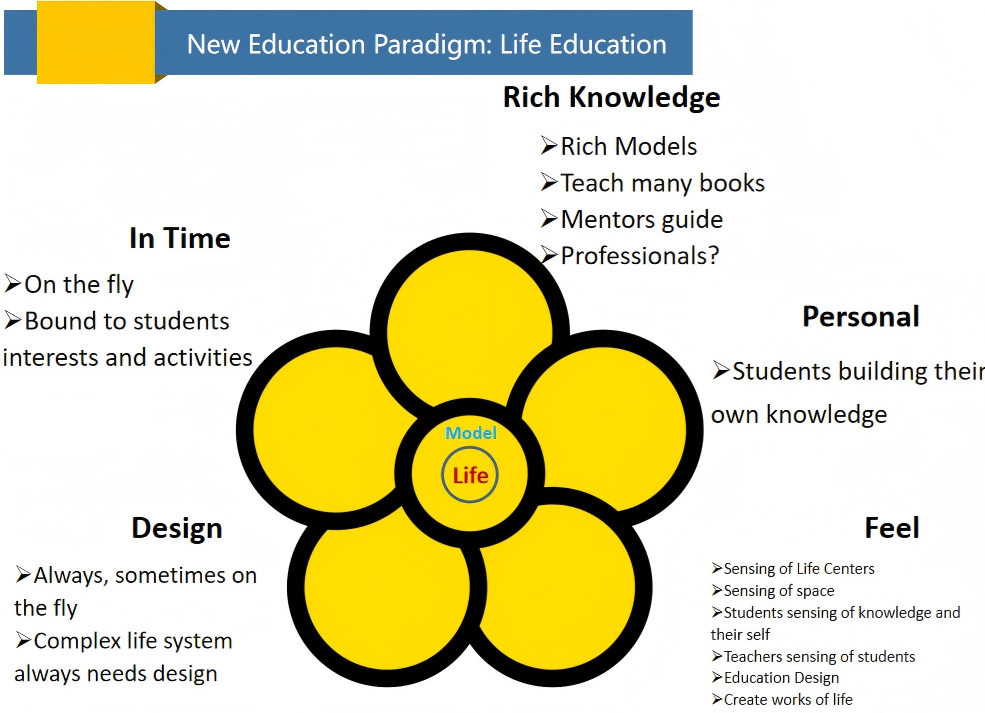
Beyond the equality and omnipresence of life, let us examine
other attributes of life that we should be familiar with. The following diagram
illustrates the life attributes manifested by Self-Directed Education as a form
of life-based education. As we can see, these characteristics are entirely
different from the old educational paradigm.
Life is rich and diverse; therefore, we must feel it fully. Consequently, life is also individual. Life is full of design, and educational design must often be just in time and dynamic. These life attributes are all derived from the concept of life centers—they are the macroscopic manifestations of these centers, and thus, they are all grounded in significant experiences and abstract models.
For example, as mentioned earlier, once we clearly understand which significant experiences in life are related to music or drawing, and we identify which experiences we hope the learners will gain, as well as which experiences in their current play are already related to these fields—once all of this is laid out, we can design appropriate PlayGrounds for different learners. This allows learners to start playing and organizing themselves within these PlayGrounds. The educator’s role is then simply to facilitate the life discovery and help learners achieve their own life expression.
Due to space constraints, I will not explain these points in depth here. These topics have been discussed in detail in previous articles on my WeChat official account.
In this series: