
The self-sufficient and inherent “capabilities of life.”
A core component of “capabilities of life” is the capacity for learning, which we possess from birth (or even earlier). This learning capacity is the ability to feel, explore, reflect, and create. When conducting educational activities, teachers must be able to sense the students’ inherent “capabilities of life” at any moment. While different teachers may vary in this ability, at the very least, they should not obstruct or suppress a student’s natural “capacity for learning.” Therefore, every one of us possesses this “capability of life” to feel, to play, to explore, to reflect on the experiences within play, and to create; this is an innate ability we are all born with. Various “SDE” (Self-Directed Education) communities have already proven this. They possess a rich body of publications; those who care about education need only to read them carefully to reap immense benefits and gain a profound understanding of the “essence of education.” Where does this self-sufficient “capability of life” come from? We believe this capability stems from life’s ability to recognize the phenomena of life. Using the concept of “Life Centers,” this capability arises from our innate power to sense “Life Centers.” The ability to interact with “Life Centers” (“Playing”) and the ability to establish new “Life Centers” (“Creating”) are both grounded in this fundamental perception. This defines the relationship between “Learning,” “Playing,” and “Creating.” Recognition is both learning and creating; through learning, we create new “Life Centers” within our minds. This act of recognition is the uniquely human capability of “seeing.” However, I must add that, as mentioned above, this recognition of “Life Centers” also stems from the experience of “playing.” Before we are able to recognize a “Life Center,” we have already played with it countless times. Therefore, this is the foundation of the self-sufficient “capabilities of life”—an innate power derived from the triadic, unified life activities of “playing,” “learning,” and “creating” that we have engaged in since birth. Through these continuous activities, we perpetually exercise and strengthen these capabilities. Thus, we say that this power resides within every living being, and every child possesses this innate capability. Therefore, when we “play,” we are simply flowing with the “Life Centers.” But how do you “see” these centers? That is where “learning” begins. Especially for those “Life Centers” that cannot be simply seen with the eyes or heard with the ears, you need to use your whole body to “see” them. Why does life engage in such activities? What is the underlying will or driving force? We say it is “beauty,” “fun,” and “love.”The Drivers of Life: The Pursuit of Beauty, Fun, and Love
“Beauty,” “fun,” and “love” are the inner “forces of peace” within every individual. It is these “forces of peace” that drive the progress of human history. We can view human history as a narrative where these “forces of peace” increasingly break through the powers of “weapons and capital” to manifest themselves. These “forces of peace” are the internal driving forces within each of us. Our sense of “beauty” stems from our appreciation of “Life Centers.” This is primarily related to the spatial and positional relationships between these centers. The static “geometric properties” of a “Life Center” have a profound impact on our senses and emotions—such as “beauty,” “loneliness,” or “hope.” I will not elaborate on the specifics here, as Christopher Alexander has already provided extensive descriptions in his books. “Life Centers” are both independent and powerful, yet they are interconnected, echoing, sacrificing for, and cooperating with one another to foster a greater whole—an even larger “Life Center.” Through the recognition of “Life Centers,” we come to understand the complex universe and our complex selves. The “self” is also a “Life Center,” and every individual, as a “Life Center,” serves as the basic unit of society. The prosperity of a society requires healthy and strong individuals, and it necessitates the cooperation between these “Life Centers.” Because of the emergence and disappearance of “Life Centers,” the complex universe is simultaneously simple and peaceful. “Life Centers” exist, yet they do not exist. The universe changes, yet it remains unchanged. Christopher Alexander also described this profound experience attained through the recognition and appreciation of “Life Centers” in his books. The above primarily discusses our sense of “beauty.” It is more about the static “geometric properties” of “Life Centers,” constructing a feeling of beauty within our minds. On the other hand, our sense of “fun” or “play” comes from the dynamic interaction with “Life Centers.” This is an experience generated from our movement and engagement with these centers. Our consciousness of “love” arises from the experience where the distinction between “subject and object” dissolves within our relationship with a “Life Center”—or, rather, from the mutual experience between the subject and the object.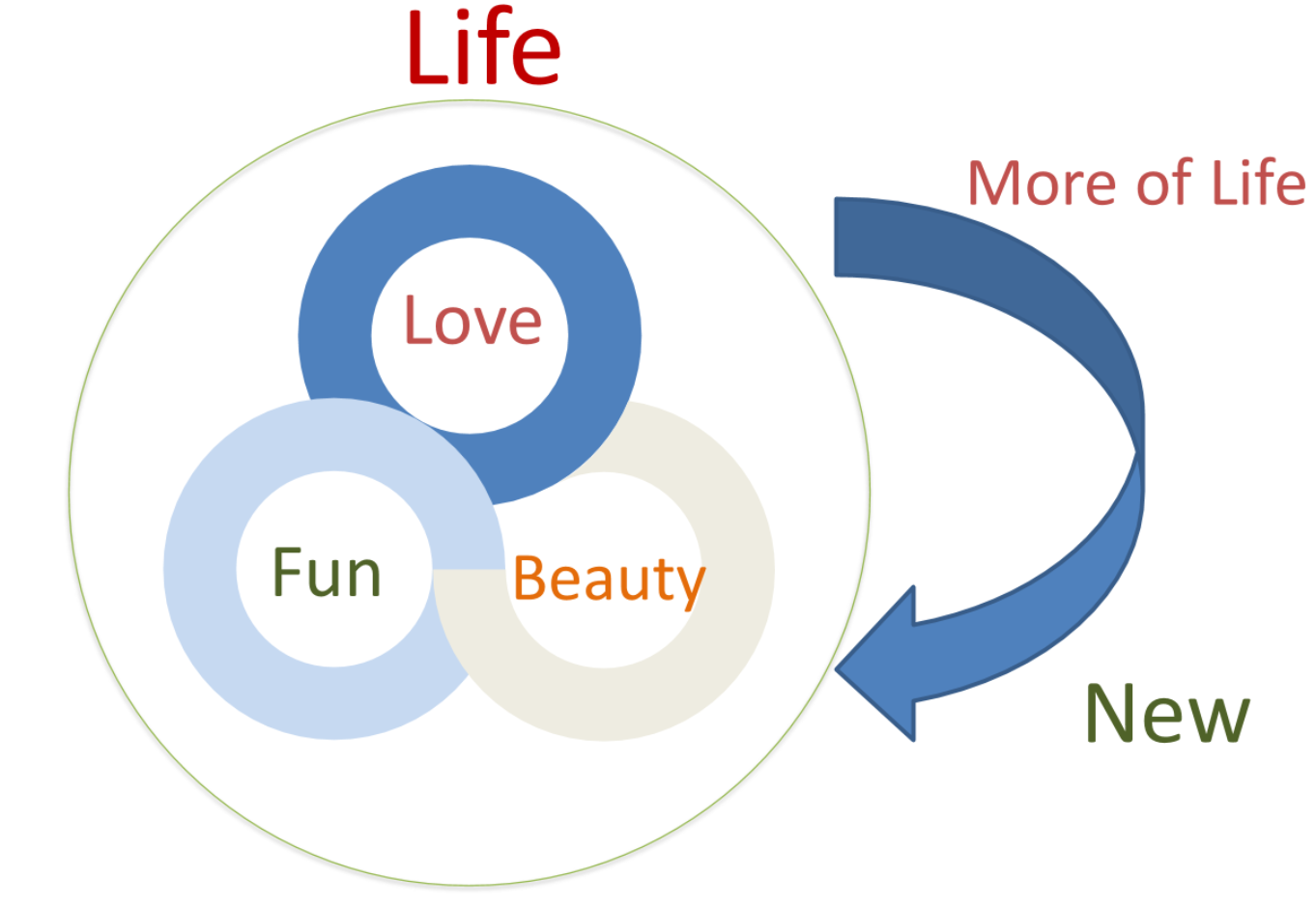
“Life Centers,” they provide us with “fun,” a state where “subject and object,” or “subjective and objective,” merge. A high degree of “beauty” and “fun” then generates the feeling of “love.” Men and women are attracted to each other because of their “beauty” and the “fun” they can experience together. With “true love,” the “subject and object” fully integrate into one another—they disappear. The static forms of “Life Centers” can be viewed as our “knowledge or vision.” The dynamic interaction of “playing” with these centers represents our “action.” In our actions, we dissolve our knowledge; this is what is known as the “unity of knowledge and action.” Therefore, in static forms, the fusion of subject and object constitutes “beauty.” In dynamic movement, the fusion of subject and object constitutes “fun” or “playfulness.” These are the two forms of “love.” Therefore, “beauty,” “fun,” and “love” constitute our “sense of life” within complex living systems. By participating in the life activities of “learning, playing, and creating,” we generate more or better “Life Centers,” thereby establishing a whole with a higher “Degree of Life.” (As noted, “Degree of Life” is the specific term used by Christopher Alexander.) Understanding the innate “capabilities of life” and the underlying “driving forces of life” is the foundation of our confidence in Self-Directed Education (SDE). Many parents and educators are dissatisfied with traditional education and have a preliminary resonance with SDE; however, when faced with practical difficulties—such as a child playing for extended periods—they often harbor doubts and find it hard to persevere. Therefore, it is crucial to understand these innate capabilities and driving forces to build a profound “trust in life.” In fact, this transcends Self-Directed Education. Throughout human history, all constructive efforts of life and peace have originated from a fundamental “trust in life,” allowing the “forces of peace” to manifest. I felt this “power of life” firsthand in elementary school when my teacher organized us to build a self-managed book corner. Traditional schools rarely grant students the opportunity to improve their own surroundings. Yet, every Self-Directed Education community is defined by the learners’ “equal participation” in community building. The ability to feel one’s environment and strive to improve it is, in itself, the most important learning activity. In the implementation of Self-Directed Education, educators must possess an “intimacy with life” and a deep familiarity with the “feeling of life.” Only then can they design a suitable environment for Self-Directed Education that resonates with their specific learners and their unique surroundings. The next section primarily focuses on two attributes of life: the “equality of life” and the “omnipresence of life.” Both of these attributes, in fact, originate from the concept of “Life Centers.” In this series: