Chinese Version
Keywords:
Paracraft, Learning Center, Youth Programming Education, Exploratory Learning, Significant Experiences, Abstract Modeling, Complex Systems, Playground, Small Project Lists, Learning Documents, Learning Records, Learner Profiles, Learning Consulting, Self-Directed Learning, Self-Directed Education, Spatial Perception, Spatial Thinking, New Education Paradigms, Life Education, Life Discovery, Life Expression, Life Center, Future Education
Abstract
This paper introduces the educational model of Paracraft Learning Center (PLC), which is a Self-Directed Education (SDE) model based on the Sudbury model. The difference is that PLC is part-time, and is for all children and parents, even if those families haven’t heard of SDE at all. By doing so we hope all children and families have access to the Sudbury Model of SDE, and thus we can spread the Sudbury model to the whole society. It is a replicable and scalable model of SDE, is a future-oriented model of education. Its successful implementation and the large-scale replication, which can be expected in the near future, will be a key part of the future education of mankind based on the new educational paradigm.
Our pilot Paracraft Learning Center, also known as Creative Space, is available both on and off campus. The school is used for 4:30 class time, 2 hours a week. It’s Saturday and Sunday off campus, and it’s two hours at a time. There is a charge outside the school.
This paper gives a brief introduction to the learning/education model of the Paracraft Learning Center.
Paracraft, “Learn to program, learn to learn!”
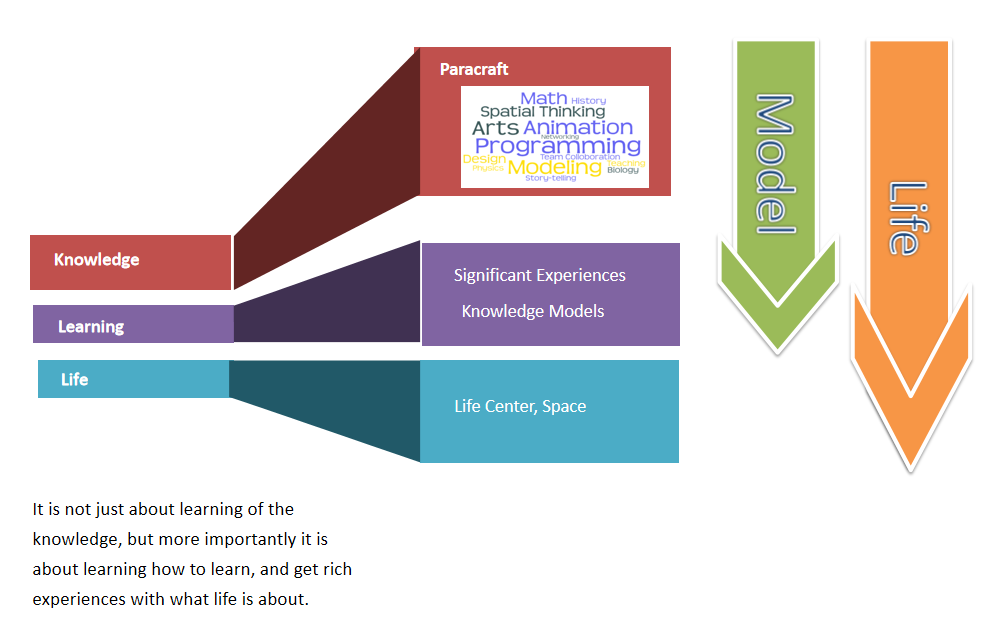
Figure: Paracraft, “Learn to program, learn to learn!”
Our slogan has always been “Learn to program, learn to learn!” “Paracraft’s learning is not only about learning a wealth of knowledge, but also about learning how to learn. And what we’re talking about here is learning not in a linear way, but in an interactive way, in interaction with the living space, including the process of feeling, making choices, interacting, collecting feedback, iterating. That is to say, the process of self-learning.
Implementation and operations:
Let’s first look at how learning in a specific creative space works.
First of all, the creative space is project-oriented. Students start working on projects from the very beginning when they enter Paracraft, and they have plenty of time to work on their projects. We also have lessons, even a wide variety of lessons, but that is only a relatively small part of PLC. Our approach is not the same as many project-based learning. Simply speaking, our students are playing independently and really in the rich playground. Real play, will certainly contain a wealth of learning, as long as we build up good playgrounds.
Our resource/soil construction is an important part of this playground.
Resources and Playgrounds to build
In the construction of resources, we uphold three principles:
The first is richness. Children of all ages and backgrounds can come to Paracraft to find what they can do, or projects that suit their current level of skills, with a wealth of choices. This is the basis of SDE.
The second is openness and transparency. In this way, exploratory learning is easy to carry out.
The third is to be well structured. We have such abundant resources, if there is a good structure, students can see the approximate structure at a glance, as if we look at a complex but well-structured building. This makes it easier for students to interact with them. instead of linearly seeing from the beginning to the end. Students can interact with resources according to their own interests and levels, to achieve their current needs of growth, to achieve organic learning.

Figure: Complex buildings with good structure
When the rich resources are well presented, and we also mentioned earlier that Paracraft itself is a platform for children to play and create, these resources together with Paracraft itself then become a good playground to play with, children will be self-directed in their exploration of learning.
Let’s take a look at our current resources. Our resource and playground construction is continuous, we continue to build our resources according to the feedback obtained during the operations of PLC.
Small Projects List
The following image is a list of our small projects. A list of small projects is what students can do in their studies. When they don’t have any thoughts or ideas, take a look at this small list of projects to see which ones they can currently try. Generally, project-based learning is a relatively large project, and our students can quickly move on to a large project in Paracraft, and they spend most of their time working on that kind of project. But they usually try those small projects to during their break of working on large projects to learn knowledge and skills related to their large projects. And the children all know how to make such switches and how to manage their time very well.

Figure: Screenshot 2 of the list of small projects
In the Small Projects List, We have only made distinction of large stage difficulty levels, from beginners to advanced levels. There is no finer division, let even by age. When students browse through the list of these small projects themselves, they can sense what they are able to work on. Some of our children also specifically challenge themselves by picking really difficult projects to see if they can grow their skills faster. If they find it really hard, they’ll choose something less difficult. This process of self-directed learning is in fact part of our natural learning ability.
Learning Document
The following figure is our learning document. One of the most important things in programming learning is to learn to query documents to learn. Have a general idea of what’s in the document and know where to look when you need it. In fact, this is modeling-based learning. We’ll cover modeling-based learning in more detail later. Any study of complex systems requires modeling-based learning skills, such as document queries. So we build up rich documents to consciously develop students’ ability of learning in a complex system.
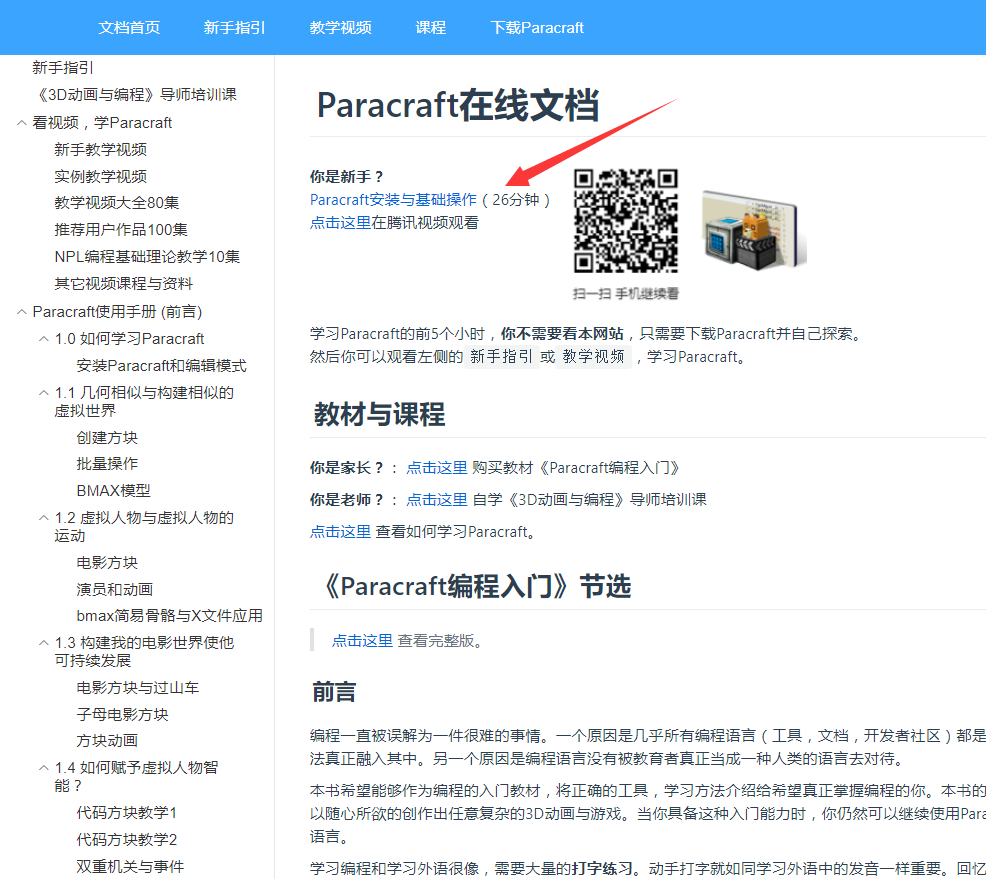
Figure: Learning Document
The first is a 26-minute instructional video. Also on the list of small projects. Students who are just starting out with Paracraft can start doing projects in Paracraft as soon as they watch this video. So the students in PLC are working on projects from the start.
Tutorial Videos
This is our tutorial video. Watching video for learning can be a problem because it is difficult to find what you have learned before. So we mark the time, such as minute and second of important learning content under the tutorial video for students to browse quickly. Because these pages are searchable, students can do a search on them as well.
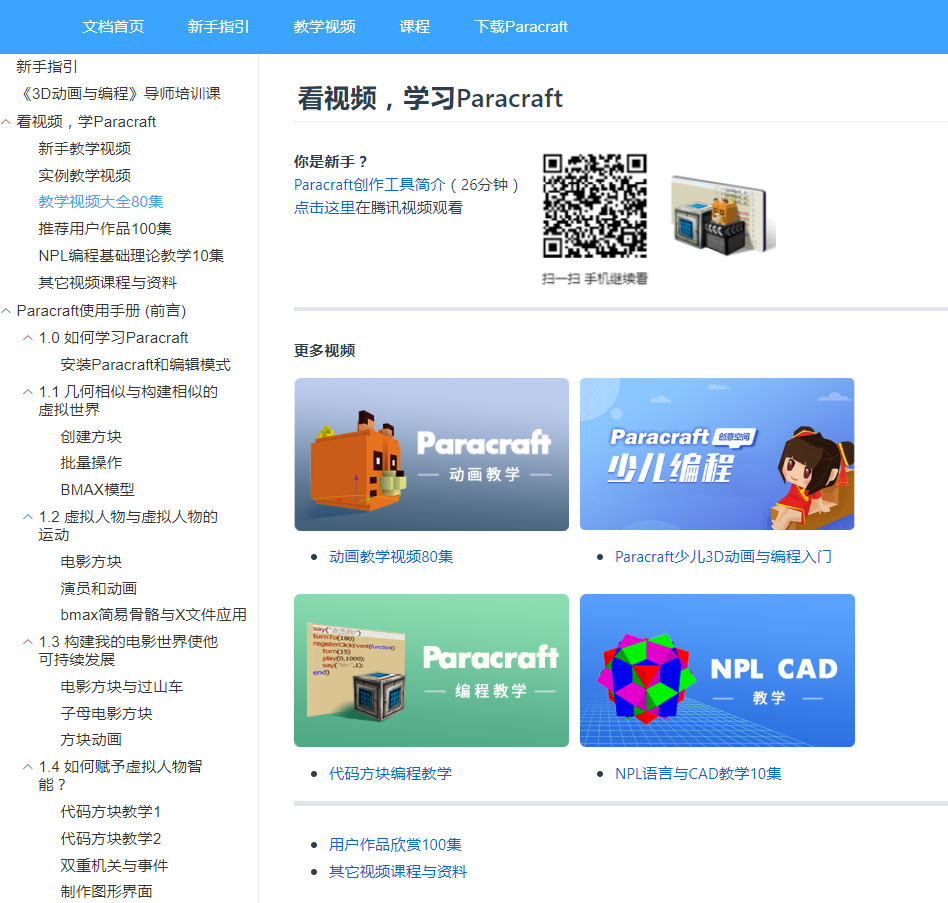
Figure: Tutorial Videos

Figure: A video on the timeline that identifies the important learning content
Excellent Works, including Paracraft itself
In addition to the above resources, in fact, Paracraft itself, because of its software design adhering to the principle of openness and transparency, also become a good learning resource. This is reflected in the following areas:
First, in Paracraft, you can open a project through the id of the project, and then you can switch to edit mode and open the code editor or movie editor to see how the project is made. This makes it very easy to learn from other people’s works. In fact, many students in the creative space are learning in this way.
Secondly, we have keepwork.com, this works sharing platform, so that students can share their works and communicate.
In Paracraft, it’s easy to open up a terminal where you can see the state of real-time code execution. Paracraft and NPL are open source software. For potential students, they can gain an in-depth understanding of the source code for Paracraft and NPL and participate in the software development of Paracraft and NPL.
Therefore, in Paracraft,, we recommend the excellent works of other students. Our students often browse through all kinds of works to learn from them.
Our students explore these works and open them up for study. Even our official works, which are quite complex, they’ll open them up. These works are our very important learning resources.
Learning how to explore up to a certain level, students will explore the terminal that can see the real-time running status of the code, and into the study of the source code. Paracraft was designed to be software that open students can learn on their own. We presently are focusing on very young kids. We are building more content, building better playgrounds for them, so that all students can start the exploratory self-directed learning from the very beginning.
Learning Record
In addition to learning resources or the construction of playgrounds, another major feature of creative space is Learning Records. We do a lot of learning recording in PLC, including learner profiles, learning counseling records, and daily learning records.
Students Learner Profiles
We will build a learner profile for each student from the beginning. This document will be updated as we learn more about the student. This learner profile represents a student’s life as a unique individual. Just as expressed in Paracraft’s work “We Are All Wonders”, everyone is a unique life. The Learner Profile also represents the mentor’s continued interest in the growth of this life. A new mentor, just look at the student’ profile, should be able to have a general understanding of this life.

Figure: Student Learner Profile
Learning Consulting Records
We do Learning Consulting for our students about once a month. 5 minutes per student. Students take turns and can ask the mentor any questions about their learning. If the students have no problem, the mentor will take the initiative to ask students some questions, to understand the current situation of students, where their interests are, what kind of projects they want to do and so on. Mentor can also guide project ideas based on students’ ideas and their abilities. We have a document on how to do a learning consultation.
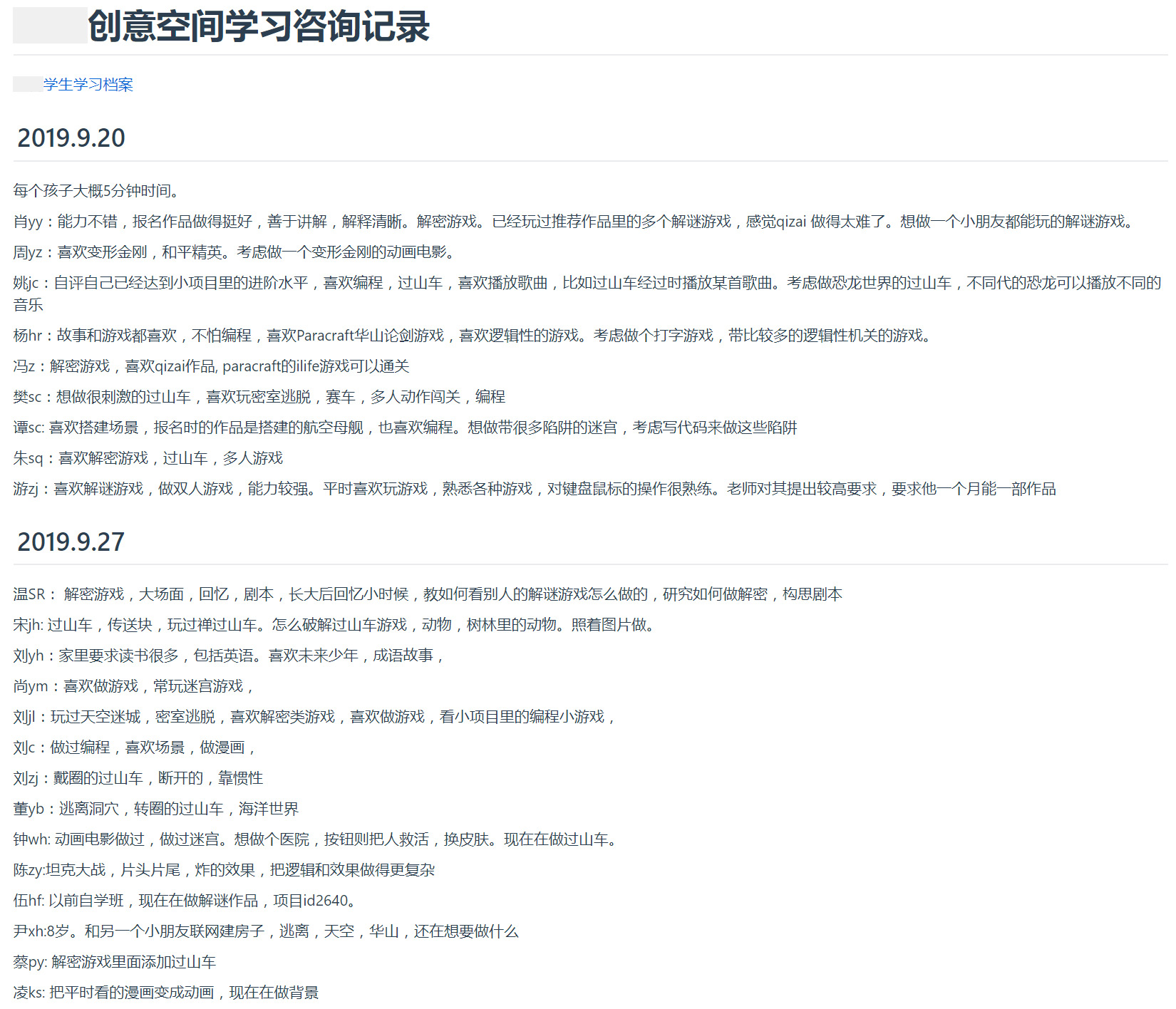
Figure: Creative Space Learning Consulting Record
Daily Learning Records of PLC
Then there’s the daily learning records of PLC.
We say that knowledge is an abstract model based on significant experiences. Therefore, we think that a teacher can only teach what s/he has the abstract knowledge model of, representing her/his own personal understanding, and s/he can only teach to what s/he has experienced significantly.
Our teachers, in fact, we do not have teachers, only mentors, our mentors are professionals with very rich learning experience. An important responsibility of mentors is to guide students to explore learning, to cultivate their habits of self-learning, and to create their own knowledge models.
To guide students to develop their own learning habits and abilities
Therefore, when students ask questions, we specifically ask the mentor not to directly give students answers. Specifically, we ask the mentor to follow these steps:
Mentors don’t give answers directly. Mentors should have enough knowledge of our resources and abstract knowledge models to point out the direction of exploration. For example, if our documents or tutorial videos have relevant content, let students find in it, and observe whether students can successfully find the resource and be able to understand for themselves.
If other students know, let the other students answer. Encourage students to communicate more with each other and teach and learn from each other. It’s actually something that kids are very good at, and from what we’ve seen, it works very well.
If we don’t have anything in our resources and other students don’t know as well, then our mentors need to be able to demonstrate on-site how to explore and discover knowledge. So we ask our mentors to have a wealth of learning experience and relevant important knowledge models so that they can demonstrate exploratory learning in the field.
Afterwards, the mentor shall do some analysis, if it is indeed our resource that is lacking, or the structure is not clear and difficult to find, or the content is obscure and so on, can be further improved, they shall continue to improve our resources.
Guide students to build their knowledge based on Significant Experiences and Abstract Models
In addition to guiding students to develop their own learning habits and abilities, our mentors need to guide students to build their knowledge based on significant experiences and abstract knowledge models.
Here I give two examples.
These kids love to connect with each other online and use Paracraft’s networking features to work on projects together. I feel they like networking so much, constantly trying to enter the LAN or Internet server URL. I asked them whether they know what they entered, why is it such a string of numbers? Why are a few points separated? How do I locate a computer on the network with these numbers? What is the difference between a local area network and the Internet? What’s the url you entered? What does the previous ip address have to do with this url? Then let them open the command-line terminal in windows or mac (children cheer when they see that their computer can enter the command line like Paracraft), use commands to find their computer’s LAN ip address, and then find out what the ip address of a website is. Then let them open the browser and tell them what is behind entering url in the browser address bar when visiting a website.
Because children are very interested in networking, it is a very good opportunity to guild them to explore what is networking. I see what they’re doing and what they’re interested in, point out the knowledge behind it, and guide them to explore. By networking with Paracraft, they have accumulated some Significant Experiences about the networking knowledge. Based on my own knowledge model of the networking and my significant experience that make up that knowledge model, I made a design on the field dynamically in real time. Show students something on the spot, let them try something, accumulate more significant experiences related to the networking knowledge model, let them have a little concept of the network knowledge model, establish an initial framework, and when they encounter the significant experiences related to the networking again, they can quickly identify them, can continue to enrich their knowledge model.
Another example is that many of our students like to play a digging game in Paracraft, or like to build high ladders or mountains, and then climb mountains, climb high and high. (Jump down again!) I asked them, do you know how tall you can go up? Or how deep can you dig? Tell them it’s 255 and ask them why it’s such a number. 256 is 2 to what power. Very young suddenly can not answer this immediately, then ask what is 2 to the power of 2, and so on. It’s about pointing out the relevant knowledge behind the phenomena they’re exposed to on a daily basis, such as the binary here, and allowing them to accumulate more relevant and significant experiences based on the level they can currently understand.
Professional programmers are people with very rich learning experience who are well aware of the important knowledge models in software programming, who are very aware of the significant experiences involved, and who can quickly identify relevant knowledge models and significant experiences when they see what children are doing. Then instantly point out the relevant knowledge model to the child, and then according to the child’s interests and abilities, give more relevant significant experiences, so that children can quickly have a accumulation of related significant experiences. Our mentors also need to have a good ability to express abstract models in concise words. This is also a very important ability as a programmer.
So in the implementation of the creative space, our mentors are constantly doing these things, repeatedly exposing students to these significant experiences and knowledge models, to help students build their own knowledge.
Therefore, it is very important that we have mentors with rich learning experience in a certain field. It is only by having a very rich experience that has impressed him/her that such kind of guiding can be conducted, and is possible to impress his/her students with Significant Experiences.
Of course, all of this is based on the interests of students. Children love to play Paracraft and create things in it. Mentors who are familiar with Paracraft and related resources also need to tell their children where to play, which is also a role for mentors. Children usually communicate fun things with each other. For new students, the mentor should give a little guidance. And as the students advance, the mentor needs to constantly show them where the next palyground is. These are actually part of the construction of our playground.
Therefore, you see that our mentors must pay attention to the growth of life, must carefully observe the students’ learning.
Mentors also need to make a learning record every time they run the PLC. Keep a record of what they observed students have learned today. At the end of each creative space, the mentor asks the students what they have learned today to help them continuously enhance their ability to reflect on their learning and build a significant sense of learning. Now it is mainly mentors to record what students have learned. Gradually we will let students do this recording themselves. The mentor’s recording is shared with the student’s parents respectively on the same day. At the Paracraft Learning Center, we want parents to be involved in their children’s education. Our modeling-based knowledge representation is basically understandable to parents, because a lot of knowledge (based on abstract modeling) is connected and there is not much knowledge gap.
The following figure is a sample recording of significant experiences of one of our student.
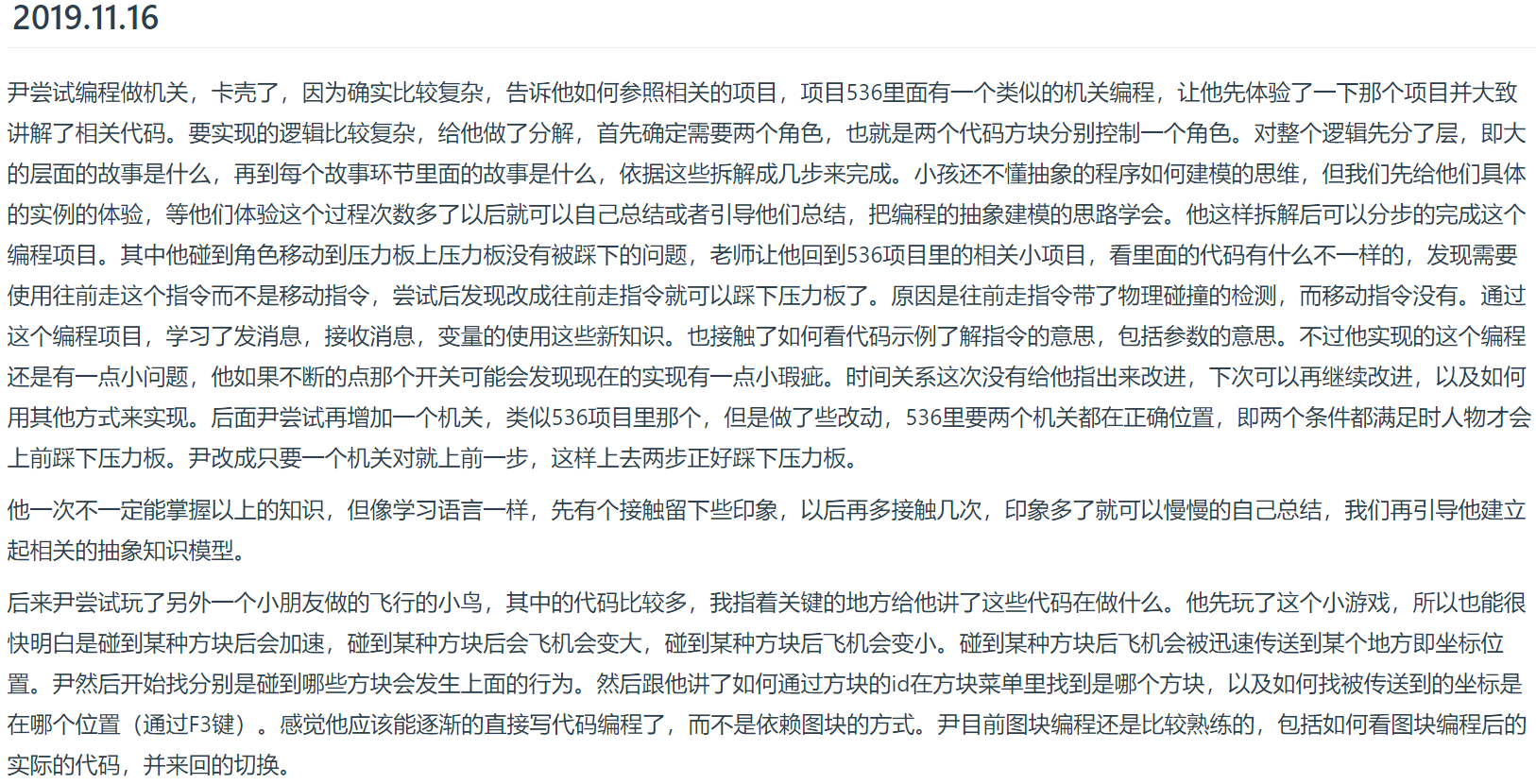
Figure: PLC Daily Learning Records: What Students Learned
Our mentors also document what they have learned. We think that mentors must be learning as well when mentoring. If the mentor has provided mentoring at PLC and there is no Significant Experiences of learning recorded, we feel that there may be a problem.
The following figure is an Significant Experience in PLC documented by a mentor.

Figure: PLC Daily Learning Record: What Mentors Learned
These learning records are also the basis for our mentor training and supervision.
In addition, we want students to have a learning plan before they come to PLC, what they want to do today, and what to learn. Parents can help students with this recording at first. Later slowly we let students record on their own.
A wide variety of “lessons”
The learning at PLC is mainly about working on creative works. In addition, we also have “lessons”, and a large variety of lessons. The Special Topic Lesson is for a specific topic, such as how to design the game level, how to save your game when passing a level and so on. We will also observe the overall situation of students learning and design some lessons accordingly, or provide project guidance. More often it is the kind of the real-time dynamic little “lessons” based on abstract knowledge models as described earlier, maybe a couple minutes to ten minutes. This kind of “lesson” is the daily routine that we have at PLC.
Well, above we have introduced the specific operations of PLC. You can see that the Paracraft Learning Center is based entirely on working on creative works, and based on play/learn/create activities.
Effect
Let me briefly talk about the effects of student learning in the creative space. Less than a semester of study, our students have developed the habit of self-directed learning, such as when they have problems they will first go to our resources such as documents or tutorial videos to find out if there is anything there to help them. They’ll look at the list of small projects when taking a break from working on their large projects to see if they can fill in some related knowledge with the small projects. Some will even explore rather difficult coding projects to see if they can master programming faster. If they find it too difficult, they will choose a less difficult project themselves. Such ability to explore and feel is in fact the most fundamental ability of learning. Of course, when mentors see the students making such a challenge, they give appropriate guidance to see if they can help students succeeding in the challenge. They will also check out content related to their projects, such as reading on documents and videos related to the train track in Paracraft when they are exploring the roller coaster project. Students who make puzzle games will read on documents and videos related to setting up traps, or study how the traps in other people’s projects are set up. Some students are interested in circuits, so they will focus on the content of circuits, and they will build many small projects of circuits.
I believe that through these examples, we can see that “Self-Directed” has great significance in learning.
Children in the creative space have plenty of time to do what they want to do, and you can say that they spend almost all of their time doing what they want to do. They just need to take a look at our resources during the break or when they run into problems, to see if there’s anything that can solve their problems or help them grow. They also regularly schedule some time to browse our documents or videos to ensure continuous learning.
Because these children are doing what they want to do (rather than doing a teacher-designated project like in many schools or institutions, or even following the teacher step by step), we can observe the real interest of children of these ages through their projects. For example, their favorite projects are in these categories: roller coaster, parkour, puzzle game. Boys, in particular, will be fond of making roller coasters and parkour. I watched a lot of the thrilling roller coaster games they made and all kinds of scenes and types of parkour games. Many children like to build mountain climbing game, and they build beautiful games. Children who play puzzle games like to study the use of various traps and command lines.
In addition to these categories, many children also show their unique interest. For example, some children like to build very complex circuits. Some like to build aircraft ships and so on and have demonstrated very good modeling skills.
Although there are many stories about students’ learning and creation, we don’t talk much about them here, as we will tell in other articles.
PLC model, to understand from the perspective of learning and education
Let’s take a further look at the creative space from the learning and educational perspectives.
Based on abstract modeling and spatial learning
Paracraft’s learning is based on modeling and space. Paracraft’s learning is rich, but it’s a highly integrated, unified whole.
First, for building 3D scenes in Paracraft, the 3D modeling is based on abstract modeling. Programming is also based on abstract modeling. We say it is more important to learn how to learn, learning is also based on abstract modeling, it is a modeling process from the significant experience to the abstract knowledge model.
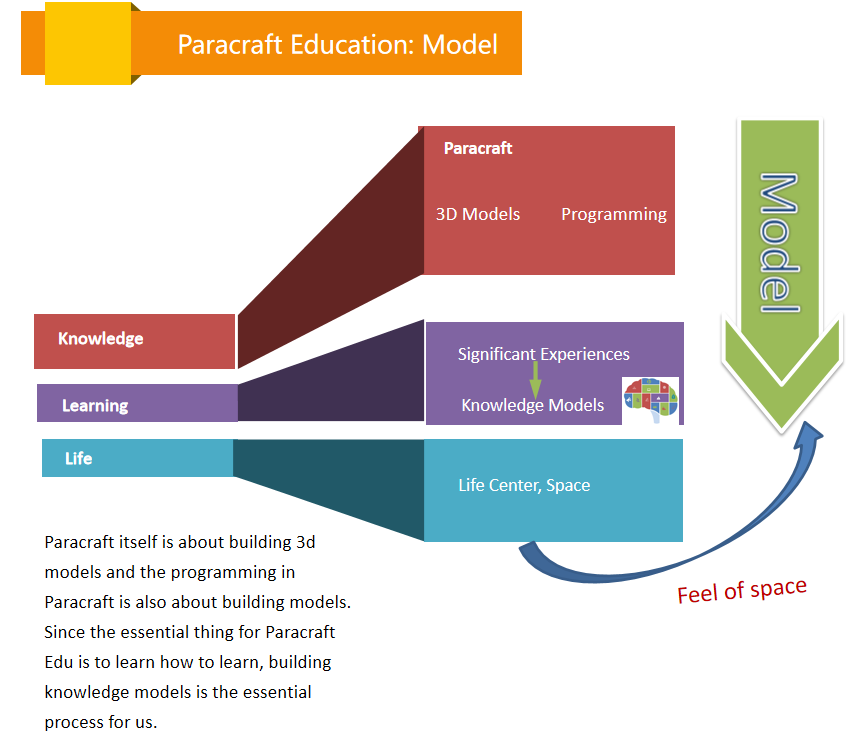
Figure: Paracraft Education: Abstract Modeling and Space
Abstract modeling is based on the feel of life space. This feel is the basis of spatial thinking. Spatial thinking is the core of thinking, is the basis of all thinking. Paracraft’s 3D construction, animation and programming, as well as how to learn, are all about the space from sensibility to sense layer by layer learning, is a very complete and unified learning. Software programming is actually a rational understanding or science about the nature of life space. Therefore, we can also say that Paracraft is the most complete programming education.
Knowledge in Paracraft, the core of which is knowledge of 3D animation and programming. The typical books are shown in the following figure.
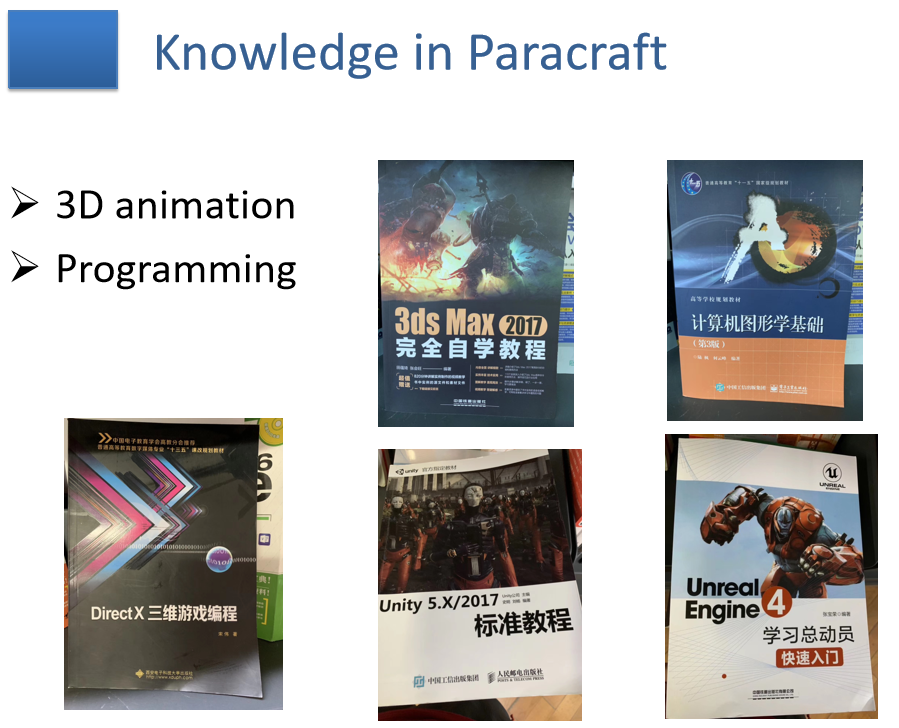
Figure: Core knowledge in Paracraft
In fact, all the books on this whole shelf of the city’s central bookstore are the relevant knowledge contained in Paracraft’s software. In Paracraft, students end up learning so much that they can become professional animators or programmers.
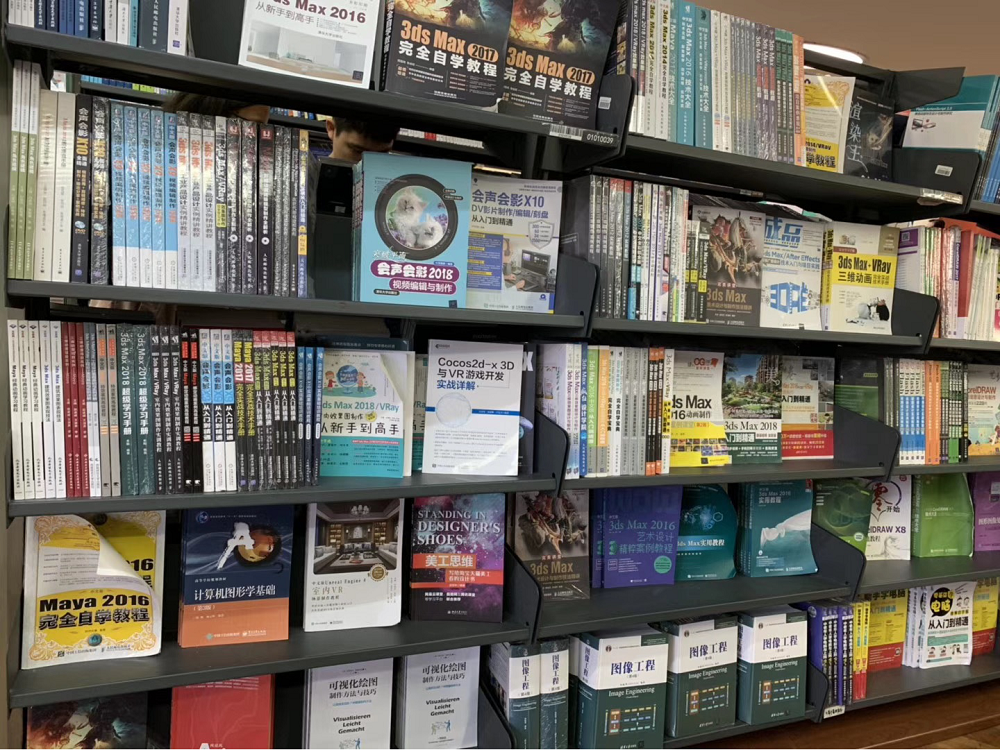
Figure: Core knowledge in Paracraft
But that’s not all. In the following figure we also just list some relevant knowledge. There are more that can not be listed here. So the Paracraft Learning Center is designed to teach such a wealth of knowledge. In the face of such a wealth of knowledge, how do students learn, how do we teach? It can only be organic learning, organic mentoring.
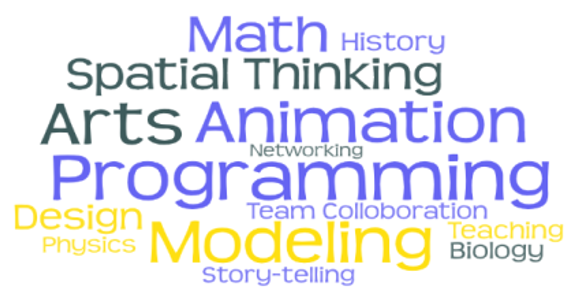
Figure: Knowledge in Paracraft
Unlike ordinary schools or institutions, which can only teach one or two textbooks, our mentors are professionals with extensive learning experience. In their careers, they have read thousands of books and developed their own understandings. Their mentoring is to fit into what students are doing and their interests to help them absorb this great amount of knowledge organically.
Significant Experience and Abstract Knowledge Model, let’s discuss what learning is and what knowledge is
We’ve said earlier that learning is a process of knowledge modeling based on significant experiences.
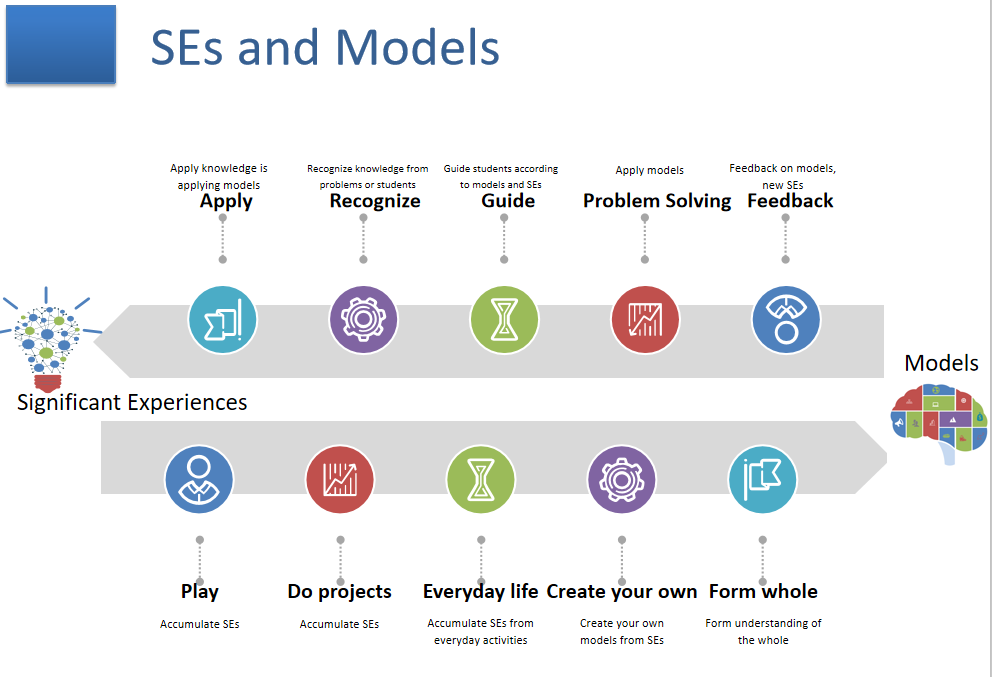
Figure: Knowledge modeling
We say that knowledge is an abstract model in our brain that represents our overall understanding and it is based on significant experiences. If we believe that learning is the growth of life, including the growth of knowledge, then those that have touched our lives are significant experiences, and are the basis of life growth.
Whether it’s playing, doing projects, or everyday life, we’re accumulating significant experiences. Learning doesn’t happen in the classroom. When there is enough significant experiences collected in a learning area, we can then reflect on and summarize these significant experiences, that is, to build our own knowledge model based on significant experiences, that is, to form our own overall understanding of something.
Then the application of knowledge is to use these abstract knowledge models in our brains, to identify the relevant knowledge models of current events, and to gain more significant experiences in the use of models, which also form feedback on the knowledge models we build, helping us to adjust our knowledge models.
Among them, the recognition or feel of knowledge models and related significant experiences is a very core skill.
This is the process of using knowledge. For example, when our mentor guide students, we need to be able to identify the relevant knowledge models in what students are doing, to perceive the status of the knowledge models that students currently have or the significant experiences that they have accumulated, in order to do timely mentoring and make design of mentoring on the fly.
The same is true of other common thinking skills for complex systems, such as problem solving and diagnostic capabilities for complex systems.
To solve a problem, we need to quickly identify the relevant knowledge model in the problem we are dealing with, and apply the relevant knowledge model. The process of solving problems is itself a learning process, such as whether the existing knowledge model can solve the problem well, that is, the validation of the existing knowledge model, the significant experiences that may be gained in this process will allow us to adjust the existing knowledge model, and we might find new knowledge models for us to explore and summarize.
In the diagnosis of complex systems, such as the doctor to see a patient, asking the patient about the symptoms, and recall their own existing knowledge model to determine what is probably the problem, for example, if it is bone-related problems, then bone-related knowledge models, then knowledge models such as bone-forming cells (chondrocyte) and bone-breaking cells (chondroblast) working mechanisms and so on. And in diagnostic practice, we continue to enrich the significant experiences related to these knowledge models to build a better understanding. Doctor making diagnosis is also a process of knowledge construction and learning. It is also exploratory and through interactive iterations. This process is very similar with programmers resolving software failures (debug).
Other more complex system-oriented thinking abilities, such as critical thinking ability, dividing skills, composing skills. This diagram didn’t listed more cases due to the limited space. But in fact, it’s all about the use of knowledge based on abstract modeling.
The essence of abstract modeling is the feel and construction of life space and the application of the basic attributes of life center. Everything around us that we can identify is life center. (Readers unfamiliar with the Life Center can take a look at our other articles for a more detailed explanation.) The life center has only a few basic properties that help us identify life centers. Familiarity with these properties can help us feel life in a variety of things, including knowledge models. Various thinking abilities for complex systems are essentially constantly identifying life centers at all levels, including dividing and composing. So for these complex thinking skills, we can help you learn very quickly based on recognition of life centers. This is also the advanced learning content as you progress through Paracraft education, which is the learning of spatial thinking. We’re not going to dive into more details here.
Therefore, we can see the process of playing, is the process of accumulating significant experiences, that is, the process of learning. And the process of using knowledge, whether it is to guide students, or to solve problems or complex system diagnosis, and so on, are also play as well. This process is also a process of constantly gaining new significant experiences, constantly revising knowledge models, or discovering new knowledge. So we can see that there is actually such a close relationship between play and learning that we can see this very clearly through abstract modeling of knowledge. At the same time, the abstract modeling of knowledge is creating one’s own knowledge, so creation is no different from play and learning. Whether it’s from significant experiences to abstract knowledge models, or from abstract knowledge models to significant experiences, it’s a process of playing, learning, and creating, three in one.
We believe that the process of life is the process of playing, learning and creating. We often say that there are only three things to do in life or every day: play, learn, and create. We also saw earlier that learning based on abstract modeling and the process of applying knowledge are based on the recognition of life. Paracraft, is thus such a life-rich education.
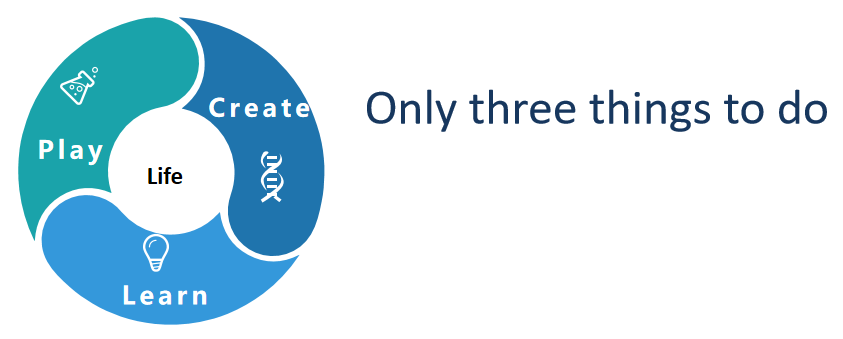
Figure: There are only three things to do in life or every day
The New Education Paradigm: Life Education
We see the education we demonstrate in creative spaces as a new educational paradigm. Different from the old linear learning from taking lessons to homework and to exams, this kind of learning is interactive and life-rich. The education that serves this kind of learning and based on this kind of learning is life education, which is life-rich education. This “life”, is mainly in 5 aspects.
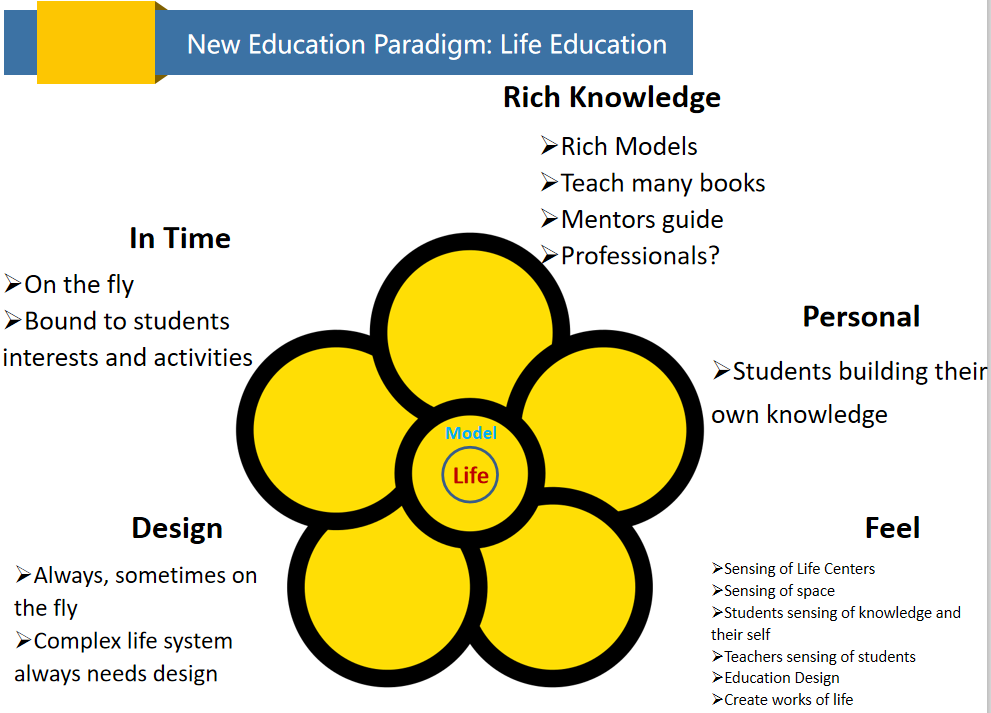
Figure: The New Education Paradigm: Life Education
The first is “Rich”. The word richness is also used when we talk about the construction of learning resources. One of the characteristics of life is richness. First, our learning content is rich. Because we are learning based on knowledge models, knowledge models are very rich, and we can summarize very rich knowledge models based on rich and significant experiences. This knowledge is not like the past teaching materials that are only one or two books, but to learn the content of many books. To learn so much, only the mentor’s guiding is the most efficient. And we need mentors who are professionals with extensive learning experience and lots of practices.
And in the creative space, knowledge is “Personal”. To create their own knowledge, everyone must have their own understanding expressed in their own words.
This kind of learning and education is based on “Feel”, the most fundamental of which is the feel of life centers. For example, students’ feel of resources, of knowledge model and of their personal growth. Students’ feel of knowledge usage and feedback. The mentor’s feel of the student, including knowledge models and significant experiences that the student has. In the operation of the creative space we mentioned earlier, the mentor’s real-time dynamic educational design is based on knowledge model, but also on feel. Students create works of life based on their feel of life.
Another life-rich feature of this education is “Instant”, instant interaction. Make dynamic educational design based on students’ current interests or what they are doing presently.
Then there’s “Design”. We believe that all life-rich systems are inseparable from design. For example, in management, we all need to design with real-time dynamics for the assignment and execution of a task. Who is better suited to do this project, what kind of growth he/she can get, how members collaborate with each other. Each task is different, so there needs to be such a dynamic design process. At the Paracraft Learning Center, design can be said to be ubiquitous.
Therefore, Rich, Personal, Feel, Instant, Design of these five characteristics are important characteristics of the life system. Paracraft Learning Center’s education is life-rich education. This is very different from traditional education. This new paradigm of education is called life education.
Life-rich Paracraft
Paracraft is particularly suited to the above-mentioned life education platform, because Paracraft itself, is rich in life.
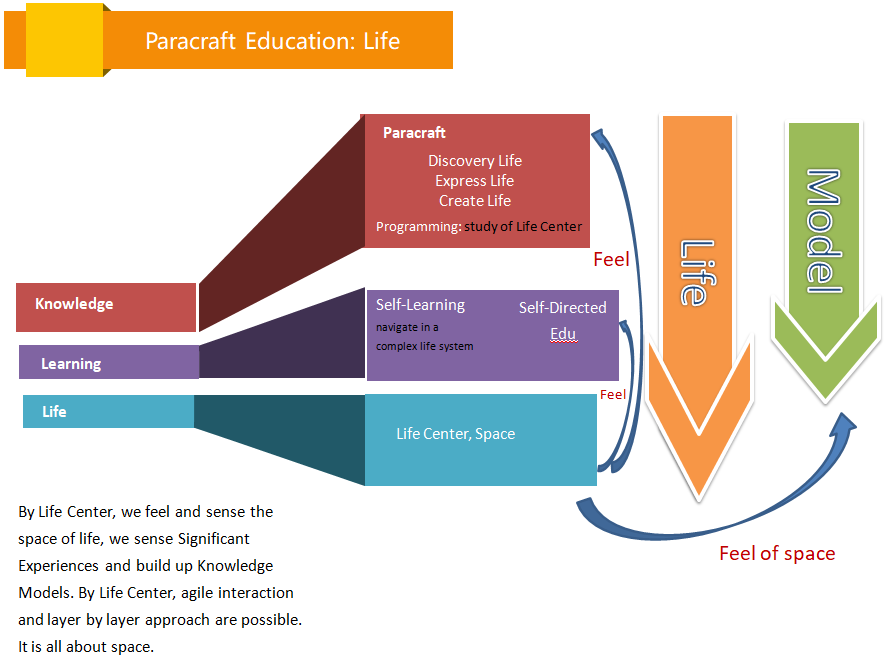
Figure: Paracraft is a life-rich education
In Paracraft, different children can discover what they like to do. By doing projects and in-depth learning, they will constantly discover more of themselves, and discover how their life grow. So Paracraft is a rich platform for life discovery.
Through the creation of works, children express the things that have touched them in their life, to express their feelings, their ideas, the uniqueness of each of them. These are all expressions of life.
Children’s works are creating life. In Paracraft, there are many life-rich works created by children. Paracraft author said that everyone should have their own works. From a very young age on, he created a variety of software works. His work Paracraft empowers children can start to create their own works from a very young age like him.
At the heart of Paracraft is learning of software programming. It is my understanding that software programming is about the science of life centers and about the rational understanding of the nature of life space.
We say it is more important to learn how to learn in PLC. This learning, in our case, is also based on life. First of all, students learn on their own. Our understanding of self-directed learning is that learning is a process of cruising in a complex life system, and the ability to feel and the courage to explore are very important. Paracraft Education, is Self-Directed Education. The content of SDE, we understand is to build a better playground that is rich in life, so students can learn richly, create richly!
We say all of Paracraft’s learning is based on abstract modeling. The feel of the model is also based on the feel of life, or the feel of the life centers.
As we’ve said, learning in Paracraft is composed of feeling, making choice, interacting, gaining feedback, iterating learning, all of which is based on the feel of life space.
So we can see that Paracraf is life-rich at all levels, and it centers around life.
The learning system in Paracraft
Paracraft’s entire learning system is shown in the figure below. From entry-level 3d building, to the higher-level of feeling and gain a rational understanding of life centers, we have these general progressing levels.
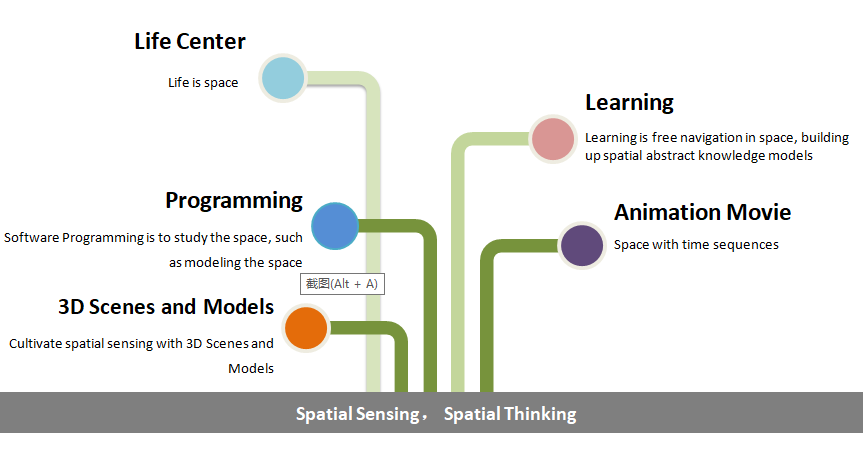
Figure: Spatial thinking cultivation in PLC
Younger children can start with 3D scenes and models, which is the enlightenment and cultivation of spatial feeling. You can then move up to learn animated movies, learn more about abstract models/life center expressing, such as plot design, script writing, and learn how to arrange life centers in time series.
Further up, through the learning of software programming, slowly form a rational understanding of the space of life.
After a long time of such self-directed learning in creative space, after accumulating a large number of significant experiences about life space, gradually form a rational understanding of learning, master this learn while playing, learning while doing skills, master how to learn efficiently and systematically based on abstract modeling.
With these rich significant experiences and rational understandings of life space, students can slowly appreciate and summarize our knowledge of life center, so as to master the ability to learn everything, to deal with all the thinking methods of complex systems, and to understand his/her own life.
And all of this is based on spatial feeling and spatial thinking.
A new educational paradigm based on modeling
The educational model of creative space is based on the educational model of abstract modeling, and all the operations in our education revolve around abstract modeling.
In this education system, all interactions are based on abstract modeling of knowledge.
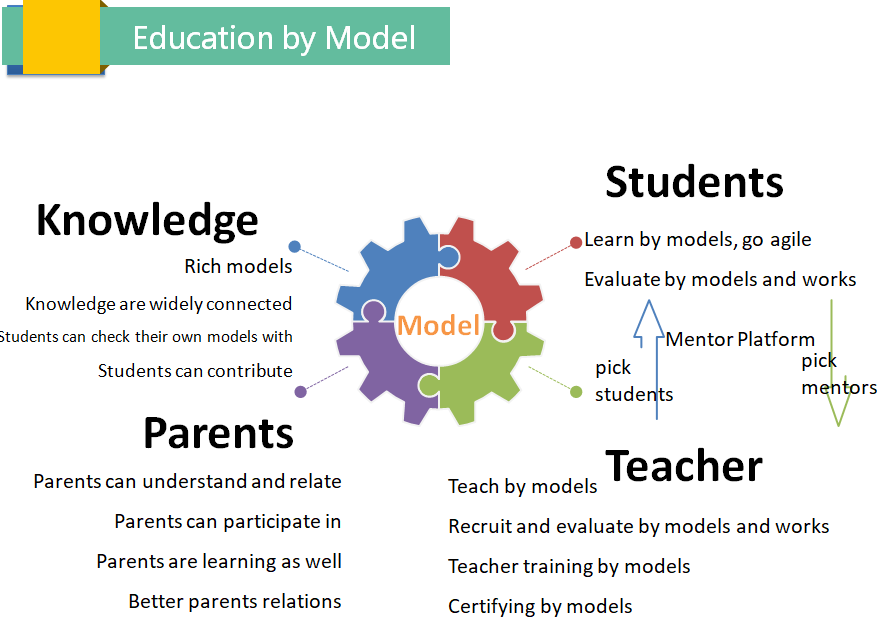
Figure: Education based on abstract modeling
Knowledge
First of all, let’s look at knowledge.
Because it is based on abstract models, the knowledge in this new educational paradigm must be very rich.
This wealth of knowledge forms a widely connected knowledge. Knowledge is supposed to be broadly connected, isn’t it?
Learners see the knowledge models of their mentors, as well as the rich significant experiences behind them, and know how they are obtained, so that learners, on one hand, can understand them more easily, and on the other hand, learners automatically know what significant experiences they can gain in order to build up such knowledge models.
And knowledge based on abstract models is equal, communicative, not top-down authoritative or even coercive.
Learners can participate in the building of public or mentor’s knowledge models, such as providing their own relevant significant experiences.
This knowledge based on abstract models is dynamic. We all know that the process of modeling is to constantly apply existing abstract models and constantly adjust our abstract knowledge models based on the feedback we get from new significant experiences. Learners can also see the process of this dynamic adjustment of knowledge by the mentor. Everyone is a learner, so this new educational paradigm must be equal.
This dynamic knowledge must be closely connected to play, to life, and to community, and is constantly updated knowledge that is not as easily out of date as document-based knowledge of the past.
In fact, knowledge based on abstract models brings revolutionary changes in many aspects, and the knowledge engine we design is the work in this area. We’ll keep concise here without going into too much detail, so we’ll stop here.
Students
We prefer the word learner to the word student.
So in this modeling-based education, our learners are engaged in learning that based on abstract modeling, which is very agile. As we said, it is like cruising in a life system, you’re ready to develop and adjust your learning strategies so you can learn the fastest and best, based on the feedback you get from your feel and exploration.
Our assessment of learners is based on the knowledge models and works that learners have and is in fact the same as our assessment when hiring mentors.
Mentor
Our mentor’s guidance is also based on abstract modeling. This has been covered earlier.
Mentor recruitment is also based on knowledge models and works, as is the assessment of learners.
Our training and certification of mentors are based on abstract models. We certify mentors based on abstract models, such as their major knowledge domains and levels of knowledge, so that learners can choose mentors.
So we’ll have a matching platform for learners and mentors. Learners choose mentors, and mentors choose learners based on their knowledge models and works.
Parents
Finally, let’s look at what the role of a parent is like in modeling-based education.
Modeling-based knowledge expression is understandable and relevant to parents. Because knowledge models can connect knowledge in many fields, in fact, a lot of knowledge is connected. We don’t want to shut out parents with the kind of discipline knowledge that we used to have. In the past, it was difficult for parents to participate in their children’s education. But at the Paracraft Learning Center, parents can also participate, and parents are also in the process of continuous learning. Because our learning content is based on knowledge modeling, we can communicate with parents. The result is a more harmonious relationship with parents, rather than the very strained and distorted relationships with parents as in many schools and training institutions today.
Comparison of old and new educational paradigms
We believe that this educational model of the Paracraft Learning Centre represents a new educational paradigm. Compared with the old educational paradigm, which is composed of textbooks, teachers, and classrooms, we make a comparison from several dimensions. The purpose of the comparison is only to enable us to understand our educational model more systematically and comprehensively and to understand the meaning of our model more easily. We need to show that the new educational paradigm is a mature system as a whole and goes beyond the old educational paradigm in every way. I hope you can feel that we should have been able to enter such a new educational paradigm! Nothing can stop this progress if we are clear in our minds what education really is. So it’s important to make a comprehensive comparison. I hope the comparison below will give you more information.
Of course, as a contrast to the old educational paradigm, we just focus on its main characteristics in the system. We know that many teachers in conventional schools are actually doing a lot of great work in our direction trying to make a change to the current education, I have a few such teachers in my own life experience. We always have the greatest respect for such kinds of teachers! Our goal is to hope that everyone can become such a teacher. We hope that we work together to achieve the education of the future!
Knowledge and teachers
First of all, we look at the dimension of knowledge and teachers:
- a. The old paradigm: textbooks taught by non-professionals
b. The new paradigm: many books that professionals understand and comprehend
- a. In the old paradigm, according to teachers’ books, linear learning: classes, assignments, examinations
b. The new paradigm is organic, interactive learning
- a. In the old paradigm, there were no teachers with relevant knowledge models
b. In the new paradigm, we have mentors with rich knowledge models
- a. In the old paradigm: teachers who have not been touched
b. The new paradigm: mentors who have been touched countless times
- a. The old paradigm: Document-based knowledge, includes books
b. The new paradigm is based on a knowledge model, which is built on top of significant experiences
- a. In the old paradigm, teachers tried to maintain false authority
b. In the new paradigm, learners and mentors are equal. Although mentors have more abstract knowledge models, everyone is a learner.
Parental involvement
Let’s look at this dimension of parental involvement:
- a. The old paradigm was something that parents could not understand, because one of the core of the old paradigm was the division of subjects
b. The new paradigm is something that parents can understand
- a. Parents in the old paradigm were not the object of education. Only children need education
b. Parents are also part of the new paradigm and are involved
- a. In the old paradigm, parents did not need to know about learning and education, which was a matter belonging to the experts
b. In the new paradigm, we help parents understand education. Our philosophy is that everyone should understand education.
Teacher-student relationship
Let’s look at the dimensions of the teacher-student relationship:
- a. The old paradigm was war with children, and the usually gentle teacher immediately turned into an animal tamer as soon as he entered the classroom
b. The new paradigm is fun and relaxing
- a. In the old paradigm, teachers did not have the relevant knowledge, but merely maintained an authority
b. The mentoring in the new paradigm is easy for truly knowledgeable mentors
- a. Teachers in the old paradigm do not learn
b. Mentors in the new paradigm study with students. This is mainly due to several reasons: mentors are professionals, need to learn constantly, and eager to learn, and the best learning is to teach others; learning to understand children is to know of themselves, will help them remember how they learned when they were young; to learn more about what learning is; to learn what education is, everyone will become a parent, so education is everyone’s business, not just the so-called education experts.
Teacher training
Finally, let’s look at the differences between the old and new paradigms from the dimensions of teacher training:
- a. In the old paradigm, teachers did not have professional practical knowledge and taught full-time
b. In the new paradigm, mentors are professionals, the best teachers, and do not give up their jobs and mentor in their spare time
- a. In the old paradigm, teachers were assessed and certified through so-called standardized tests
b. In the new paradigm, evaluation and certification through abstract knowledge models and works
- a. Teachers in the old paradigm had no career in the industry and no study!
b. Mentoring in the new paradigm is part of professional learning. Never stop learning!
- a. Teacher training in the old paradigm was done through teacher colleges, which is also classroom-based
b. The training and supervision process in the new paradigm is completely different.
Here we focus on the training and supervision process in the new paradigm. First of all, the mentors in the new paradigm are excellent professionals who have passed the assessment in the mentor recruitment process and have relevant knowledge models and learning experience. Then we have the following training process:
Read our social media and brochures, as well as past learning records, to build a general understanding
Then there’s the internship:
Learn in the same way as students in PLCs
Observe how mentors mentor students in PLCs
Further, become an assistant to help the mentor
The next step is to enter the trial period while maintaining learning records. We provide feedback through these learning records to help them improve their mentoring skills
Mentors who go through these steps can officially become our contracted mentors.
Significance
These are the learning/educational models of the creative spaces we share. We think this model is of great significance.
Part-time
First of all, different from many SDE, our SDE is not full-time. Students usually spend 2 hours a week with us. But these two hours are a rare chance for students to explore freely. We give our children such a space so that they can have a breathing space in the running from class to class, can re-experience what they have been very good when they are before going to school, their free exploration skills of learning, which melts play, learn and create together in wholesome learning.
In the operation of the creative space, we do see that young children still have the ability to explore learning, such as doing experiments in their learning, to try various uses of a particular block in Paracraft, to figure out all its properties. The older the children are, the more they are used to just asking the teacher directly. The even older children are not only used to asking the teacher, but also expect the teacher to give direct answers. When the teacher try to guide them to find out for themselves, these children will complain about it. Adults don’t even have questions, they just expect the teacher to give lectures, or wait for the teacher to finish class and assign homework. But after a while in the creative space, they gradually resume the exploratory learning they would have at an early age, to feel themselves and explore our resources to learn, and to arrange their own time, knowing how to arrange projects together with other learning tasks. In their previous school experiences, no one ever told them that these are learning, but at PLC we keep telling them that these are learning!
Mentors in creative spaces need to observe carefully how their children play and learn, and then tell them what they are learning. For example, tell children their ways to explore, experiment, and search for information is learning. They sense their abilities in the small projects list and pick the projects they can do at the time: this is learning too. When they take a rest from working on their projects, they usually will browse through our learning document to see if they can gain more knowledge, and that’s learning. They explore other people’s good works, such as complex puzzle games or programming games, to learn the use of various traps and command lines, to study how other people’s code is written, to challenge themselves, to see if they can quickly master more complex programming, this is learning. They reflect and summarize, this is learning. Every day we ask our children what they have learned today, to let them know that their “play” is a natural learning process, and is the most efficient learning so that they can build a clear understanding and gradually form a conscious system in their minds as to how to learn. In Paracraft’s learning system, gradually, as their in-depth experience accumulates, we also help them build a rational understanding of the true nature of learning.
Therefore, Paracraft’s learning, although only takes up a small part of the students’ time in a week, but gives them a space to explore freely, so that they can take a breath and gradually restore their natural learning ability.
With these learning abilities, they can still go to study in those traditional classes, can learn other things, but they will gradually learn to be self-directed in those environments, not led by the nose by the teacher, but take the teacher’s class as part of their own self-learning, and pay attention to enriching their real learning outside the classroom. The world is not perfect, nothing is perfect, they will learn how to deal with the imperfect world.
For all the families
Children in PLC come from all kinds of families. We didn’t exclude any students. Many people say that SDE is only suitable for certain students. The running of creative space proves that SDE is suitable for all. The parents of these students have basically never heard of SDE. The fact that we have very few lessons has been questioned by parents at the beginning. Friends familiar with SDE know that parents who generally send their children to SDE communities to study have a deep understanding and confidence in SDE. However, SDE actually has great advantages. We need to be able to express that advantage very well. What I said above is our efforts on this. We need to be good at communicating with parents, so that ordinary parents can understand the model of SDE, recognize the great advantages of SDE.
PLC thus helps the vast number of ordinary families to have access to SDE, to experience SDE. We think this is of great importance to the spreading of SDE. At present, SDE is still far from being mainstream. For the vast number of ordinary families, let children participate in full-time SDE, for those parents not already having a very deep understanding and strong beliefs of SDE, it is a very difficult decision to make. I think the creative space model provides an opportunity for the average family to have a try of SDE.
Moreover, we feel that educators should not always want to have an ideal perfect environment for children. No world is perfect. But we need to give our children daily access to the beauty of life so that they can often feel the power of life. Don’t let them be in a life-suppressing environment for too long and gradually lose the power of life.
Of course, it is not only the spreading of SDE, this kind of education should be the future of education, and it is the new educational paradigm. Through this essay, we also hope that we can see that this new educational paradigm is a mature system, and it can become a new economic form. This article doesn’t have the length to talk about the corresponding business model and even the overall economic form of the new education, which we can talk about in another essay.
Education of the future
As for the future of education, we have a mature systemic thinking. Here’s just for some simplicity.
Finland has abolished subject-based education, but in most other countries it is subject-based education, although SDE is booming in many countries. The old education paradigm, do not care about students’ interest since it is all about passing the tests. Therefore, in the tests-based education system, no matter how you emphasize on student-centered, it is impossible. But the education of the future must be truly student-centered. The Paracraft Learning Center’s educational model, as shown here, is student-centered education.
What should you do if you aspire to devote your life to education and aspire to work on this future-oriented, student-centered education?
The first is to find a playground or build a playground. For example, in Nature Learning, they take the rich nature as the media of learning, let children do free exploratory learning in nature, at the same time have the guidance of the mentor. For example, in the field of English learning, you can consider how to build a fun and rich playground. For scientific learning, including math learning, we can all build such playgrounds.
With a playground to explore freely, then we will also have the mentoring of the mentors. Mentors must have a wealth of learning experience, hands-on experience, or we can say a wealth of significant experiences and related abstract knowledge models (that is, have their own holistic understanding). We have a brochure giving advice on how to mentor. Mentors are only for students who have somehow lost the free exploratory skills and habits due to schooling, helping them recover those skills.
Then there are the learning records, as what can be reflected upon to form knowledge, or reusable units of knowledge. Our knowledge engine is designed to turn learning records into truly interactive knowledge.
We share all of these, hope that more people can join us, so we can discuss and exchange ideas, together to achieve the future of education!